한국어
 Bahasa Indonesia
 ไทย
 中文 (中国)
 Tiếng Việt
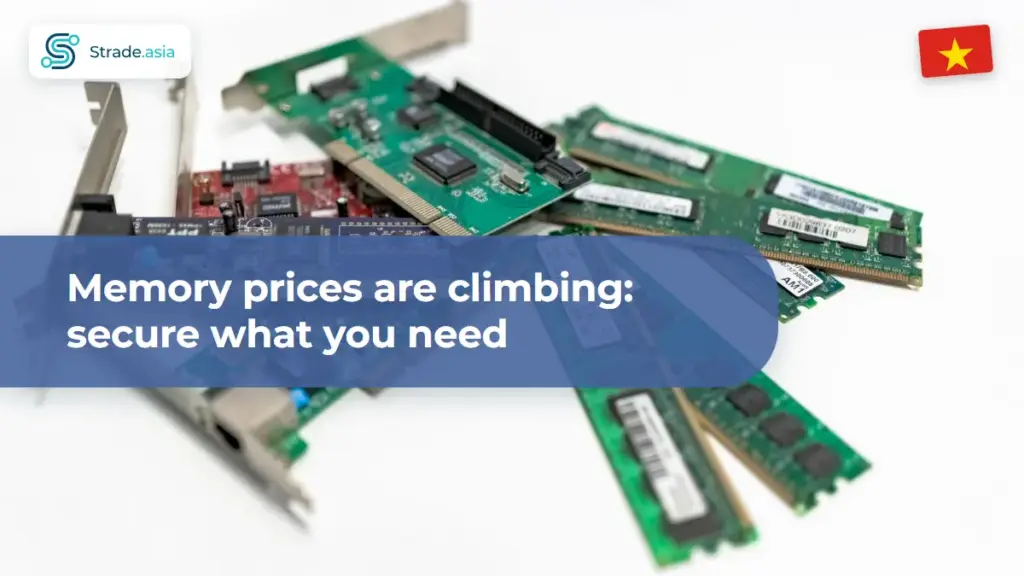
Memory buyers are having a difficult autumn. Contract prices for DRAM and NAND flash have been rising sharply, and shortages of conventional memory are being reported across the market. The cause is not a sudden jump in demand for phones or PCs. It is a shift in where memory makers put their capacity: towards high-bandwidth memory (HBM) and high-capacity server memory for AI data centres.
For factories in Vietnam building industrial controllers, networking equipment, displays, meters and consumer devices, this means higher costs and longer waits for the ordinary DRAM, eMMC and NAND parts that sit on almost every board with a processor.
What is driving the market
- AI servers come first. HBM and server memory earn more for each wafer, so makers are giving them priority in both wafer and packaging capacity.
- Older generations are winding down. As we noted in June, makers have been moving away from DDR4, and legacy parts are now tight as well.
- Buyers are ordering ahead. When prices rise, customers order earlier and in larger quantities, which tightens supply further.
- New capacity takes time. Memory fabs take years to build, and makers were cautious about adding capacity after the last downturn.
Memory has always moved in cycles. The recovery in late 2023 followed a deep downturn. This upswing comes with a change in the type of memory the market wants, which makes it harder to say how long it will last. Nobody can promise a date when prices will ease, and plans should not depend on one.
What it means for factory buyers
- Quotes change quickly. Expect short quote validity and price changes between quote and order. Plan internal approvals so that orders can be placed while a quote is still valid; our note on price increases and quotation validity covers how to handle this.
- Allocation. Some suppliers may share limited output among existing customers based on past volumes. If you are unsure how this works, see allocation explained.
- Smaller buyers wait longer. Industrial customers ordering modest volumes carry less weight than large server and phone makers, so their lead times can stretch first.
- Counterfeit risk rises. Tight memory markets attract remarked, refurbished and pulled parts sold as new.
A buying checklist
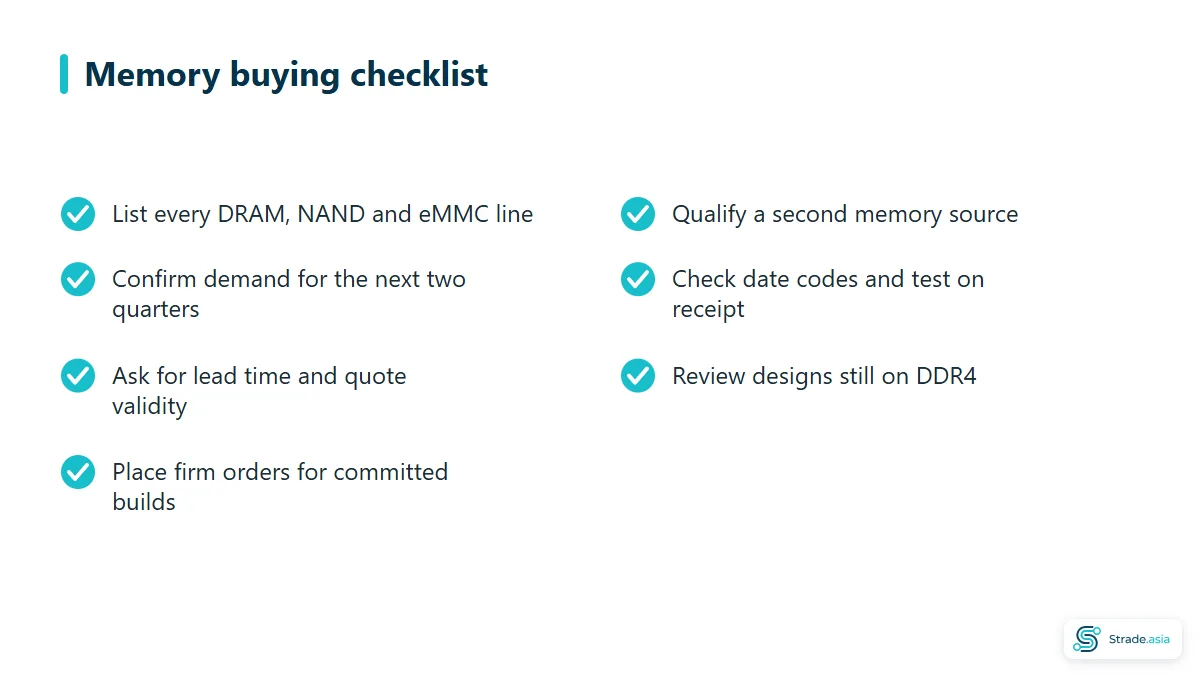
- List every memory line. DRAM chips and modules, eMMC, NAND, NOR flash and SSDs, with the products that use each one. Many teams find more memory part numbers than they expected.
- Confirm demand. Firm up requirements for the next two quarters with production planning, and separate committed builds from forecasts.
- Ask the right questions. For each line, ask for lead time, quote validity, minimum order, and whether the part is on allocation or has a lifecycle notice.
- Commit for confirmed builds. For production that is already sold, a firm order now may cost less than a late one. Avoid stockpiling beyond real needs: it ties up cash and can leave you holding expensive parts when the market turns.
- Qualify a second source. DRAM and eMMC from different makers can often replace each other at the same density and interface, but boot settings, firmware and timing need testing on the real board.
- Inspect on receipt. Check labels, date codes and packaging, and test samples of parts bought from the open market. Store moisture-sensitive memory dry and sealed.
- Review the roadmap. Products still on DDR4 or on small, older memory densities may face the hardest supply. Put migration on the engineering plan now.
Talk to your customers too
If memory costs are rising for you, they are rising for your competitors as well. Customers usually accept price changes better when they hear early, with a clear explanation and an option such as an alternative memory configuration. Agree with your sales team how cost changes will be passed on before the next quote round.
How Strade can help
Strade Asia is an independent electronic component distributor supplying semiconductors and other components to factories in Vietnam and across Asia, sourcing from manufacturers, their distributors and vetted open-market sources. Every lot is inspected on receipt, with X-ray or sample testing for sensitive parts or on request, and moisture-sensitive parts are packed under MSL control. When a memory part is short, our engineers can propose alternates with matching specifications for your team to approve. Send your memory lines through our RFQ page, or browse our semiconductor range.