한국어
 Bahasa Indonesia
 ไทย
 中文 (中国)
 Tiếng Việt

On the morning of 3 April, a strong earthquake struck near Hualien on Taiwan’s east coast, the strongest on the island in about 25 years. It caused deaths and heavy damage in Hualien. Taiwan’s major chipmakers evacuated staff from some fabs as a precaution, inspected their equipment and, within days, reported that operations were resuming.
For a factory in Vietnam, the headlines are not the useful part. What matters is how much of your own bill of materials depends on sites in Taiwan, and how quickly you can find out whether any of your confirmed orders will move.
Why Taiwan matters to almost every BOM
Taiwan’s foundries make wafers for a large share of the world’s fabless chip companies, including many microcontrollers, power management ICs, connectivity chips and display drivers. The island also hosts packaging and test houses, substrate makers and large producers of passive components such as resistors and MLCCs. A part with a US, European or Japanese brand may still have its wafer made, or its package assembled, in Taiwan. The label on the reel rarely tells you that.
Earthquakes are a known risk for fabs. Wafers in process can be scrapped after strong shaking, and sensitive tools need inspection and recalibration before production restarts. The Kumamoto earthquakes in 2016 showed how a single region can hold a critical site for parts that many factories assumed were widely available.
A step-by-step exposure check
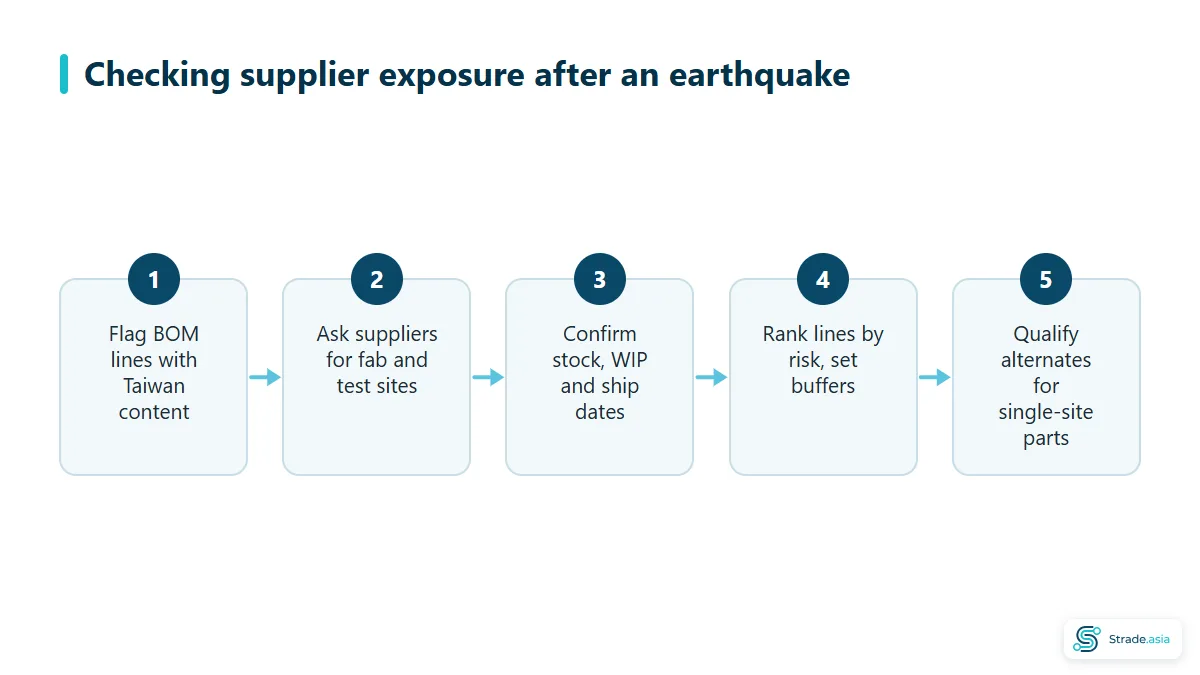
- Flag the lines with Taiwan content. Start with high-value and long-lead lines. Use manufacturers’ site information, PCN history and your own receiving records, and note where you have gaps.
- Ask suppliers precise questions. “Are you affected?” invites a generic reply. Ask instead: which fab and which assembly and test site make this part; is there finished stock, and where; how much is in process; and will confirmed ship dates change.
- Confirm stock, WIP and dates in writing. Record each answer against the BOM line with a date, so you can see what changes over the following weeks.
- Rank lines by risk. A part made at a single site, with no qualified alternate and a long lead time, ranks highest. For those lines, consider a modest buffer rather than a large speculative order.
- Qualify alternates for single-site parts. Use this moment to add a second source for parts that depend on one site; see approved manufacturer lists and second sources.
Expect answers to arrive in stages. In the first days, suppliers often know only that staff are safe and tools are being inspected; firm statements about wafers in process and revised ship dates come later. Plan to ask again after a week or two rather than treating the first reply as final.
Communication: one voice, regular updates
Agree inside your company who speaks to suppliers and who updates production planning, so a supplier does not receive five different requests about the same part. Share your forecast for the exposed lines; suppliers plan recovery around customers who give them clear demand. If a supplier confirms a delay, tell your own customers early and include a recovery plan. A short weekly status note is enough until every exposed line is confirmed.
Avoid panic buying
After any disaster, some sellers offer “earthquake-affected” parts at inflated prices. Before paying more, confirm that the part really depends on an affected site and that your confirmed orders have actually moved. Panic orders also distort demand for everyone, as the 2021 shortage showed. If you do buy outside your usual channels, insist on photos of labels and date codes before payment and on inspection when the parts arrive.
Keep the map after the news fades
When operations have returned to normal, keep the exposure map. Add a manufacturing-site field to your BOM data, update it when PCNs arrive, and review single-site lines once a year. The same map helps with typhoons, power cuts and fab fires, a risk discussed in single-source risk after a fab fire.
How Strade can help
Strade is an independent electronic component distributor with its own engineers, supplying factories in Vietnam and across Asia. We source from manufacturers, their distributors and vetted open-market suppliers, and inspect every lot on receipt: part number, labels, date code, packaging and appearance, with X-ray or sample testing for sensitive parts. When a part is at risk, our engineers can propose matching alternates for your team to decide on. Learn more about our supply chain service or send the lines you want checked.