한국어
 Bahasa Indonesia
 ไทย
 中文 (中国)
 Tiếng Việt

Most factories that build electronics have an ESD protected area (EPA) on the production floor: grounded benches, wrist straps, suitable flooring, signs at the door. The receiving area often has none of these. Yet it is where sealed ESD packages are opened first, where inspectors count parts, read markings and compare labels, and where reels and trays are split for kits. A device damaged there can pass inspection, be built into a product and fail later, because ESD damage is often latent: the device is weakened but still works.
The standards
Two standards define an ESD control programme for handling electrostatic discharge sensitive (ESDS) devices: ANSI/ESD S20.20, from the ESD Association, and IEC 61340-5-1. They are closely aligned. Both expect a written programme covering the EPA, grounding, personnel grounding, packaging, marking, training and regular compliance checks. Neither treats receiving as an exception: wherever unprotected ESDS devices are handled, the area should be an EPA.
How sensitive a part is appears in its datasheet, usually as ESD ratings in the absolute maximum table, as explained in our guide to reading a datasheet. In practice, treat every semiconductor as sensitive unless you know otherwise.
Make receiving an EPA
A humid climate does not remove the risk. Air-conditioned rooms are drier than the air outside, and charge builds up more easily in dry air. The same controls used on the line belong at the receiving bench.
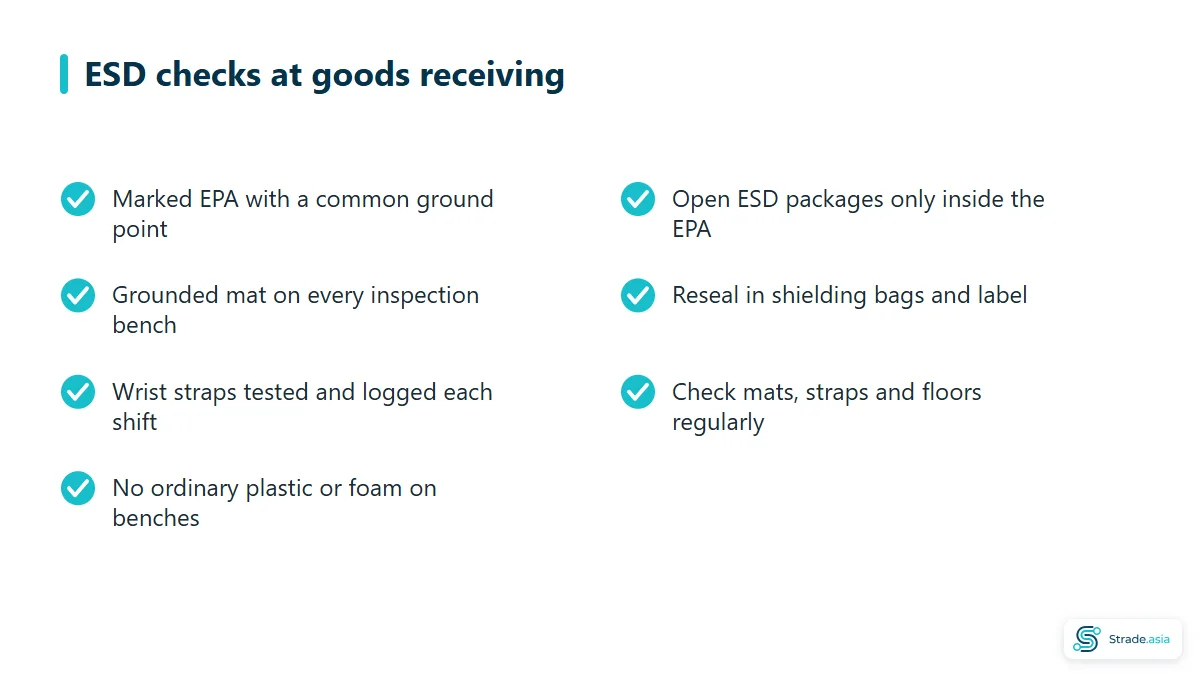
- Mark the boundary. Define the EPA with floor marking and signs, and let only trained people handle open ESDS devices inside it.
- Ground the benches. Use dissipative work surfaces or mats connected to a common ground point at each inspection bench.
- Ground the people. Seated inspectors wear wrist straps; people who stand or move need ESD footwear on a suitable floor. Test wrist straps at the start of each shift and log the result.
- Remove insulators. Ordinary plastic bags, foam, bubble wrap, plastic cups and document sleeves charge easily and have no place on an ESD bench. Where an insulator is essential to the process, use an ionizer or keep it at a safe distance.
- Use ESD-safe tools. Trays, tweezers, carts and racks inside the EPA should all be ESD-safe.
Packaging and labels
Know what each package does:
- Shielding bags, usually metallised and semi-transparent, protect their contents from discharges and fields when closed. They are the right package for ESDS devices outside an EPA.
- Pink and other antistatic bags are low-charging only; they do not shield. Do not rely on them to carry sensitive parts outside an EPA. Specify static-shielding packaging on the purchase order, and hold parts that arrive in plain plastic or pink bags for quality review rather than putting them straight into stores.
- Reels, tubes and trays made of dissipative or conductive materials protect parts inside the EPA, but outside an EPA they must travel in closed static-shielding bags or closed shielding containers.
- Outer cartons give no ESD protection. Open them at the EPA boundary and keep cardboard off the bench.
Look for the ESD susceptibility symbol, a hand crossed by a line inside a triangle, on packages of sensitive devices. A package that carries it should be opened only inside the EPA.
Opening packages for inspection
- Check the outer seal first and flag any torn or re-taped shielding bag, then move the sealed ESD package to the EPA bench before opening it.
- Ground yourself and check your wrist strap.
- Open only what you need to inspect. Count from the label or by weight where possible, and sample rather than handle every part.
- Handle parts by the body or the reel, never by leads or contacts.
- For parts in dry packs, combine ESD and moisture control: opening a dry pack starts the floor-life clock, as explained in our guide to moisture sensitivity levels.
- Reseal in a shielding bag, label it and record what was opened.
Keep it working
An ESD programme decays without checks. Measure benches, mats, floors and wrist straps at regular intervals, as both standards require. Train new receiving staff before they handle parts, and include receiving in internal audits. Records matter too: if a batch of field returns points to ESD damage, you will want to know how the parts were handled from the moment they arrived.
How Strade can help
Strade is an independent electronic component distributor with its own engineers, supplying factories in Vietnam and across Asia. Every lot is inspected on receipt, parts are shipped in ESD-protective packaging, and moisture-sensitive parts are handled according to their MSL. Read more about why factories work with Strade.
Send us your BOM and we will quote parts packed and documented for your incoming inspection.