한국어
 Bahasa Indonesia
 ไทย
 中文 (中国)
 Tiếng Việt
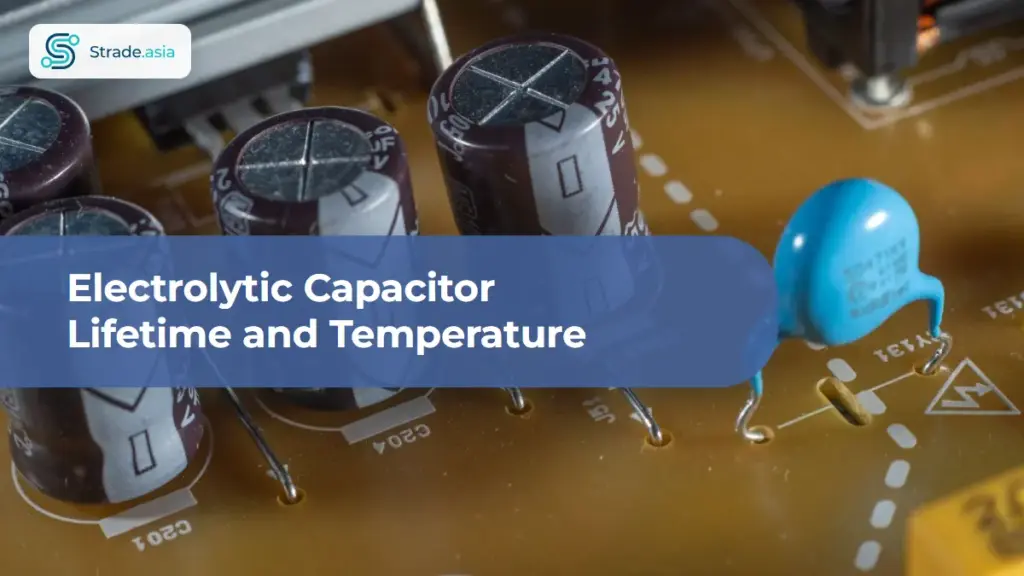
Temperature is the primary factor that determines how long an aluminum electrolytic capacitor lasts. Inside every wet aluminum electrolytic capacitor is a liquid electrolyte that gradually evaporates and degrades through the rubber end seal as heat rises. Capacitance drops and equivalent series resistance (ESR) climbs until the power rail loses regulation or fails. For factories in Vietnam and across Asia—where shop floors run warm and sealed enclosures trap waste heat—controlling capacitor temperature is essential to preventing field returns and downtime.
Rated Life and the 10 °C Rule of Thumb
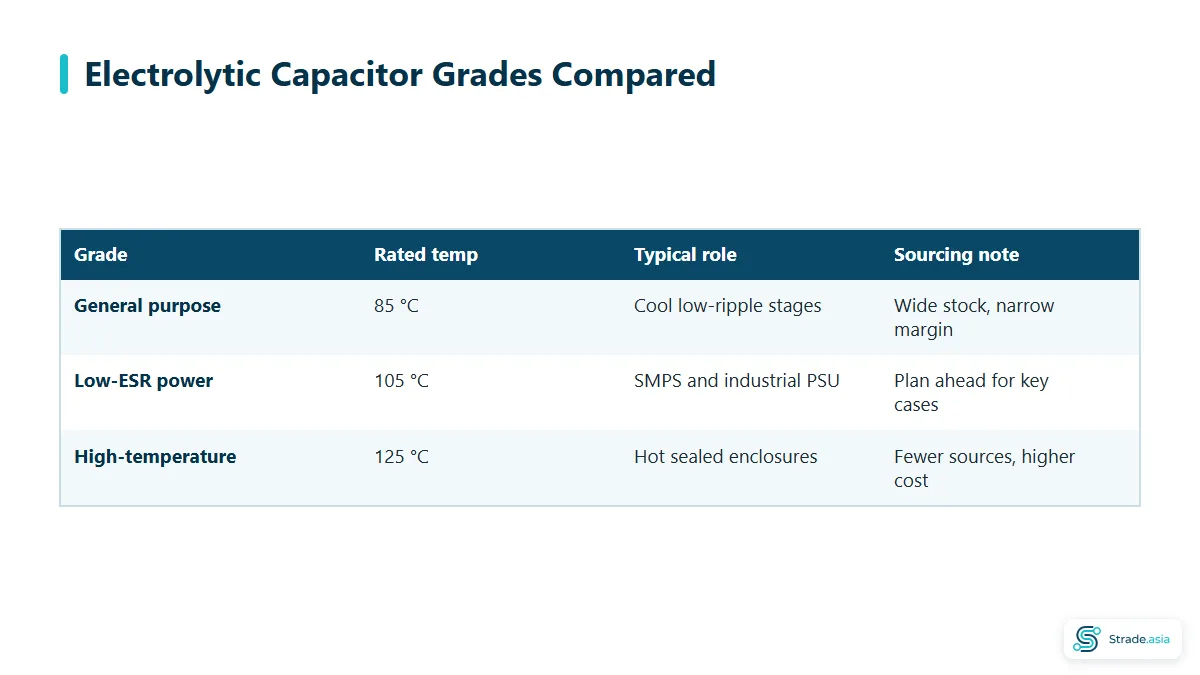
Datasheets state endurance as rated hours at the capacitor’s maximum temperature—typically 85 °C, 105 °C, or 125 °C—with rated voltage and rated ripple current applied. Depending on the series, that rating usually spans 1,000 to 10,000 hours. Running continuously at those ceilings leaves no thermal headroom, which is why design teams distinguish ratings from real operating margins when reading datasheet limits against operating conditions.
Under the standard Arrhenius-based rule of thumb, expected lifetime roughly doubles for every 10 °C drop in core temperature below the rated limit. A 105 °C capacitor rated for 2,000 hours running at a 65 °C core sits 40 °C below its ceiling, stretching expected life roughly sixteenfold, whereas an 85 °C part at the same core temperature has far less margin. Because seal aging imposes an upper ceiling, treat the 10 °C rule as an engineering guide and confirm final estimates against manufacturer life curves.
Ripple Current Self-Heating and Low-ESR Types
Ambient air inside an enclosure is only part of the thermal load. In switching power supplies, drives, and LED drivers, AC ripple current flows continuously through bulk and output capacitors, generating internal heat proportional to ripple current squared times ESR (I² × ESR). Because this heat originates inside the winding, core temperature rises above surrounding PCB air.
Power stages therefore rely on low-ESR 105 °C series rather than general-purpose 85 °C types. Lower ESR cuts the capacitor’s own I² × ESR loss, limits core temperature rise, and allows a higher rated ripple current. In compact housings like Level VI external power supplies, limited airflow amplifies any extra dissipation, so substituting a higher-ESR general-purpose part with the same capacitance and voltage often triggers rapid wear-out.
Voltage Derating and PCB Placement
Operating below rated DC voltage reduces leakage current, lowers dielectric stress, and leaves margin for line surges. Many power engineers target roughly 70% to 80% of rated voltage, balancing reliability against larger case sizes and higher BOM cost. Voltage derating adds a smaller direct life multiplier than lowering temperature, so it supports rather than replaces thermal control.
PCB placement is equally decisive. Keep electrolytic capacitors away from heatsinks, power MOSFETs, rectifiers, transformers, and power resistors. Place them upstream of hot components when cooling airflow is present, and avoid routing hot copper pours directly into capacitor pads. Careful layout works alongside proper protection—such as choosing the right fuse for power circuits—to keep industrial power stages dependable across their service life.
Sourcing Risks and Actions for Buyers and Engineers
Many early capacitor failures begin at the sourcing stage. Long-life 105 °C low-ESR series and 125 °C series come from fewer makers than standard 85 °C radial parts and can carry longer lead times. Under allocation or cost-down pressure, buyers are often offered substitutes matched only on capacitance and voltage, quietly sacrificing ESR, ripple rating, or temperature class and shifting cost into field failures.
Design and purchasing teams can reduce this risk with five actions:
- Lock complete specs on the BOM: List rated temperature, endurance hours, maximum ESR and ripple current rating at your operating frequency (for example 120 Hz or 100 kHz), diameter, height, and lead spacing—not just capacitance and voltage.
- Pre-approve alternates early: Qualify at least two matching 105 °C low-ESR series before volume builds so longer factory lead times do not force a downgrade.
- Test in the final enclosure: Measure capacitor case temperature at full load and realistic factory ambient conditions, not open on a cool bench.
- Verify date codes on receipt: Wet electrolytics stored for a long time without voltage show rising leakage current, and warm storage speeds this up, so check date codes, packaging and the maker’s shelf-life limit before releasing lots to production.
- Review layout after redesigns: Any change to airflow, switching frequency, or nearby power devices requires re-checking ripple heating.
Strade Asia is an independent distributor of electronic components with its own engineers, supplying factories in Vietnam and across Asia with passive components, power products, semiconductors, connectors and other component categories. When a required high-temperature or low-ESR capacitor faces long lead times or discontinuation, Strade’s engineers propose specification-matched alternates for the customer to evaluate and decide. Every incoming lot is checked on receipt for part number, label, date code, packaging and visual condition, with CoC, C/O and CQ included when provided by the source and DDP or DAP delivery arranged. Upload a BOM or enter lines directly to request a quotation.