한국어
 Bahasa Indonesia
 ไทย
 中文 (中国)
 Tiếng Việt

For more than a year, buying memory was easy. DRAM and NAND prices fell through 2022 and most of 2023 as demand for PCs and smartphones slowed and inventories piled up across the supply chain. Buyers could wait, order to demand and renegotiate. That phase is ending. After a long series of production cuts by memory makers, market trackers such as TrendForce report that contract prices for both DRAM and NAND have started to rise again this quarter. For factories that build industrial controllers, networking equipment, displays or any product with a memory chip or module on the board, it is time to change the buying approach.
Why DRAM and NAND prices are turning
The memory market moves in cycles. When prices fall below what it costs to make chips, makers cut wafer starts, delay new capacity and sell from inventory. During this downturn all the major makers reduced output, and some made deep cuts. As their own inventories and those of their customers came down, the balance shifted, first in spot prices and now in contract prices.
Demand has not fully recovered. PC and smartphone sales are still soft, though stock levels at their makers are closer to normal. What has changed is supply. Makers are also directing more investment toward high-bandwidth memory for AI servers, which leaves less room for expanding output of conventional parts.
What it means for industrial buyers
Most industrial products do not use the newest memory. They rely on DDR3 and DDR4 DRAM, low-density NAND and NOR flash, eMMC and industrial-grade modules, often with extended temperature ranges and long lifecycle commitments. These parts follow the main market with a lag, and sometimes in a different direction:
- Prices for mainstream parts may move first, and quotations will carry shorter validity.
- Older generations can tighten for a different reason. When makers shift capacity to newer products such as DDR5 and high-bandwidth memory, they issue end-of-life notices for older ones, often DDR3 and low-density parts, and supply of the remaining stock becomes uneven.
- Industrial-grade and extended-temperature parts come from a smaller set of production lines and can see longer lead times when the market tightens.
Embedded storage such as eMMC tends to move with NAND prices, and memory modules and industrial SSDs follow the chips they are built from, sometimes with a short lag, so check those quotations too.
We have been through this turn before. In 2016 prices began rising after a long fall, as described in memory prices turn up, and supply stayed tight through the following year. Buyers who had forecasts and orders in place early were in a far better position than those who waited.
How to plan the next orders
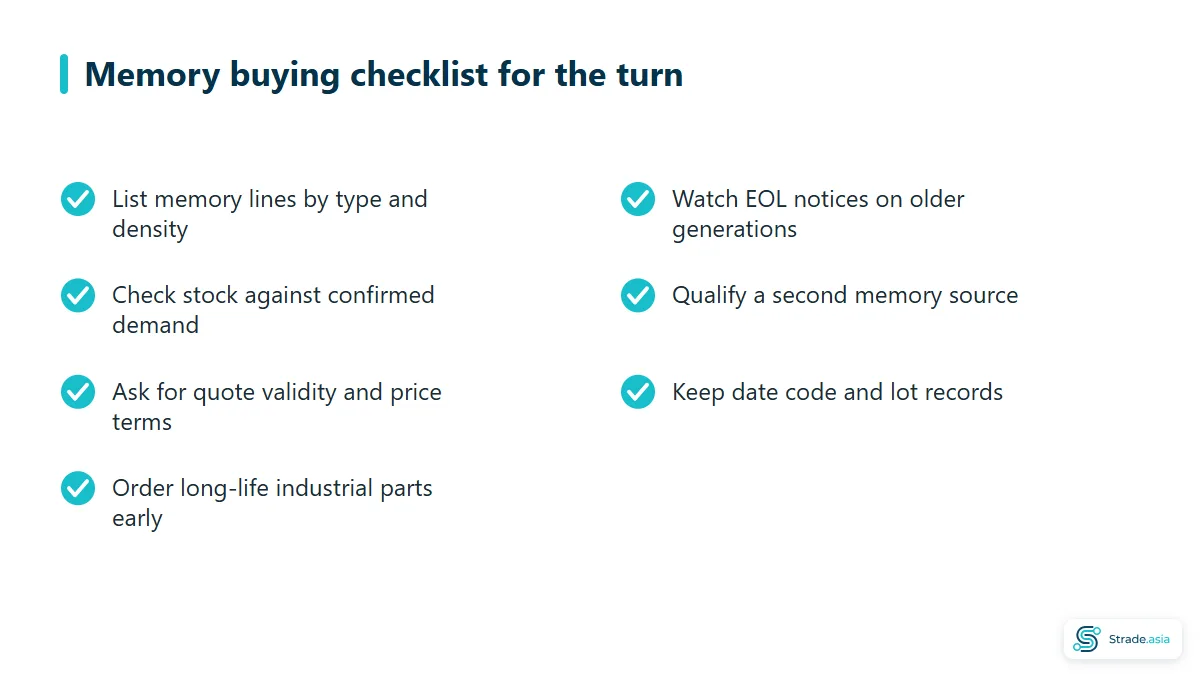
- List your memory lines by type, density, speed, temperature grade and package, with annual demand and the products that use each one.
- Check stock against confirmed demand. The downturn left some factories with surplus memory; use it, but know when it runs out.
- Ask about quotation validity and price terms. In a rising market, short validity, price adjustment clauses, pricing at the date of shipment and stricter NCNR terms come back. Our article on price increases and quotation validity explains how to compare offers.
- Order long-life parts early. For industrial and extended-temperature memory, place orders within the quoted lead time and share forecasts.
- Watch for end-of-life notices on older generations, and plan last-time buys or redesigns before the deadline, as described in handling PCN and EOL notices.
- Qualify a second source. Many memory parts are made by more than one maker in compatible packages, but timing, firmware and qualification must be checked by engineering.
- Keep date code and lot records. When memory supply tightens, open-market offers return, including remarked or pulled chips; receiving inspection and lot traceability matter again.
Do not swing too far
The opposite mistake is just as costly. The points in buying memory in a downturn work in both directions: avoid double orders, keep forecasts honest and do not build large stocks on the expectation of further rises. Nobody knows how long this upturn will last, and the next correction may come sooner than expected.
How Strade can help
Strade is an independent electronic component distributor with its own engineers, supplying semiconductors, including memory, to factories in Vietnam and across Asia. We source from manufacturers, their distributors and vetted open-market suppliers, and every lot is checked on receipt for part number, label, date code and packaging, with X-ray or sample testing for sensitive parts or when the customer asks. When a memory part reaches end of life, our engineers can propose compatible alternates for your team to approve.
Send us your memory lines with quantities and required dates, and we will quote the current options.