한국어
 Bahasa Indonesia
 ไทย
 中文 (中国)
 Tiếng Việt
A product change notice arrives by email, addressed to a buyer who left the company last year. Nobody reads it. Months later, a new lot is held at incoming inspection because the package marking has changed, or a part is suddenly unavailable because its last-time buy date has passed.
Product change notices (PCNs) and end-of-life (EOL) notices are routine. Manufacturers issue them constantly as they move fabs, change materials, consolidate product lines and retire old parts. Handled well, they give you time to act. Handled badly, they turn into line stoppages and rushed redesigns.
PCN and EOL: what they are
- A PCN tells customers that a product or its manufacturing process will change: a new wafer fab or assembly site, a die revision, a change in materials, packaging or marking, or a datasheet update. The part number may stay the same.
- An EOL notice, also called a product discontinuance notice, says a part will no longer be made. It normally gives a last-time buy date, by which final orders must be placed, and a last shipment date.
The joint JEDEC, ECIA and IPC standard J-STD-046 sets out practice for notifying customers of product and process changes, and J-STD-048, which replaced JEDEC’s JESD48, covers product discontinuance. Both set minimum notice periods and the information a notice should contain. Not every supplier follows them, especially outside the semiconductor industry, so check what each of your main suppliers commits to.
Make sure notices reach you
Many notice problems start with delivery. Notices go to whoever was registered with the manufacturer or distributor, often years ago.
- Use a shared mailbox for notices, not a personal one.
- Register that address with your main suppliers and on manufacturers’ notification portals.
- Ask distributors to forward notices for the parts you buy from them. For parts bought through traders or the open market, notices rarely arrive on their own, so subscribe to those part numbers on the manufacturer’s portal.
- Review subscriptions every year and whenever staff change.
Assess the impact
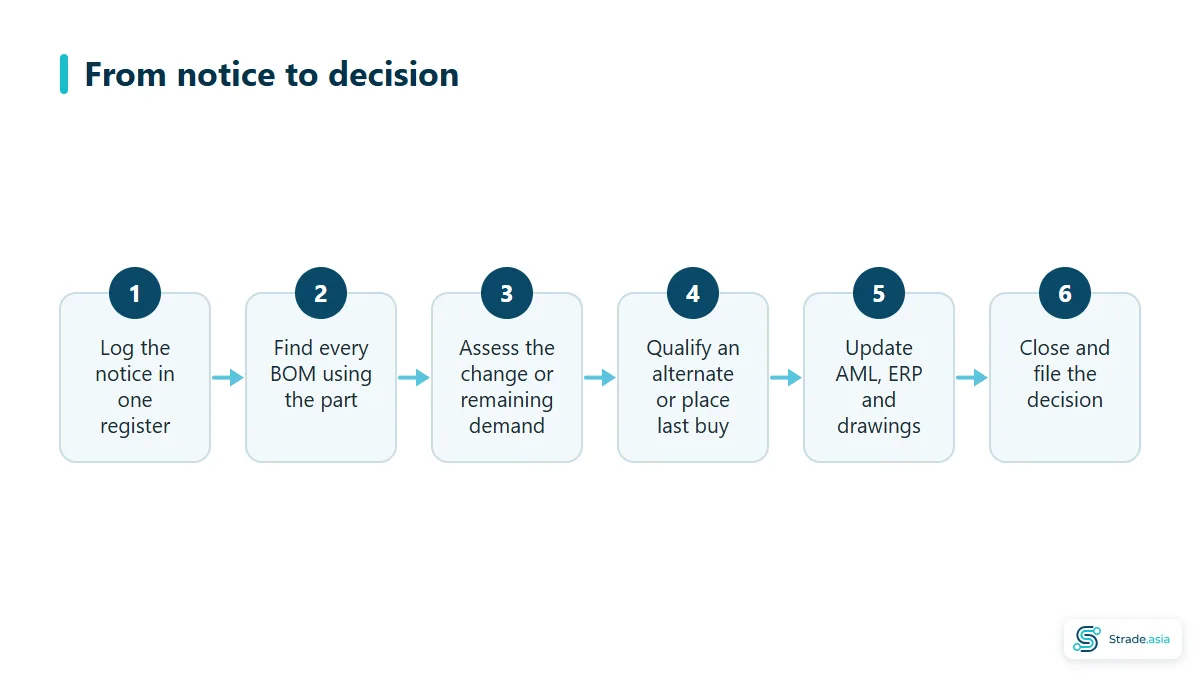
For each notice, someone must answer three questions quickly:
- Where is the part used? Run a where-used search across all BOMs, including service and spare parts.
- Does the change matter? For a PCN, engineering judges whether form, fit, function or reliability could be affected, and whether customer approvals require requalification or notification.
- What is the remaining demand? For an EOL, estimate how many parts each product needs for the rest of its life, including spares and expected losses.
Choose the response
For a PCN, the options are to accept the change, accept it after testing samples, or qualify a different part. Check the response deadline at once: under J-STD-046 and many supplier terms, no response within the review period, often 30 days, counts as acceptance. Ask the supplier for samples and qualification data early, and record which date code or lot is the first with the change.
For an EOL, the main options are:
- Last-time buy. Buy enough to cover remaining demand. Last-time buy orders are usually non-cancellable and non-returnable (NCNR), and may be limited by minimum quantities or allocation. Calculate carefully: too little means a second crisis later, while too much ties up cash, as described in excess component inventory. Plan storage as well, including dry packing for moisture-sensitive parts; see MSL storage and baking.
- Alternate part. A pin-compatible part from another manufacturer, or a successor from the same one. It must be qualified, as covered in approved manufacturer lists and second sources.
- Redesign. If no alternate fits, start the redesign while last-time-buy stock still covers production.
- Open-market buys after the date. Some stock remains in the market after the last-time buy, but discontinued parts carry a higher risk of counterfeit and poorly stored stock. Inspect every lot carefully.
Memory is a frequent source of EOL notices as makers move to newer generations, as we noted in buying memory in a downturn.
Close the loop
A notice is only handled when the records are updated:
- the approved manufacturer list and ERP item master show the new status;
- drawings, BOMs and work instructions reflect any change;
- buyers know the last-time buy quantity and date;
- the notice and decision are filed with the part record.
A simple register, with one line per notice, an owner, a due date and the decision, is enough for most factories. Review open items at a regular meeting, and once a year go through the past notices to see which suppliers and product families change most often.
How Strade can help
Strade is an independent electronic component distributor with its own engineers, supplying factories in Vietnam and across Asia. Most of our orders are bought to the customer’s request, and many are urgent. When a part is discontinued or short, our engineers propose alternates with matching specifications, and your team decides. We source from manufacturers, their distributors and vetted open-market suppliers, and inspect every lot on receipt, with X-ray or sample testing for sensitive parts or on request. Learn more about our services.
If an EOL notice has just landed on your desk, send us the part numbers and we will look for stock and alternates.