한국어
 Bahasa Indonesia
 ไทย
 中文 (中国)
 Tiếng Việt

A year ago, most purchasing plans were still shaped by shortage: long lead times, allocation and safety stock everywhere. Through 2023 that picture turned around. Demand for consumer electronics stayed weak, customers worked down the stock they had built, and lead times for most standard parts returned to normal. As 2024 approaches, the correction has largely run its course in many part families, but the market is not uniform. Memory prices are rising again, power devices send mixed signals, and new trade and compliance rules add work. A good plan for next year starts by accepting that different lines on the same BOM are in different situations.
Where the market stands
- Standard passives, logic and discretes. Supply is comfortable and lead times are short. Distributor stock is available for most common values and packages.
- Memory. After a year of production cuts, DRAM and NAND contract prices have started to rise, as we described last month in memory prices recover. Older generations may also see end-of-life notices.
- Power devices. Mixed. Some IGBT and MOSFET lines have eased as industrial demand softened in some markets, while parts for electric vehicles, solar and energy storage, including silicon carbide devices, are still in demand.
- Automotive and industrial microcontrollers. Much improved compared with a year ago, though some qualified parts still carry long lead times.
What changed in the rules
Several 2023 developments will shape buying next year. China’s licensing of gallium and germanium exports started in August. The US updated its rules on advanced chips and chipmaking equipment in October, covered in our October 2023 export control update. The EU Battery Regulation applies from 18 February 2024, so European customers will begin asking for more battery documentation. None of these stops ordinary component supply, but each adds questions that purchasing must be able to answer.
Lessons from the correction
Much of the surplus of 2023 was self-inflicted: double orders, long NCNR commitments and safety stock set during the shortage and never reviewed. Our March article on inventory correction and NCNR orders covered how to unwind it. For 2024 the lesson is to set buffers deliberately, line by line, and review them every quarter, so that the next swing, in either direction, does not catch the plan off guard.
A 2024 component purchasing checklist
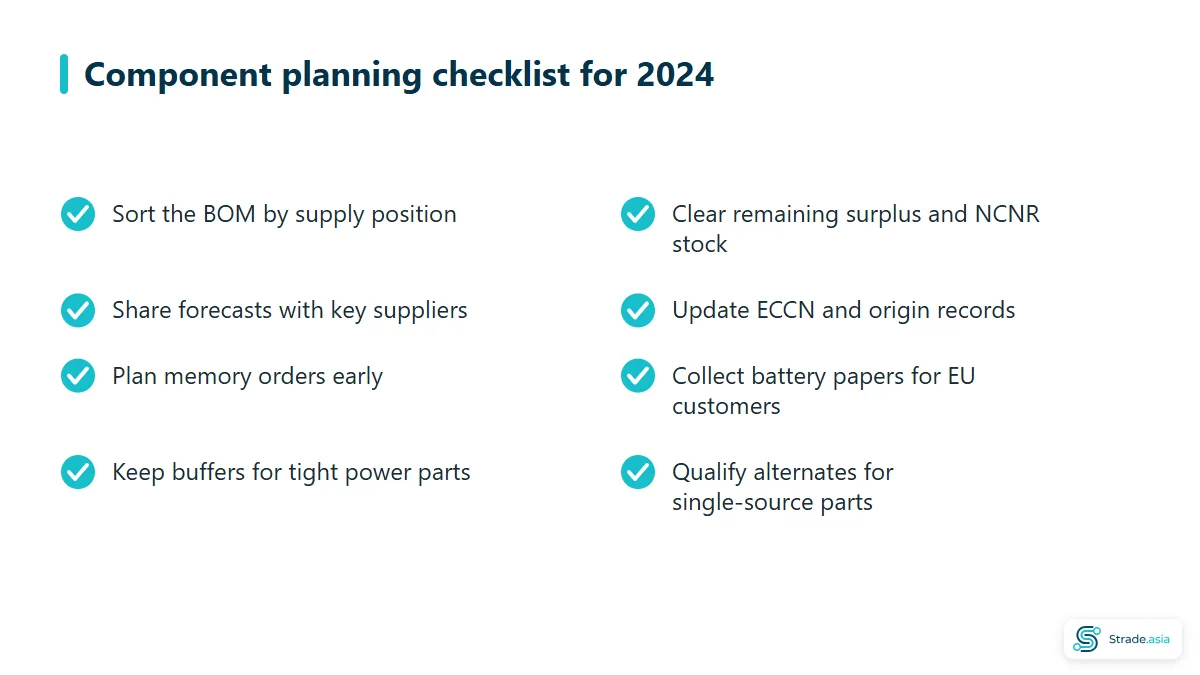
- Sort the BOM by supply position. Mark each line as easy, watch or constrained, using current lead times and supplier input, not last year’s data.
- Share forecasts with key suppliers. A rolling forecast, even an imperfect one, helps suppliers reserve capacity for the lines that may tighten. Where supply is comfortable, as with standard passives, logic and discretes, review prices and NCNR terms that were set during the shortage.
- Plan memory orders early. In a rising market, short quotation validity returns; agree quantities and timing in advance.
- Keep buffers for tight power parts. Hold safety stock or consignment for constrained IGBT, SiC and automotive-grade parts, and release buffers on lines that are clearly easy.
- Clear remaining surplus and NCNR stock. Plan consumption across products before buying more of the same part.
- Update ECCN and origin records. Keep classification, supplier declarations and certificates of origin, including those for trade agreements such as Form E or RCEP, current for each line.
- Collect battery documents for products sold in Europe: cell maker, chemistry, test reports and substance declarations.
- Qualify alternates for single-source parts. Engineering time is easier to find in a calm market than in the middle of a shortage.
Timing around Tet
Tet falls on 10 February 2024. Factories, forwarders and customs in Vietnam, and many suppliers in China, slow down or close for part of that period. Suppliers and logistics in China also need time after the holiday to return to full output, so orders needed in February and March, especially for parts shipped from China, should be placed in December or early January, and buffers for critical lines should cover the slow weeks after the holiday.
Planning habits that last
Each cycle is different, but the core habits stay the same: realistic rolling forecasts, clear framework agreements, buffer stock where lead times justify it and approved alternates. The cycle changes; the habits that protect a production line do not.
How Strade can help
Strade is an independent electronic component distributor with its own engineers, supplying factories in Vietnam and across Asia with semiconductors, passive components, connectors, power products and other groups. Most orders are bought to the customer’s requirement, and when a part is short or reaches end of life, our engineers propose alternates that match the specification, with the customer deciding. Our component supply chain service explains how we work with regular buyers.
As you finalise next year’s plan, send us your BOM or forecast and we will quote the lines and point out any that may need early orders.