
 한국어
 Bahasa Indonesia
 ไทย
 中文 (中国)
 Tiếng Việt

Not long ago, a component quote stayed valid for weeks, and the price on it was the price you paid. This year, many quotes are valid for a few days, some only “subject to prior sale”, and some state that the price will be set at the time of shipment. Several manufacturers have announced price increases this year, citing higher costs for wafers, materials and freight, and distributors pass those increases on. For buyers who need to compare offers and win internal approval before ordering, this creates new work and new risks.
Why quotes have become shorter
Prices are moving at every level. Manufacturers adjust their price lists, freight costs remain high, and for scarce parts sold on the open market, prices can change from one day to the next. Stock moves just as fast: a reel offered this morning may be sold to another buyer by the afternoon. In this market, a long validity period would be a promise the supplier cannot keep, so quotes are shorter and carry more conditions.
The lead time on the quote is also less certain than it used to be. As described in planning for 52-week lead times, a quoted lead time is an estimate, and parts on allocation may arrive late or in partial quantities.
What to read on every quote
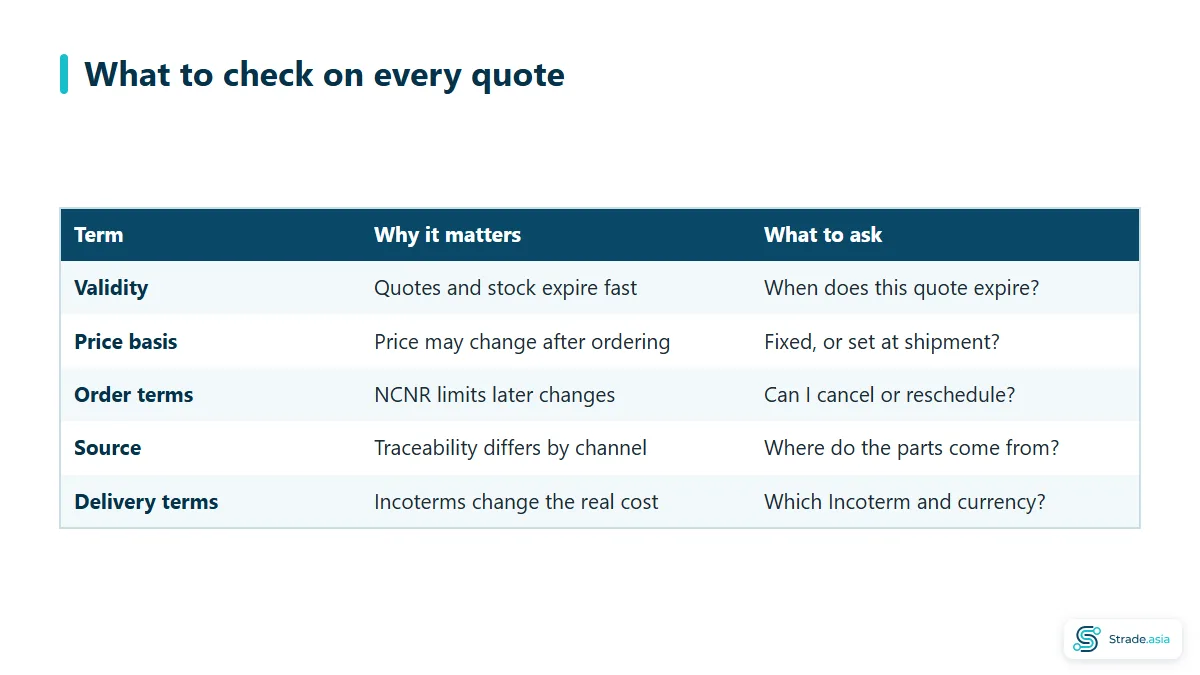
- Validity. Note the exact expiry date, and whether the offer is “subject to prior sale”. Stock quotes in particular may be gone before your purchase order arrives.
- Price basis. A fixed price applies to the order as confirmed. “Price at time of shipment” means the supplier may apply increases announced before delivery. For long-lead orders this can make a real difference, so ask how and when increases are notified, and whether they apply to confirmed orders.
- NCNR. Non-cancellable, non-returnable terms are now common for scarce parts. Once accepted, you must take and pay for the parts even if your needs change.
- Quantity. Check minimum order and standard pack quantities. A price for a full reel is not comparable with a price for cut tape; our guide to MOQ, SPQ and packaging quantities explains the difference.
- Delivery terms and currency. A price EXW in US dollars and a price DDP to your factory are not the same thing. Freight, insurance, duties, import procedures and exchange rates all sit between them. See Incoterms 2020 for who pays for what.
- Source and documents. Ask whether the parts come from the manufacturer, one of its distributors or the open market, and which documents come with them: CoC, date codes, original packaging.
Comparing offers fairly
When three suppliers quote three prices, the lowest number is not always the cheapest order. To compare offers on equal terms:
- Bring every offer to the same delivery point. Add freight, duties and handling to EXW or FCA prices so that all offers are landed at your factory.
- Adjust for risk. An open-market offer may need inspection or testing, and may require prepayment. Include those costs, and the cost of a lot that fails.
- Look at date codes and lead time. Older date codes may need extra checks. A later delivery may cost more in lost production than the price difference saves.
- Check the terms behind the price. A slightly higher fixed price can be better value than a lower price set at shipment.
Shorten your own approval time
Short validity collides with long internal approval chains. A quote that expires in three days is of little use if a purchase order needs a week of signatures. Some practical changes:
- Agree a price tolerance in advance for critical parts, so buyers can approve within a range without a new sign-off.
- Pre-approve alternates with engineering, so a second offer can be accepted quickly.
- Keep supplier, payment and customs details up to date, so a purchase order can be issued the same day.
How Strade can help
Strade is an independent electronic component distributor with its own engineers, supplying factories in Vietnam and across Asia. We source from manufacturers, their distributors and vetted open-market suppliers, inspect every lot on receipt and deliver DDP or DAP with customs documents prepared. When a part is scarce, our engineers can propose an alternate with matching specifications for your team to approve, which can give you more than one offer to compare.
Send us your BOM in Excel, CSV or PDF, or enter the lines one by one, and ask about anything on a quote that is not clear.


