한국어
 Bahasa Indonesia
 ไทย
 中文 (中国)
 Tiếng Việt
On 17 October, the US Commerce Department’s Bureau of Industry and Security (BIS) published an update to the export control rules it introduced in October last year on advanced computing chips and semiconductor manufacturing equipment. The changes close gaps that the industry had found in the original rules, extend licence requirements to more destinations, and add more companies to the Entity List. Most factories in Vietnam do not buy the high-end processors at the centre of these rules, although Vietnam is among the destinations the wider licence requirement covers. Even so, every update is a good moment to check that your own export control routine is sound, because customers, auditors and banks increasingly ask about it.
This article is a practical overview for buyers, not legal advice. For decisions on a specific shipment, consult a trade compliance specialist.
What the US changed on 17 October
In broad terms, the update:
- Revises the technical tests for advanced computing chips, so that chips designed to sit just below last year’s thresholds are now covered.
- Extends licence requirements for those chips to a wider group of countries, beyond China and Macau to most destinations in US Country Groups D:1, D:4 and D:5, a group that includes Vietnam, and in some cases to subsidiaries of companies headquartered in restricted countries.
- Adds more types of semiconductor manufacturing equipment to the controlled list.
- Strengthens due diligence expectations, with guidance on warning signs that a buyer may be trying to get around the rules.
- Adds further entities to the Entity List, which we explained in our earlier article on export controls and the Entity List.
BIS has invited public comments, and further adjustments are possible.
Does this affect ordinary components?
For most industrial BOMs the direct effect is small. Passive components, power devices, standard logic and general-purpose microcontrollers are not the target. But “not the target” is not the same as “not controlled”. Some common parts carry an export control classification for other reasons, for example encryption functions in wireless modules and some processors, or high-performance data converters and FPGAs. And any item, even one classified EAR99, needs a licence if it goes to a listed party or a prohibited end use.
Plants that run semiconductor assembly or test lines are a separate case. If your factory buys or services chipmaking or test equipment, the new equipment controls may affect spare parts, software updates and service visits, so ask the equipment supplier how it is applying them.
Controls on materials are moving too: China’s licensing of gallium and germanium exports, in force since August, shows that restrictions can appear at any point in the supply chain.
A practical check for component buyers
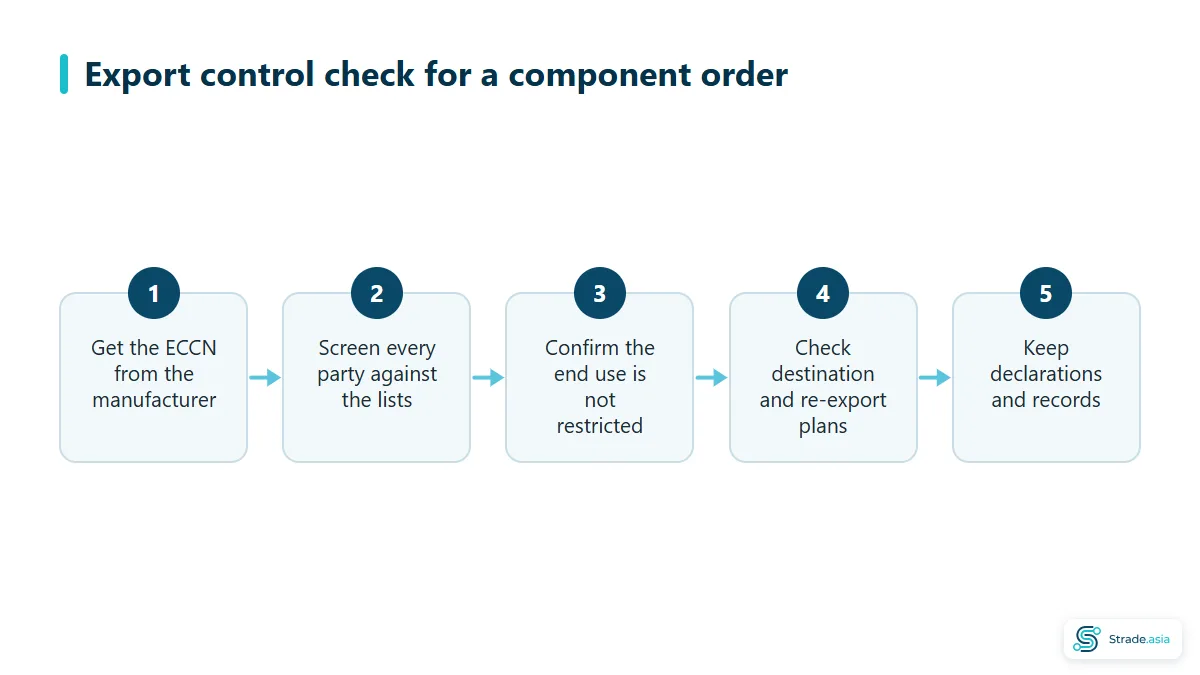
- Get the classification. Ask the manufacturer or distributor for the Export Control Classification Number (ECCN) of each line, or confirmation that it is EAR99. Manufacturers publish this for most parts; record it in the item master.
- Screen every party. Check your own customers, consignees and end users against the Entity List and other US and UN lists, note where each customer’s parent company is headquartered, since the chip rules now reach some subsidiaries of companies headquartered in restricted countries, and repeat the check when lists are updated, as they were this month.
- Confirm the end use. Know what the product is for and who will use it. Restrictions on certain end uses apply even to low-level items.
- Check destination and re-export. If the parts, or products containing them, will be re-exported, check the rules for the final destination as well.
- Keep declarations and records. Keep supplier declarations, ECCN records and screening results on file for each order, so you can answer questions quickly.
What to ask your suppliers
- The ECCN, or EAR99 status, for each part, and any changes after this update.
- Whether any line now needs a licence for your destination, and how long that might take.
- Whether the supplier screens its own customers and keeps records.
- Notice of any changes in classification or sourcing that affect your orders.
Suppliers who answer these questions clearly are easier to work with when rules change again. Interest in Vietnam as a production base, reinforced by the US-Vietnam partnership upgrade last month, means that buyers here should expect these questions from their own customers more often.
How Strade can help
Strade is an independent electronic component distributor with its own engineers, supplying factories in Vietnam and across Asia. We buy from manufacturers, their distributors and vetted open-market sources, and we can pass on the classification information that manufacturers publish for the parts we quote. Our origin and compliance service covers certificates of origin, HS code review and export documents.
Send us your BOM for a quotation, and tell us the destination and end use if your parts go into products for export.