한국어
 Bahasa Indonesia
 ไทย
 中文 (中国)
 Tiếng Việt

With MLCCs, chip resistors and some memory and semiconductor lines in short supply, one word keeps appearing in supplier emails: allocation. A buyer asks for a lead time and is told the part is “on allocation”. It sounds like a lead time, but it is something different, and understanding it helps you get a better share of what is available.
What allocation means
A part is on allocation when the manufacturer cannot make enough to meet all orders and decides how to share out its output. Instead of filling orders in the sequence they arrive, the maker sets a quantity, usually per customer or per channel for each period, and ships no more than that, however large the order.
Allocation is not the same as a long lead time. A long lead time means you will get your full quantity, later. Allocation means you may get only part of your quantity, even if you order early. Often both apply at once.
How makers decide who gets what
Each manufacturer has its own rules, and they are rarely published. The common factors are:
- Purchase history. Customers who have bought steadily usually get a share based on that history. New customers and one-off buyers come last.
- Forecasts and commitments. A credible forecast, and orders that cannot be cancelled, carry weight. Makers want to ship to demand that is real.
- Strategic markets. Makers often favour markets they see as core, such as automotive, or products where they earn more. In the current MLCC shortage, general-purpose parts have been hit harder for this reason.
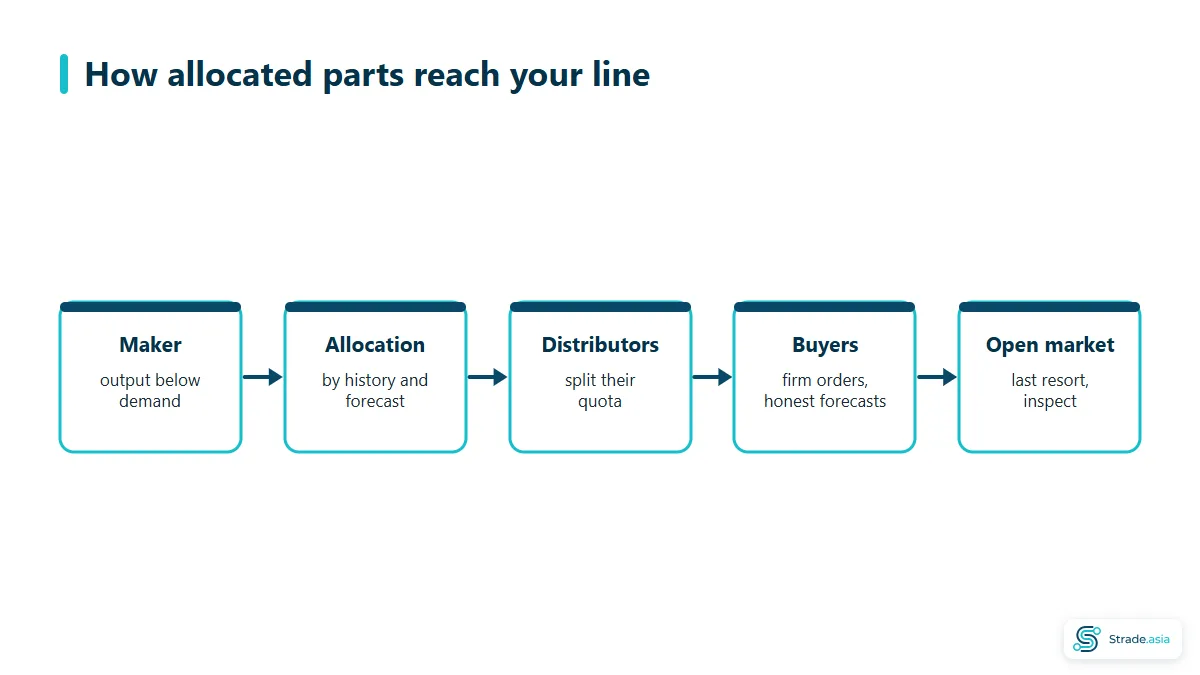
- Direct accounts and distribution. Large customers that buy direct receive their own allocation. The rest goes to the maker’s distributors, who then share it among their own customers.
Allocation through distributors
Most factories in Vietnam buy through distributors rather than direct from the maker. A franchised distributor receives a quota from the maker and has to divide it among many customers, applying its own rules, again largely based on history and forecast. Distributor stock that looked plentiful last year can disappear within weeks once allocation starts, quoted lead times may change from one week to the next, and one order may arrive in several small shipments, each with its own freight and customs costs.
Independent distributors sit outside this system. They buy from makers, franchised distributors and the open market, which can help fill gaps, but stock from unfamiliar sources needs careful inspection before it reaches your line.
What buyers can do
- Forecast, and keep the forecast honest. Share a rolling forecast with your suppliers and update it every month. Inflated forecasts are soon noticed and discounted.
- Avoid double ordering. Placing the same demand with several suppliers in the hope that one will deliver inflates backlogs across the market and damages your credibility when you cancel. As we saw with chip resistors, early and duplicated orders lengthen the queue for everyone.
- Place firm orders for real demand. Non-cancellable, non-returnable (NCNR) orders within the lead time show commitment and secure a place in the queue. Before you sign, check the cancellation terms and whether the price is fixed or set at the time of shipment.
- Concentrate volume. Buying the same part through many small orders across several channels can leave you with no meaningful history anywhere. A steady pattern through fewer channels builds a record that counts.
- Approve alternates. A second approved maker for each critical part means two allocations instead of one. See how to qualify second sources.
- Tell suppliers what the part is for. If it goes into industrial or automotive products, or a line will stop without it, say so. It does not guarantee priority, but it helps your supplier argue your case with the maker. If you build products for a larger OEM, ask that customer to support the request; its name can carry weight with the maker.
What allocation is not
Allocation does not mean a part is unavailable everywhere at any price. Open-market offers often appear for allocated parts, sometimes at several times the normal price. Some are genuine surplus from other users; some are old, poorly stored or counterfeit. Treat them as a last resort, buy only from sources you have vetted, and inspect every lot.
When allocation ends
Allocation ends when supply catches up, sometimes suddenly. Customers who over-ordered then face excess stock and cancellation disputes. Keeping orders tied to real demand protects you on the way down as well as the way up. We covered the options for surplus parts in excess component inventory.
How Strade can help
Strade is an independent distributor with its own engineers, buying from manufacturers, their distributors and vetted open-market sources for factories in Vietnam and across Asia. When a part is on allocation, we can search across these channels, inspect what we find on receipt, and propose alternates with matching specifications for your team to decide on.
Send us your allocated or hard-to-find parts and we will check what is available.