한국어
 Bahasa Indonesia
 ไทย
 中文 (中国)
 Tiếng Việt
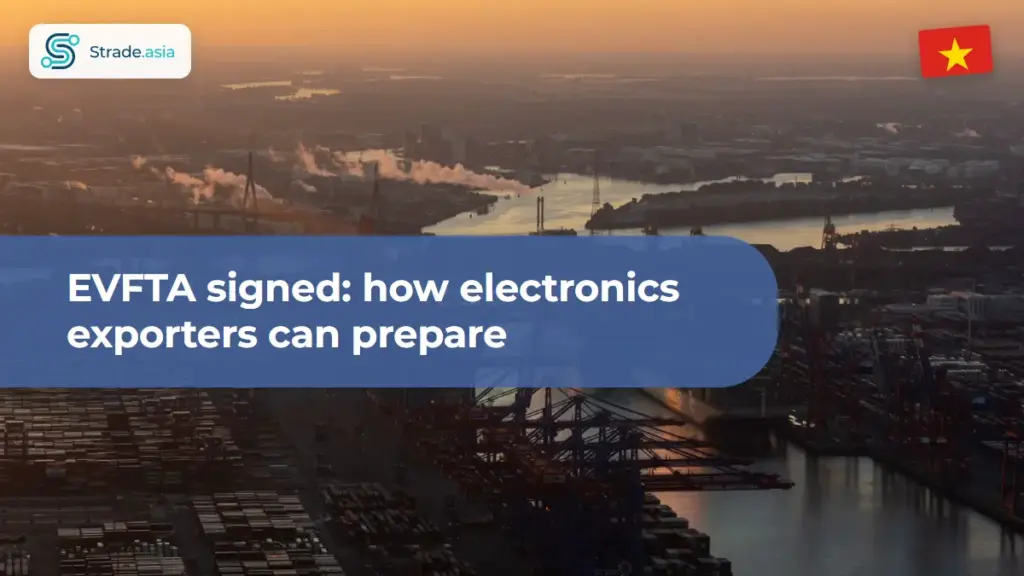
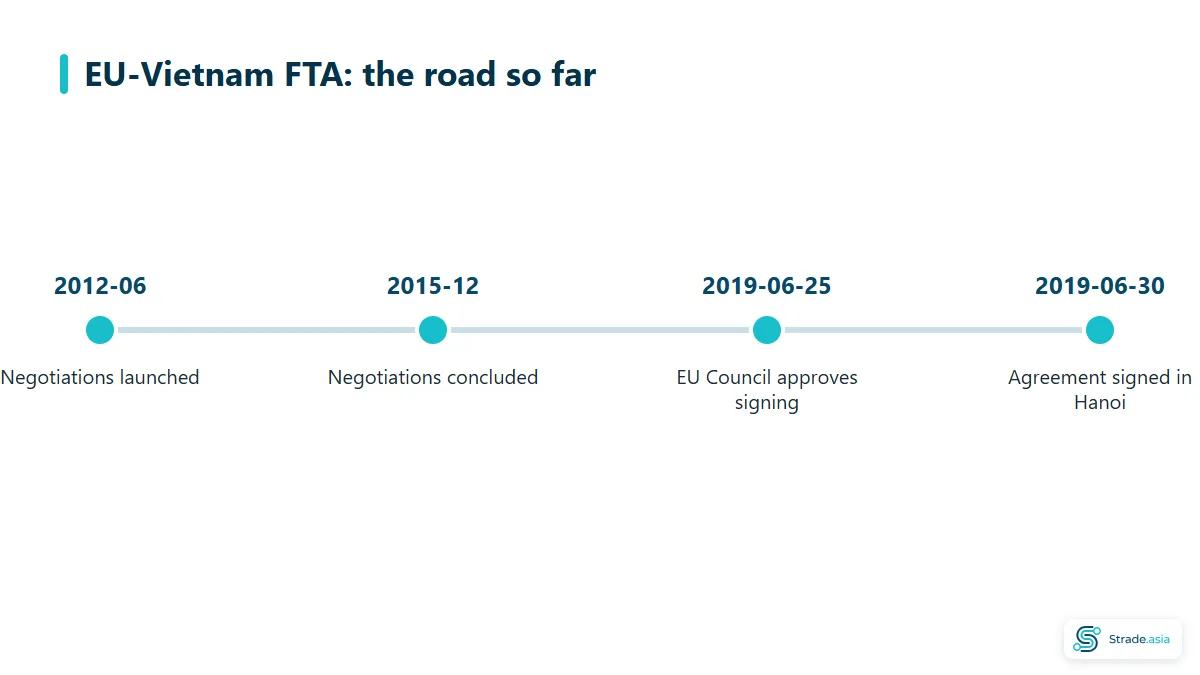
On 30 June, the European Union and Vietnam signed their free trade agreement (EVFTA) in Hanoi, together with a separate investment protection agreement. For factories in Vietnam that export electrical and electronic products to Europe, it is the most important trade development since CPTPP took effect in January.
The agreement does not apply yet. The trade agreement still needs the consent of the European Parliament, formal conclusion by the Council of the EU and ratification by Vietnam’s National Assembly before it can enter into force; the investment agreement will also need ratification by the EU member states. No date for entry into force has been set. That leaves time to prepare, and exporters who do the work now will be able to use the agreement from the first day.
Tariffs: what the schedules say
Both sides will remove tariffs according to schedules attached to the agreement. The EU will remove most of its duties on Vietnamese goods when the agreement enters into force and phase out the rest over a transition period. Vietnam will phase out its duties on EU goods over a longer period.
For electronics, the effect varies by product. Many components already enter the EU duty-free under the WTO Information Technology Agreement, so the agreement will change little for them. The gains are more likely on finished electrical products and equipment that still pay EU duties today, including goods that now enter under the EU’s Generalised Scheme of Preferences (GSP), a unilateral scheme rather than a negotiated agreement. Check the line for your product’s HS code in the EU schedule against the rate you pay today, whether the standard (MFN) rate or the GSP rate, rather than assuming a general rate.
On the import side, EU-made components, machines and test equipment bought by factories in Vietnam will become cheaper as Vietnam’s duties are phased out.
Rules of origin
To claim the EVFTA rate, goods must originate under the agreement’s protocol on rules of origin. Its approach follows the EU’s usual model and differs from the ASEAN agreements many exporters in Vietnam know:
- Product-specific rules are listed by HS code. For many electrical and electronic goods, the rule limits the value of non-originating materials as a share of the ex-works price, sometimes with a change of tariff heading as an alternative.
- Cumulation allows materials originating in the EU to count as originating when they are used in Vietnam.
- Insufficient operations, such as simple assembly, packing or labelling, do not confer origin on their own.
A value-based rule means your cost data must be solid. You need to know the value of every non-originating input and be able to show how the ex-works price is built up.
Proof of origin and EUR.1
For goods exported from Vietnam, proof of origin is expected to be a certificate of origin issued by the Vietnamese authorities in the EUR.1 format used in many EU agreements. The text also provides for origin declarations made by exporters themselves in defined cases, and for a later move to the EU’s registered exporter system. In the other direction, EU suppliers are expected to declare origin themselves on commercial documents, so factories importing EU parts or equipment should ask for that declaration. Vietnam’s implementing rules will set out the details once the agreement is ratified. Whatever the form, exporters must keep the documents that support each claim, because customs can verify origin after import.
What to prepare now
- List EU-bound products with their HS codes, the duty they pay today and the EVFTA schedule for each.
- Read the product-specific rule for each code in the published text.
- Run an origin calculation from the BOM: the value of non-originating materials against the ex-works price, with documented supplier origins.
- Review sourcing. Components from the EU count as originating; components from China, Korea, Japan, Taiwan and other non-EU sources generally count against the limit. Where you are close to the limit, sourcing choices matter.
- Prepare records: costed BOMs, supplier origin statements and production records, kept per shipment.
- Talk to your EU customers about timing, so contracts and prices can reflect the new duty rates when they apply, and confirm that the product also meets EU rules such as the RoHS phthalate limits.
How it fits with other agreements
Vietnam now has CPTPP in force, covered in rules of origin basics, the EVFTA signed, and ASEAN agreements with China, Korea, Japan and others. Each has its own rules and documents, and a product may qualify under one agreement but not another. Keeping origin data for each component, as suggested in setting up production in Vietnam, makes each check quicker. And as noted after the US tariff increase in May, origin claims must always rest on real processing and honest documents.
How Strade can help
Strade is an independent electronic component distributor with its own engineers, supplying factories in Vietnam and across Asia. We source from manufacturers, their distributors and vetted open-market suppliers, and CoC, C/O and CQ documents travel with the goods when the source issues them. Our services include origin documentation and export paperwork, such as Form E, CPTPP and HS code review; see origin and compliance.
If you are preparing EU-bound products and need component data or alternative sources, send us your BOM.