한국어
 Bahasa Indonesia
 ไทย
 中文 (中国)
 Tiếng Việt
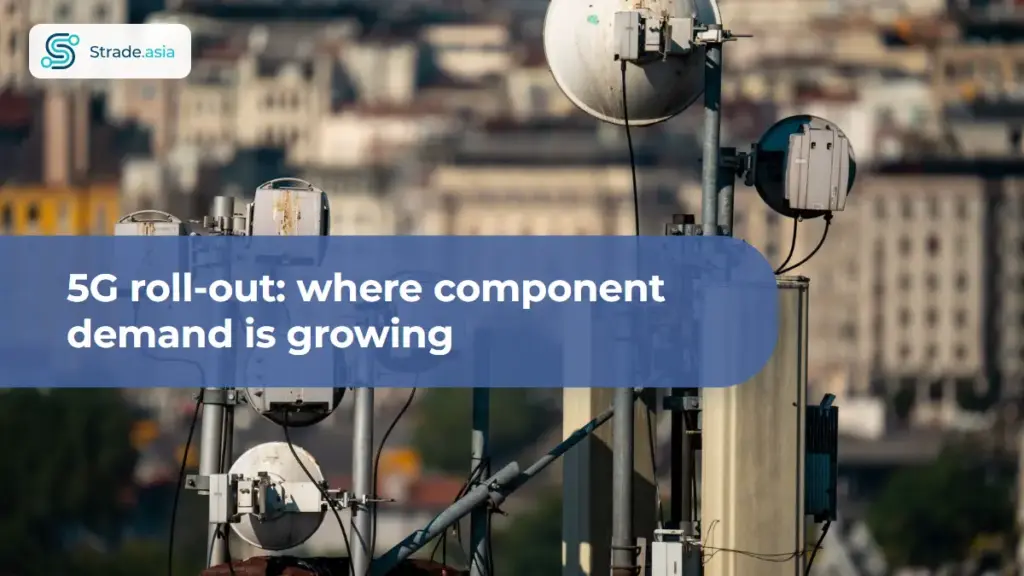
In April, operators in South Korea and the United States launched the first commercial 5G services for smartphones. Operators in Europe and other parts of Asia followed during the year, and at the start of November the three Chinese operators began commercial service. In Vietnam, operators have been running trials. The roll-out has years to go, but it is already changing demand for some electronic components, and some of those parts also sit on the BOMs of factories that make nothing for telecoms.
For buyers in Vietnam, the useful questions are where 5G adds demand and which of those parts also appear on their own BOMs.
Handsets: more bands, more parts
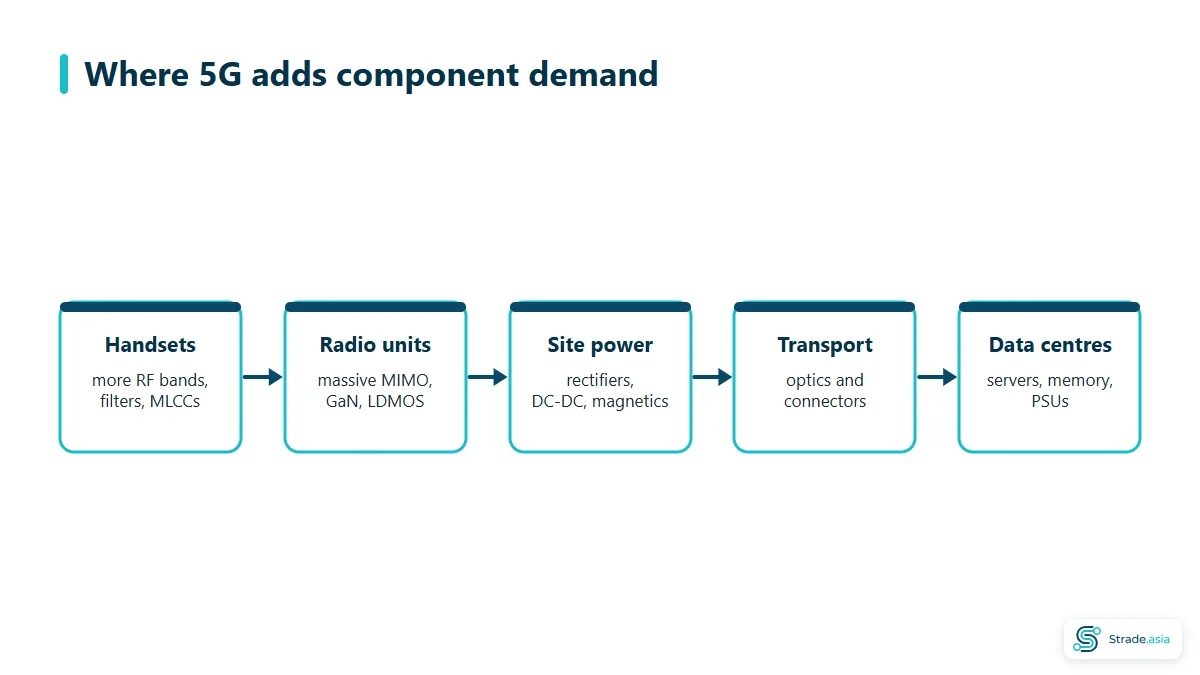
A 5G smartphone must still support 4G and earlier networks, and adds new frequency bands on top. That means more RF content: additional filters, switches, power amplifiers and antenna tuning, often combined in front-end modules. Higher data rates and more processing also raise power consumption, which brings more power management circuits and more decoupling.
The result is more passive components per phone, especially small MLCCs in case sizes such as 0201 and 0402, and RF inductors. During the MLCC shortage, demand from phone and automotive makers led manufacturers to move capacity away from older, general-purpose parts, and 5G adds to that pressure. Vietnam is a major exporter of phones, so this demand is close to home.
Base stations: radios and power
5G radios, particularly massive MIMO units with many antenna elements, contain more RF chains than earlier designs. This drives demand for RF power transistors, with gallium nitride (GaN) gaining ground alongside LDMOS, as well as for high-frequency PCB materials, filters and connectors.
Base stations also need more power. A site typically runs from a DC power system with rectifiers and batteries, with DC-DC conversion for each radio and baseband unit. More radios per site, and more sites as networks densify, mean more rectifier modules, DC-DC converters, power semiconductors, magnetics and capacitors. These are the same families of power products used in industrial equipment, and often come from the same manufacturers.
Networks and data centres
Behind the radios, operators need more fibre transport, optical modules and switching equipment. Data centres that handle the traffic need servers, memory and power supplies. Parts of this market have been through a slower patch this year, as falling memory prices show, but many in the industry point to 5G as a source of demand in the coming years.
What it means for factory buyers
For a factory in Vietnam that makes power supplies, industrial controls or appliances, 5G may matter in three ways:
- Competition for passives. If 5G phone and infrastructure demand grows as expected, the small MLCCs and inductors they use could tighten again. The lessons from the passive component shortage still apply: keep forecasts visible, qualify alternates, and know which parts depend on one source.
- Competition for power parts. Power MOSFETs, gate drivers, DC-DC modules and polymer capacitors serve both telecom power and industrial designs. Watch lead times on these parts; our basics on gate drivers and DC-DC converter modules cover what to compare when choosing alternates.
- Technology shifts. As manufacturers invest in parts for 5G, older product lines may be rationalised. Watch for product change and end-of-life notices on mature parts.
Keep 5G demand in proportion
5G will roll out over several years, at different speeds in different markets. Forecasts of component demand vary widely, and the early phase may bring uneven ordering as operators, phone makers and network equipment makers adjust their plans, build stock or qualify new suppliers. The practical response is not to stockpile, but to watch lead times for the categories above and to plan alternates where you depend on one source.
A short review now is enough:
- list the MLCCs, inductors and power parts on your main BOMs that are single-source;
- check current lead times against the last quarter;
- share a longer forecast with suppliers for the parts that would stop a line.
How Strade can help
Power products are Strade’s main product group, alongside semiconductors, passive components and connectors. We are an independent electronic component distributor with our own engineers, supplying factories in Vietnam and across Asia from manufacturers, their distributors and vetted open-market suppliers. When a part is short, our engineers can propose an alternate with matching specifications for your team to decide on. Browse our power products.
To check lead times and alternates for the passives and power parts on your BOM, send us your part list.