한국어
 Bahasa Indonesia
 ไทย
 中文 (中国)
 Tiếng Việt
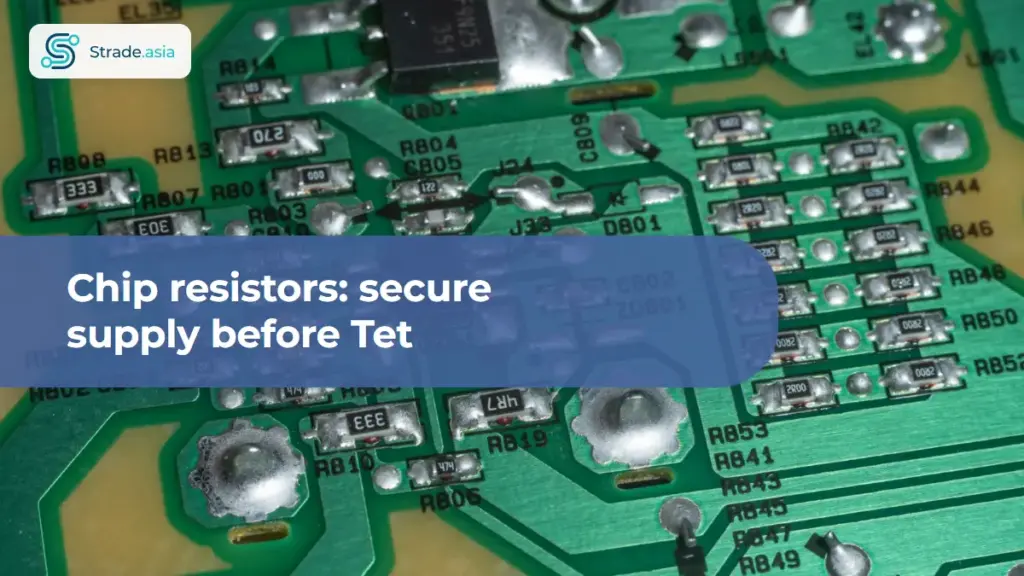
Just as buyers were getting used to long lead times for multilayer ceramic capacitors, a second basic part has started to slip. Since late last year, a growing chip resistor shortage has lengthened lead times for thick-film parts at several makers, some distributors have limited quantities per order, and open-market prices for common values have climbed. With the Tet holiday two weeks away, and many suppliers in the region closing around the Lunar New Year, now is the time to check your resistor lines.
Why resistors are tight
Chip resistors share many of the drivers behind the MLCC shortage. Phones, cars and industrial equipment use more of them each year. Like capacitor makers, resistor makers have focused capacity on small case sizes and higher-value products such as automotive-grade and precision parts, and have been slow to add lines for general-purpose resistors after years of low prices. The price of ruthenium, used in the resistive paste of thick-film parts, also rose sharply during 2017, adding to makers’ costs. Some companies make both resistors and capacitors, so capacity, materials and attention are shared. Buyers worried by the capacitor situation have also begun ordering resistors earlier and in larger quantities, which adds to backlogs for everyone.
The good news is that most chip resistors are highly standardised. A 10 kΩ, 1%, 0603 thick-film resistor is made by many manufacturers to similar specifications, so there are usually more alternates available than for a capacitor or a semiconductor. The work is in checking them properly.
What to check on an alternate
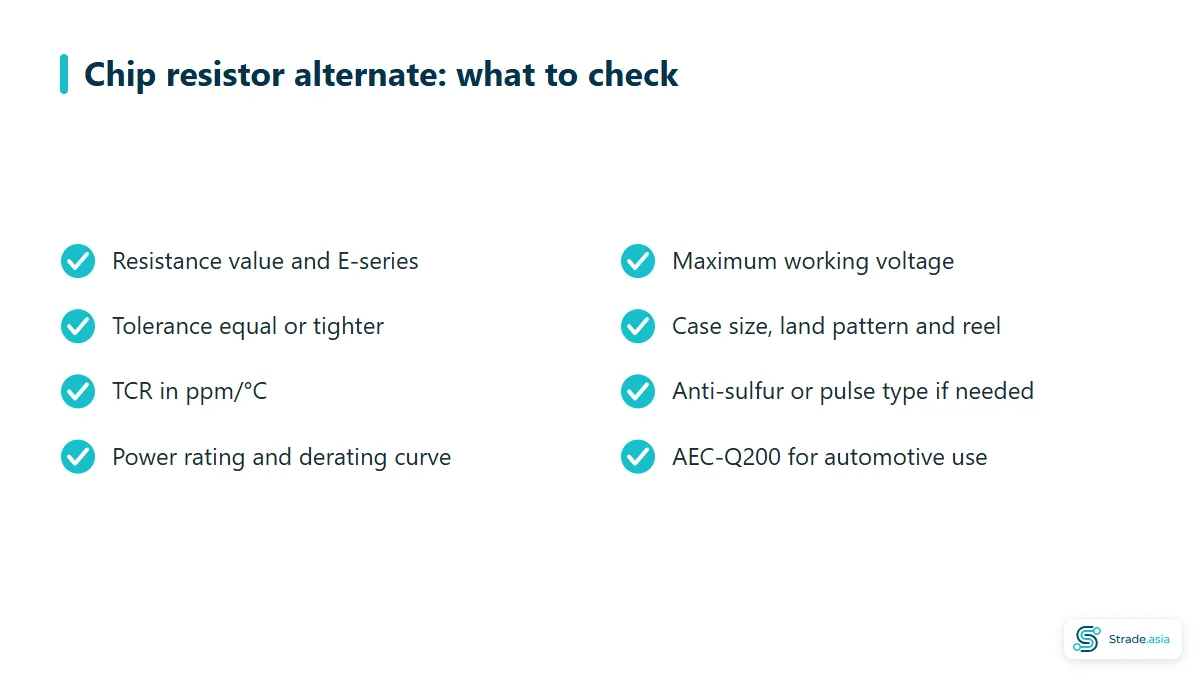
- Value and series. Standard values follow the E24 series for 5% parts and E96 for 1% parts. Values outside these series have fewer sources; ask engineering whether a standard value would do.
- Tolerance. An alternate must match or beat the original. A 1% part can usually replace a 5% one; the reverse needs engineering approval.
- TCR. The temperature coefficient of resistance, in ppm/°C, shows how far the value drifts with temperature. In voltage dividers, feedback networks and sensing circuits it matters as much as tolerance.
- Power rating and derating. Ratings depend on case size and maker. Power is usually rated up to an ambient temperature, often 70 °C, and falls above it. Some makers rate the same case size higher than others, so do not assume two parts are equivalent.
- Maximum working voltage. Small cases have low voltage limits. In mains-side circuits, bleeder resistors and high-voltage dividers, voltage rather than power is often the limiting parameter.
- Special types. Anti-sulfur resistors for polluted or industrial environments, pulse-withstanding types for inrush and surge positions, and AEC-Q200 qualified parts for automotive must be replaced with the same kind of part.
- Case size and packaging. Check dimensions against your land pattern, and the tape and reel format against your feeders. Our guide to tape and reel packaging covers what to confirm.
Thin-film and current-sense resistors are a separate case. Thin-film parts offer tighter tolerance and lower TCR; current-sense resistors have very low values and particular constructions. Replacing either needs a closer engineering review than a general-purpose thick-film part.
Actions before Tet
- Count weeks of stock for every resistor line, including 0 Ω jumpers, which are easy to overlook, allowing for the holiday shutdown and the slow restart that follows at suppliers and forwarders.
- Place firm orders now for lines with thin cover, rather than waiting until after the holiday, when backlogs will be longer.
- Add approved makers for high-volume values. Many factories approve one resistor maker per line out of habit; a short qualification adds real flexibility. See how to qualify second sources.
- Consolidate values. Where a design uses several close values, engineering may be able to standardise on fewer, which concentrates volume and makes buying easier.
- Inspect open-market lots. Relabelled reels are not unknown when parts are short. Check labels and date codes against the maker’s format, and measure samples before the reel goes to the line.
Looking further ahead
Resistors are unlikely to be the last passive part to tighten while demand keeps growing and makers favour high-value products. Give your suppliers a forecast that covers passives, not only semiconductors, and review it every month. When a line runs short, the factories with forecasts on record and alternates already approved will recover first.
How Strade can help
Strade supplies passive components, semiconductors, connectors and power products to factories in Vietnam and across Asia, with its own engineers to review alternates. Most orders are bought to the customer’s request, and many are urgent. Every lot is inspected on receipt and packed in anti-static packaging. When a resistor value is short, our engineers can propose alternates that match value, tolerance, TCR and rating, and your team decides.
Send us the resistor lines you need covered before the holiday, as a BOM in Excel, CSV or PDF, or line by line.