한국어
 Bahasa Indonesia
 ไทย
 中文 (中国)
 Tiếng Việt
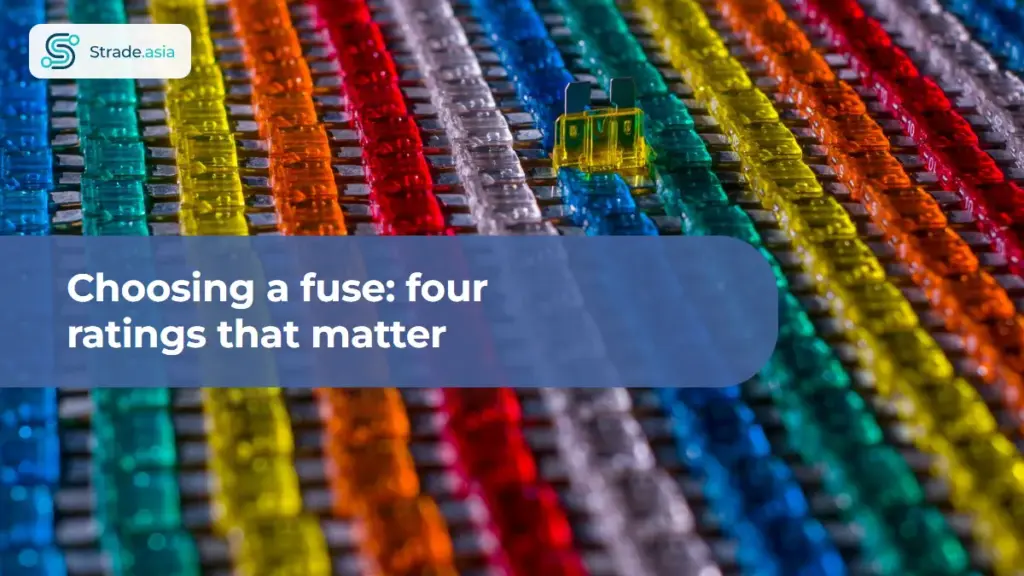
A fuse is one of the cheapest parts on a power board, and one of the easiest to get wrong. Undersized, it blows at switch-on or after months of normal use, and the product comes back as a field failure. Oversized or wrongly rated, it may not clear a fault safely, which is a safety problem. And because fuses from different makers often look identical, they are a common target for substitution when the original is short. Four ratings decide whether a fuse is right for the job.
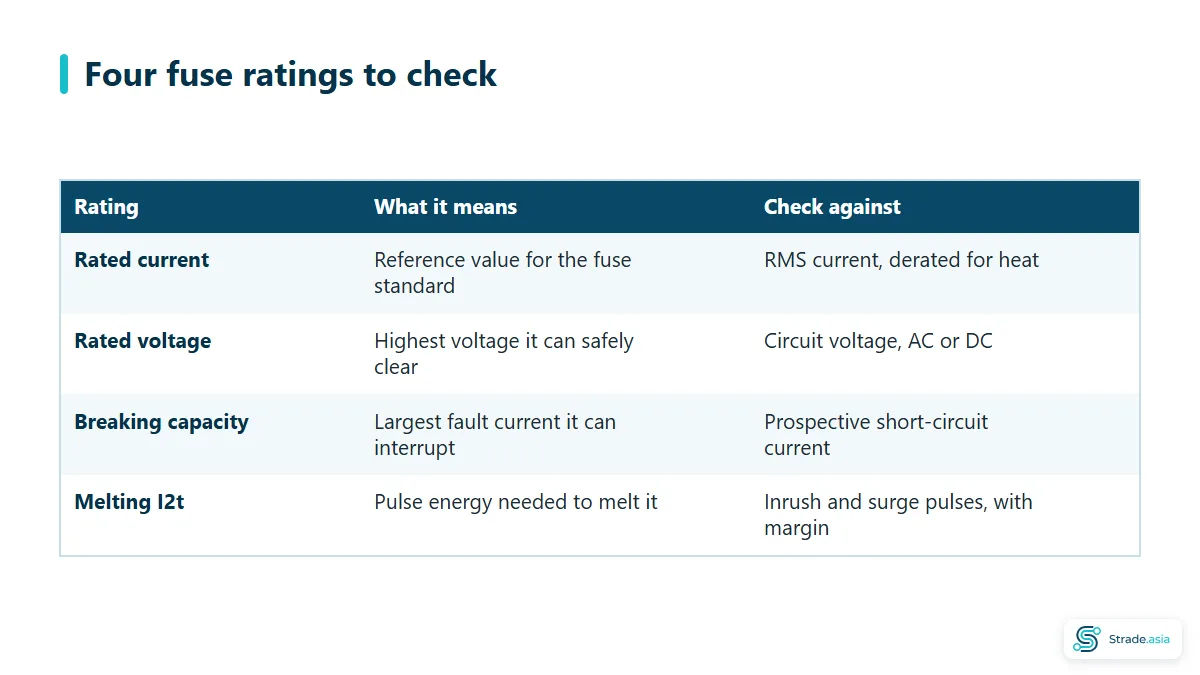
1. Rated current, and why you derate it
The rated current printed on a fuse is not the current it should carry in normal use. It is a reference value for the fuse’s test standard, and the two main standards treat it differently. A fuse made to UL 248-14 and one made to IEC 60127 with the same nominal rating will not behave the same way under overload, because the IEC test lets a fuse carry a higher multiple of its rating before it must open. Never swap a UL-rated fuse for an IEC-rated one, or the reverse, on the printed current alone.
Makers’ guides typically recommend running a UL-rated fuse at no more than about three quarters of its rating at room temperature; IEC-rated fuses are defined differently, so follow the maker’s guidance for each type. Either way, derate further for the actual temperature around the fuse. Inside a closed enclosure, next to a heat sink or a transformer, that temperature can be far above room temperature. Use the maker’s rerating curve rather than a general rule.
Measure the real operating current as a true RMS value. In a switching power supply the input current is far from sinusoidal, and it is highest at the lowest input voltage and full load.
2. Rated voltage, AC and DC
The rated voltage must be equal to or higher than the highest voltage across the fuse when it opens, because it describes the fuse’s ability to extinguish the arc that forms as the element melts. DC is harder than AC: there is no zero crossing to help put the arc out. A fuse rated for AC is not automatically rated for DC. For battery circuits, DC buses and solar strings, check that the datasheet gives a DC rating.
3. Breaking capacity
Breaking capacity, or interrupting rating, is the highest fault current the fuse can safely interrupt at its rated voltage. If the prospective short-circuit current is higher, the fuse can rupture and the arc can continue. At a mains input the prospective current can be large; on the secondary side of a small transformer it is limited by the winding. Glass-body fuses generally have low breaking capacity, while ceramic bodies, often sand-filled, are used where fault currents are high, such as the mains input of a power supply. IEC 60127 marks miniature fuses with letters for low or high breaking capacity.
4. Time-current curve and I²t
The time-current curve shows how long the fuse takes to open at each multiple of its rated current. Fast-acting fuses, marked F, open quickly on overload; time-lag fuses, marked T, tolerate short surges. The choice depends on the load.
Surges are where I²t comes in. When a power supply is switched on, its input capacitors draw an inrush current far above normal for a very short time; motors, lamps and transformers do the same. The energy of such a pulse is expressed as I²t, current squared multiplied by time. Compare the pulse I²t with the fuse’s melting I²t from the datasheet, with margin: makers publish pulse derating factors that depend on how many times the pulse will repeat over the product’s life. A fuse that survives the first switch-ons can still fail later through fatigue of the element if the margin is too thin.
I²t also works downstream. To protect a semiconductor, the fuse’s clearing I²t must be lower than what the device can withstand. Read these figures with the same care for test conditions that we described in reading a datasheet.
Approvals and substitution
- The safety file. A product’s safety certificate usually lists the fuse among its critical components, by maker and type. Changing it may need the certification body’s agreement, even for an “equivalent” part, so it pays to list two approved fuse makers in the safety file from the start.
- Markings. Check the body marking against the datasheet: current, voltage, speed, breaking capacity and approval marks.
- Bought-in adapters. In an external power supply the fuse is the adapter maker’s choice, but the same questions apply when a redesigned model arrives, as many did with the Level VI efficiency rules this year.
- Counterfeits. Cheap fuses from unknown sources may not meet their marked ratings. Buy from traceable sources, ask for a certificate of conformance where available, and check markings, packaging and the cold resistance of samples on receipt.
How Strade can help
Strade is an independent electronic component distributor with its own engineers, supplying factories in Vietnam and across Asia. When a fuse is short, our engineers propose alternates that match current, voltage, speed, breaking capacity and I²t, with your safety file in mind, and your team decides. See our power products.
Send us the fuse part numbers or your full BOM and we will check availability and matching alternates.