한국어
 Bahasa Indonesia
 ไทย
 中文 (中国)
 Tiếng Việt
Almost every industrial board needs more than one supply voltage. A 24 V input from the control cabinet has to become 5 V for logic and 3.3 V or less for a processor; a 12 V bus has to feed an FPGA core. DC-DC converter modules do this without designing a switching supply from scratch, but the first choice, isolated or non-isolated, affects safety, noise, size and cost.
What isolation means
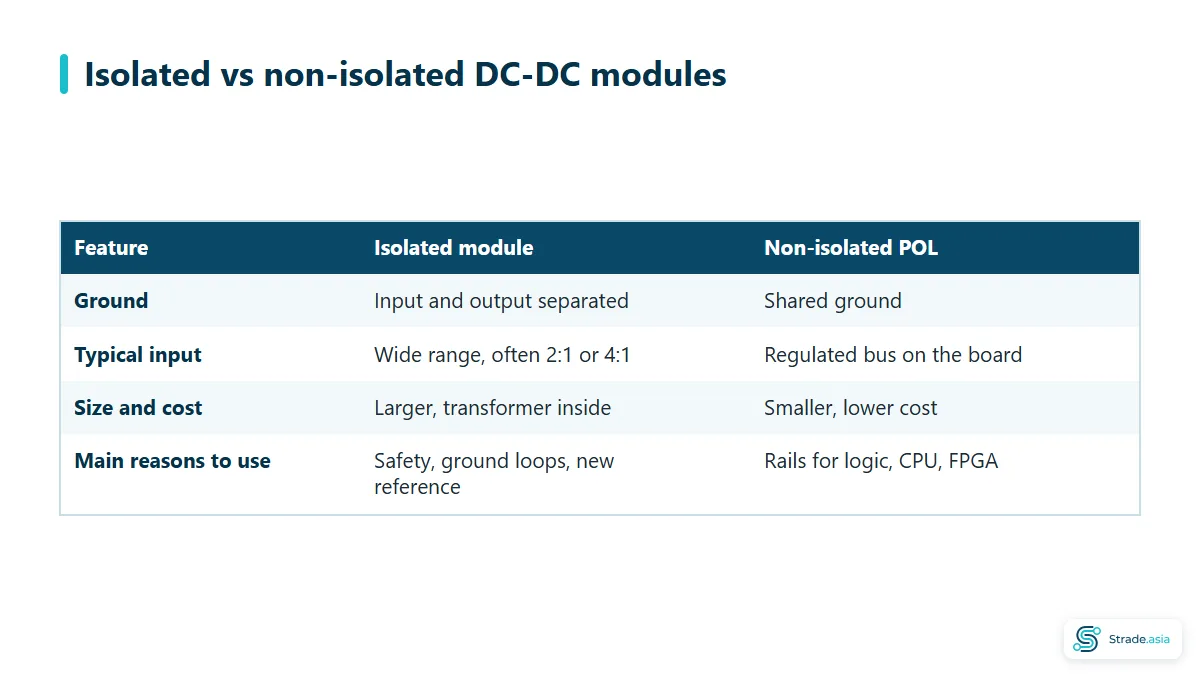
An isolated DC-DC module has a transformer between input and output. There is no direct conductive path between the two sides, so the output can float or be referenced to a different ground. A non-isolated module, often called a point-of-load (POL) converter, is usually a buck or boost regulator whose input and output share a common ground.
Choose an isolated module when:
- Safety requires it. Where the input could carry hazardous voltages under fault, or where a user can touch the output, the safety standard for the product sets the isolation needed. Isolation grades include functional, basic and reinforced, and medical equipment has its own stricter requirements.
- Ground loops cause trouble. Long cables between cabinets, remote sensors and interfaces such as RS-485 or CAN often work better with a separate ground.
- You need a different reference. For example a negative rail, a floating supply for a gate driver, or several outputs that must not share a ground.
Choose a non-isolated POL module when the input is already a safe, regulated low voltage on the same board and the load shares its ground: processors, FPGAs, memory and logic rails.
What to check in the datasheet
As with any component, read the conditions behind every figure; our guide to absolute maximum ratings explains why.
- Input range. Regulated isolated modules are often sold with wide input ranges, described as 2:1 or 4:1, that cover battery systems and the variation on industrial 24 V supplies. Low-cost unregulated modules of 1 to 2 W expect a narrow input range, and their output drifts at light load. Check the transients the input must survive, not only the steady range.
- Isolation rating. The isolation voltage on the datasheet is usually a test voltage applied for a short time in production, not a voltage the barrier can withstand continuously. For safety isolation, check the module’s approvals and the working voltage it is certified for.
- Efficiency against load. Efficiency curves peak at medium to high load and fall at light load. A module that runs mostly lightly loaded may waste more power than the headline figure suggests. Some isolated modules also need a minimum load to regulate properly.
- Thermal derating. Output power is rated at a stated ambient temperature and airflow. Derating curves show how much power remains at higher temperatures or without airflow. Inside a sealed enclosure in a Vietnamese factory in summer, the derated figure is the one that counts.
- Remote sense. On low-voltage, high-current rails, board traces and connectors drop voltage. Modules with remote sense regulate the voltage at the load instead of at their own pins.
- Capacitors and start-up. Check the maximum capacitive load the module can start into, and the input and output capacitors it needs. Electrolytic capacitors next to a hot module age faster, as explained in why temperature matters for capacitor lifetime.
- Protection and control. Short-circuit, over-voltage and over-temperature protection, remote on/off (positive or negative logic) and trim range.
- Package and EMC. SIP, DIP, SMD and brick formats differ in footprint, cooling and assembly: SMD modules must suit your reflow profile and moisture handling, while through-hole parts need wave or hand soldering. Most modules need an external input filter to meet conducted emission limits, so check the recommended filter.
Practical points for buyers
- Do not swap isolated and non-isolated versions on the assumption that the pinout is the same. Footprints may match while ground connections differ.
- Check the second source carefully. Many isolated modules follow common industry footprints, but trim, on/off logic, EMI behaviour and derating can still differ, and changing a safety-certified module may mean updating your safety report. Treat the change as a formal qualification, as with any approved manufacturer list entry.
- Keep the approval file. For products that need safety approval, the module’s certificates belong in your technical file.
- Protect the input. Fit a fuse sized for the module’s inrush and fault current, as covered in choosing a fuse for power circuits.
How Strade can help
Power products are a core part of the Strade range. As an independent distributor with its own engineers, we help factories in Vietnam and across Asia compare DC-DC modules, check derating and isolation against the application, and propose alternates with matching specifications when a module is short. Browse our power products or send us your requirements for a quote.