
 한국어
 Bahasa Indonesia
 ไทย
 中文 (中国)
 Tiếng Việt

Spending on data centres for artificial intelligence has grown quickly since 2023, and the large cloud companies have said they will keep investing heavily this year. Most attention goes to GPUs and high-bandwidth memory, but every accelerator also needs power. AI servers draw far more power per rack than conventional servers, and that is reshaping the power supply unit (PSU), the rack power shelf and the parts inside them. Even if your factory never builds a server, these changes can reach the lead times of your power components.
What is different about AI server power
Conventional server racks are designed around a fairly modest power budget. Racks filled with GPU servers can need several times as much, and the trend rises with each accelerator generation. That has several consequences:
- Higher output per PSU. Supplies in the multi-kilowatt range are becoming normal, in the same or similar form factors, which means much higher power density.
- Top-tier efficiency. At this scale, every point of loss is heat the cooling system must remove. Designs target 80 PLUS Titanium, the highest tier of that certification programme, and the EU’s ecodesign rules for servers already set minimum PSU efficiency.
- Redundancy and hot-swap. PSUs are installed N+1 or N+N and must be replaced without powering down the server, which needs OR-ing controllers, inrush control and accurate current sharing.
- 48 V distribution. Rack designs from the Open Compute Project and others distribute 48 V to cut current and copper losses, as explained in 48 V power distribution.
- Telemetry. PSUs report voltage, current, temperature and faults over PMBus, so firmware and digital controllers are now part of the power design.
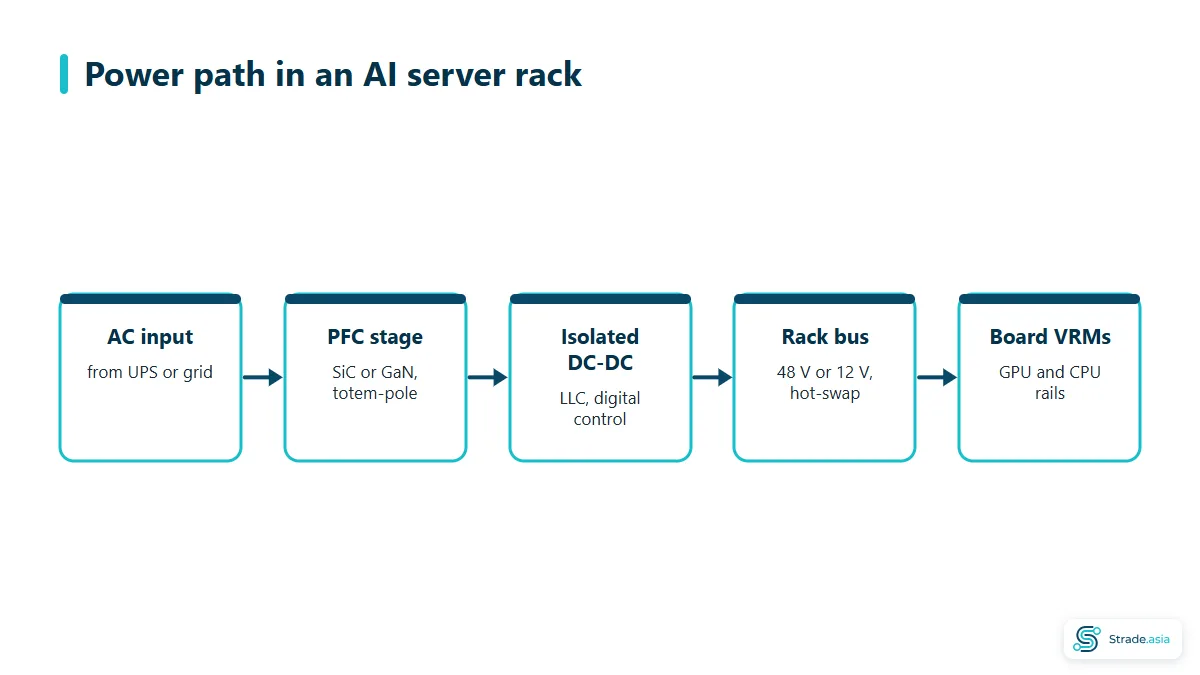
Inside a high-efficiency PSU
Reaching Titanium efficiency at multi-kilowatt output changes the topology. The front end moves from a classic boost PFC behind a diode bridge to bridgeless designs such as the totem-pole PFC, which depend on fast-switching silicon carbide (SiC) or gallium nitride (GaN) transistors. The isolated DC-DC stage is usually a resonant LLC converter with synchronous rectification. Digital controllers manage both stages, and bulk capacitors provide hold-up time through short input interruptions. Capacitors, magnetics and thermal design must all cope with higher power density; for capacitor trade-offs see polymer vs aluminium electrolytic capacitors.
What this means for component supply
Server PSU makers buy many of the same parts as makers of industrial power supplies, chargers, solar inverters and EV equipment: SiC and GaN switches, gate drivers, digital controllers, high-voltage bulk capacitors, current sensors, power inductors, transformers and high-current connectors. When one demand segment grows fast, suppliers tend to allocate capacity to their largest and most committed customers. The same pattern stretched power semiconductor lead times across the board in 2021.
For now, many general power components are readily available after last year’s inventory correction. The parts most likely to tighten first are the ones AI servers favour: high-performance SiC and GaN devices, their gate drivers, high-current connectors and some digital power controllers.
Factories in Vietnam that build power supplies, chargers, inverters or industrial controllers are the most exposed, because their BOMs share the most parts with server PSUs. Products with long qualification cycles are harder still: once a SiC device or a digital controller is designed in, moving to another source can take months of testing. The time to prepare is while parts are still easy to buy.
Practical steps for buyers and engineers
- Identify overlap. Mark BOM lines that are also typical server PSU parts: wide-bandgap switches, digital PWM controllers, hot-swap controllers and high-current connectors.
- Watch lead times monthly on those lines rather than quarterly, and note any change in quoted validity or minimum order quantity.
- Qualify a second source early for wide-bandgap devices and their gate drivers, before allocation starts rather than after.
- Forecast honestly. Suppliers allocate on credible forecasts; share yours for the next two quarters.
- Protect your own IT and test systems. Keep spare PSUs and fans for critical servers and test stations, since replacement units can become scarce when demand peaks.
How Strade can help
Power products are Strade’s core product group. We source from manufacturers, their distributors and vetted open-market suppliers, and our engineers propose alternates with matching ratings when a power part is short; your team always decides. See our power products or send your BOM for a quotation.


