
 한국어
 Bahasa Indonesia
 ไทย
 中文 (中国)
 Tiếng Việt

Power MOSFETs and IGBTs used to be among the easier semiconductors to buy. Many types came from several manufacturers, distributors held stock, and a few weeks’ notice was usually enough. Through this year, that has changed. Lead times for many power devices have lengthened month after month, and common types are often out of stock across the market. For factories that build power supplies, inverters, motor drives, chargers or UPS systems, these parts are at the heart of the product, and there is no way to ship without them.
Why power devices are short
Several pressures have arrived together:
- Cars need more of them. Electric and hybrid vehicles use many more power semiconductors than conventional cars, in traction inverters, onboard chargers and DC-DC converters, and car production is trying to recover from the shortages earlier this year.
- Industrial and consumer demand is strong. Automation, solar inverters, data centre power, appliances and chargers all compete for the same devices.
- Wafer capacity is limited. Many power devices are made on 200 mm wafer lines, where little new capacity has been added for years. New capacity is coming, such as the 300 mm power semiconductor fab Infineon opened in Villach, Austria in September, but new lines take time to ramp up and to qualify products.
- The back end has been disrupted. Much power device assembly takes place in Southeast Asia, and this summer’s lockdown in Malaysia added further delays.
Alternates are realistic, within limits
Unlike microcontrollers, power devices carry no firmware, and many come in standard packages such as TO-220, TO-247, D2PAK and DPAK. That makes alternates more realistic. But a part with the same package and voltage is not automatically a drop-in. The basics are set out in MOSFET selection basics; in a shortage, the key is to stay within the same voltage class, package and technology, and then check the details.
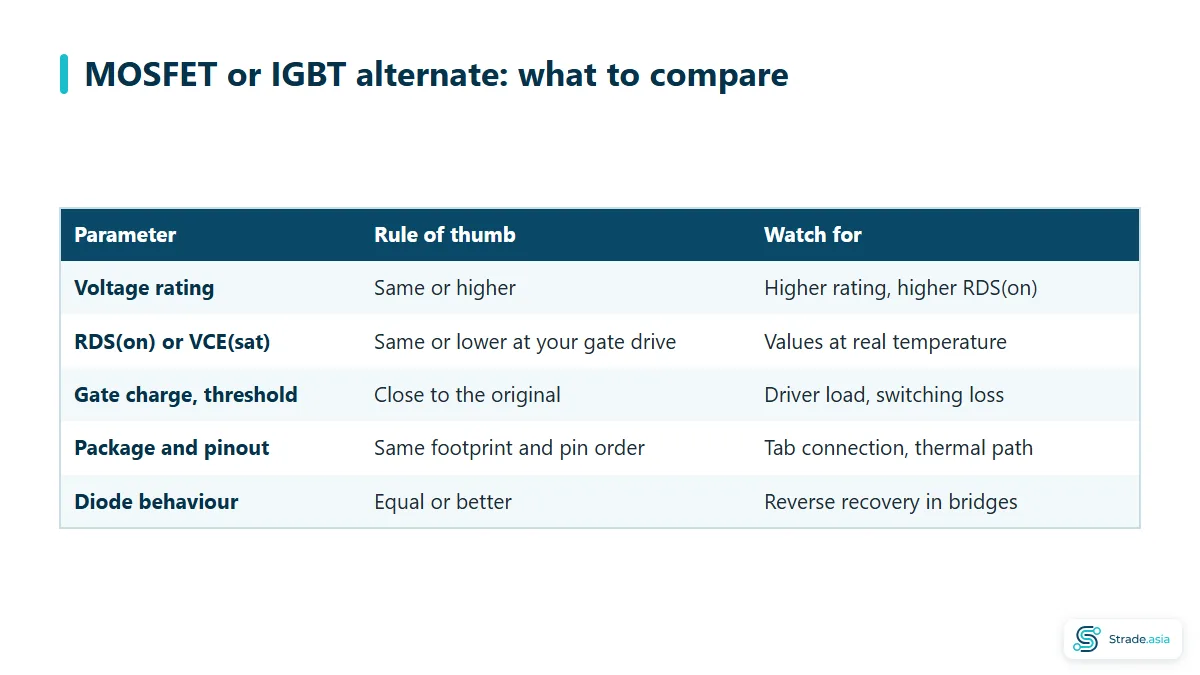
- Voltage rating. Use the same or a higher rating. A higher-voltage part in the same package usually has higher on-resistance, so check the losses.
- On-resistance or saturation voltage. Compare values at your operating temperature and at the gate voltage your board actually applies. A part specified at 10 V gate drive may behave very differently at 4.5 V.
- Gate charge and threshold. These set the load on the gate driver and the switching losses. Large differences can change timing, heat and EMC, as explained in gate drivers for MOSFETs and IGBTs.
- Package details. Check pin order, the connection of the tab or thermal pad, and thermal resistance, not just the outline.
- Diode behaviour. In bridges and synchronous rectifiers, the body diode’s reverse recovery matters. For IGBTs, check whether a diode is co-packed and compare switching energy and short-circuit withstand time.
- Technology. Moving between planar, trench and superjunction MOSFETs, or from an IGBT to a MOSFET, changes switching behaviour and needs a full engineering review.
Every alternate needs testing on the real board: temperature rise at full load, switching waveforms and, where relevant, EMC.
Order early, and order sensibly
Alternates help, but they do not remove the need to plan. A few practical steps:
- Forecast power devices for the coming year. Scheduled orders get you into the queue now, as described in planning for 52-week lead times.
- Approve more than one part per position. Qualify two or three devices for each critical socket and list them on your approved manufacturer list.
- Check the alternate’s own lead time. Qualifying a part that is just as short does not help. Confirm availability before engineering starts testing.
- Read the terms. Many power devices are now offered on NCNR terms, with prices set at shipment. Agree what can be rescheduled before you commit.
- Inspect open-market stock carefully. Power devices are counterfeited and recycled too. Check markings, date codes and packaging, and test samples, for example for on-resistance and breakdown voltage.
How Strade can help
Strade is an independent electronic component distributor with its own engineers, supplying factories in Vietnam and across Asia. Power products are our core group, alongside semiconductors, passive components and connectors. We source from manufacturers, their distributors and vetted open-market suppliers, and sensitive parts can be X-rayed or sample-tested on receipt. When a MOSFET or IGBT is short, our engineers can propose alternates with matching specifications, and your team decides. See our semiconductor range.
Send us your BOM or the power devices you need, and we will check lead times and alternates.


