한국어
 Bahasa Indonesia
 ไทย
 中文 (中国)
 Tiếng Việt
When power fails, many devices need just enough energy for a few seconds or minutes: to save data, send a last message, park an actuator or keep a clock running. A battery can do that, but it brings charging rules, limited cycle life, transport restrictions and replacement visits. For short bridging jobs, a supercapacitor is often the better part. Choosing one well means understanding a few parameters that ordinary capacitor datasheets do not emphasise.
How supercapacitors differ
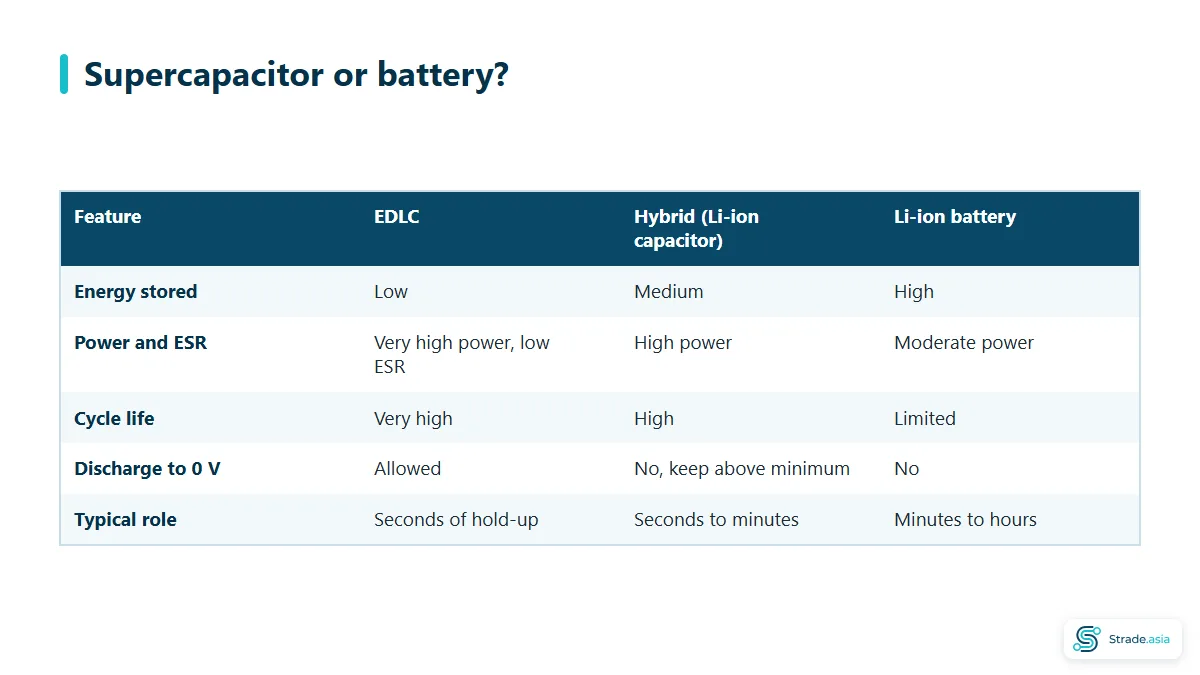
An electric double-layer capacitor (EDLC) stores charge physically, at the interface between a porous carbon electrode and an electrolyte, without the chemical reactions of a battery. That gives very high power, very long cycle life and the ability to discharge fully to zero volts. The trade-offs are low energy density and a low cell voltage, typically 2.5 to 3 V per cell, so most designs stack cells in series.
Hybrid types, such as lithium-ion capacitors, pair a capacitor-type electrode with a battery-type electrode. They store more energy, with higher cell voltage and lower self-discharge, but they must be kept above a minimum voltage and behave more like batteries when charged, stored and shipped.
Key parameters
- Capacitance and usable energy. Stored energy is ½CV², but the load stops working below some minimum voltage, so usable energy is ½C(Vmax² − Vmin²). Use the minimum input voltage of the downstream regulator, not zero.
- ESR. Equivalent series resistance sets the voltage drop at the start of a pulse and the heat in the cell. Datasheets often give both DC and AC values; for hold-up, the DC value matters.
- Voltage and balancing. Cells in series need balancing, because capacitance tolerance and leakage differ from cell to cell and one cell can be pushed over its rating. Passive resistor balancing is simple but draws current all the time; active balancing suits low-standby designs.
- Temperature and lifetime. Life falls quickly with higher voltage and temperature. A common rule of thumb in manufacturer data is that life roughly doubles for every 10 °C lower operating temperature, and running below rated voltage extends it further. The ageing resembles that of aluminium electrolytic capacitors: end of life is usually defined as a set capacitance loss or ESR increase, not a sudden failure.
- Leakage and self-discharge. These matter when a device sits unpowered for long periods and must still hold charge.
A quick sizing example: a data logger that needs 2 W for 10 seconds to save its data needs 20 J. If the stack can swing from 5 V down to 2.5 V, then ½C(25 − 6.25) = 20 J gives about 2.1 F. Before choosing a part, add margin for converter efficiency, capacitance tolerance and the capacitance the cells will lose by end of life.
Design notes
- Limit charging current. An empty supercapacitor looks like a short circuit to the supply; use a dedicated charger or a current-limited source so it does not trip the supply at power-up.
- Consider a backup controller. Dedicated ICs charge the stack, monitor cell voltage and boost the stored energy back to the system rail during backup, extracting more usable energy from the cells.
- Leave voltage margin. Run cells below their rated voltage in long-life designs, especially in hot enclosures.
- Keep them cool. Place them away from power resistors, heat sinks and transformers.
- Check transport and storage rules. Rules differ between EDLCs and hybrid types, and larger cells and modules may be classed as dangerous goods; check the manufacturer’s transport information before shipping.
Where supercapacitors replace batteries
Supercapacitors suit hold-up in smart meters and data loggers, power-loss protection in SSDs and controllers, last-gasp alarms, emergency actuation of valves or doors, peak power support for radios and motors, and real-time clock backup. They also handle wide temperature ranges and frequent cycling that would wear a battery out. For runtime measured in hours, a battery is still the right tool, with a proper battery management system. For the factory-level version of the same problem, see backup power for production lines.
How Strade can help
Strade supplies passive components and power products to factories in Vietnam and across Asia. Our engineers can compare EDLC and hybrid parts by capacitance, ESR, voltage and temperature rating, and propose matching alternates when a specified part is short; the final decision stays with your team. Browse our passive components or send your BOM for a quotation.