
 한국어
 Bahasa Indonesia
 ไทย
 中文 (中国)
 Tiếng Việt

For decades, 12 V and 24 V have been the default rails inside equipment, with 5 V or 3.3 V on the board. That is changing. Server racks, telecom sites, mild hybrid cars, robots and battery-powered machines increasingly distribute power at 48 V. For engineers specifying power parts and buyers sourcing them, the shift changes converter topologies, the voltage ratings of semiconductors and capacitors, and the choice of connectors and protection.
The physics: current, not voltage
Power equals voltage times current. Deliver the same power at 48 V instead of 12 V and the current falls to a quarter. Resistive loss in cables, busbars, connectors and PCB copper scales with the square of the current, so for the same conductor the loss falls to one sixteenth. Designers take the gain partly as efficiency and partly as smaller, lighter cables and connectors. As loads have grown, from accelerator boards drawing hundreds of watts each to electric power steering in cars, 12 V distribution has run out of room.
Why 48 V and not higher
48 V sits just below the point where safety standards start to demand much heavier protection. The older IT and telecom safety standard IEC 60950-1 treated circuits up to 60 V DC as safety extra-low voltage (SELV), and its successor IEC 62368-1 sets its lowest energy class, ES1, at the same 60 V DC under normal conditions. A 48 V nominal bus, even at a battery’s float voltage in the mid-50s, stays below that limit. Insulation, creepage distances and service procedures therefore stay much simpler than at higher voltages.
Where 48 V is spreading
- Telecom: -48 V DC has long been the standard supply in exchanges and base stations, backed by battery strings.
- Data centres: open rack designs from the Open Compute Project distribute 48 V across the rack instead of 12 V, to cope with rising power per server.
- Cars: 48 V mild hybrid systems power belt starter-generators and high-load accessories alongside the 12 V network.
- Industrial and mobile machines: AGVs, collaborative robots, e-bikes and battery tools use 48 V packs, and Power over Ethernet also works in this voltage range.
Intermediate bus converters
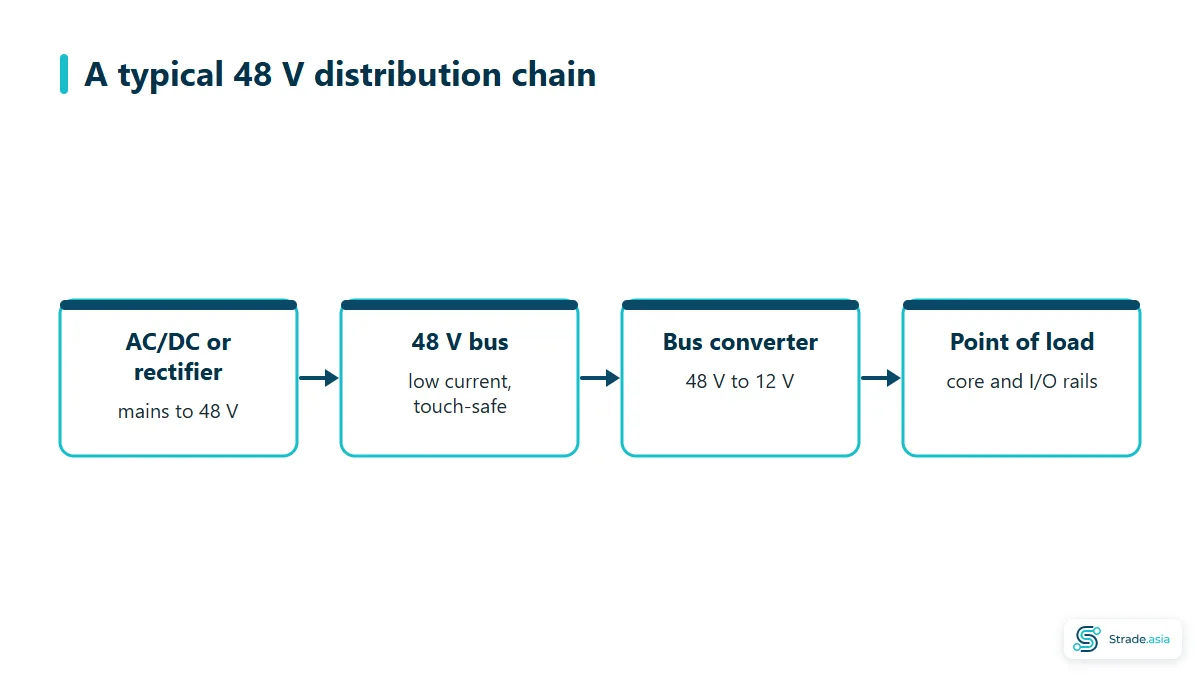
The load rarely uses 48 V directly. The common architecture converts 48 V to an intermediate rail, often 12 V, with a bus converter, then uses point-of-load regulators for the low-voltage rails. Bus converters may be regulated, or fixed-ratio (for example 4:1) for higher efficiency, leaving regulation to the next stage. Newer designs convert 48 V straight to the point of load to save a stage. Our earlier piece on isolated and non-isolated DC-DC modules explains when isolation is needed in this chain.
What changes in the BOM
- MOSFETs and GaN transistors. Switches on a 48 V bus typically need 80 V or 100 V ratings to leave margin for transients. Gate charge and on-resistance still drive efficiency; see MOSFET selection basics.
- Capacitors. Choose 63 V or 100 V ratings and check how much capacitance an MLCC keeps under DC bias at the working voltage, not just its nominal value.
- Transient protection. Hot-plug events, load dumps and inductive kicks need TVS diodes chosen for the bus voltage, as covered in TVS diodes and surge protection.
- Hot-swap and inrush. Plugging a board into a live 48 V bus causes arcing at the contacts and large inrush current; hot-swap controllers or eFuses limit both.
- Connectors and fuses. Ratings must cover the DC voltage, because a DC arc is harder to interrupt than an AC arc, which has natural zero crossings.
- Backup. A 48 V bus pairs naturally with battery or DC backup, as discussed in backup power for production lines.
What to watch
Migration is gradual. Many products will carry both 12 V and 48 V rails for years, and bus converters, controllers and magnetics designed for 48 V input are still a smaller market than their 12 V equivalents, with fewer pin-compatible second sources. When you design in a 48 V converter module, check early whether a second source with the same footprint exists.
How Strade can help
Power products are Strade’s core product group. Our engineers can check 48 V designs for voltage margin on MOSFETs, capacitors and protection parts, and propose alternates with matching ratings when a part is short or reaches end of life; your team always makes the final choice. See our power products or send your BOM for a quotation.


