한국어
 Bahasa Indonesia
 ไทย
 中文 (中国)
 Tiếng Việt

A buyer asks for a few hundred pieces of a capacitor and receives a quote for a full reel of several thousand. Another supplier quotes the exact quantity, at a unit price that looks far too high. Neither answer is wrong. Both come from the way components are packed and sold: minimum order quantities (MOQ), standard pack quantities (SPQ) and price breaks. Knowing the terms makes quotes easier to compare and helps avoid both shortages and piles of surplus.
MOQ, SPQ and MPQ: the terms
- MOQ (minimum order quantity) is the smallest quantity a seller will accept for one line. It may be set by the manufacturer, by a distributor, or simply by the economics of the part. Some sellers also set a minimum order value, and on a small imported line, freight and customs costs can outweigh the price of the parts.
- SPQ (standard pack quantity) is the quantity in one factory pack: a full reel, tray, tube or bag as it leaves the manufacturer.
- MPQ (minimum pack quantity) is used in two ways in practice: the smallest pack a seller will break down to, such as an inner bag, tray or reel, or the multiple in which orders must be placed. Always ask which meaning a supplier uses.
For many parts, MOQ and SPQ are the same: the seller will only ship full reels. For others, a distributor will split a reel and sell cut tape.
Full reel, cut tape or re-reel
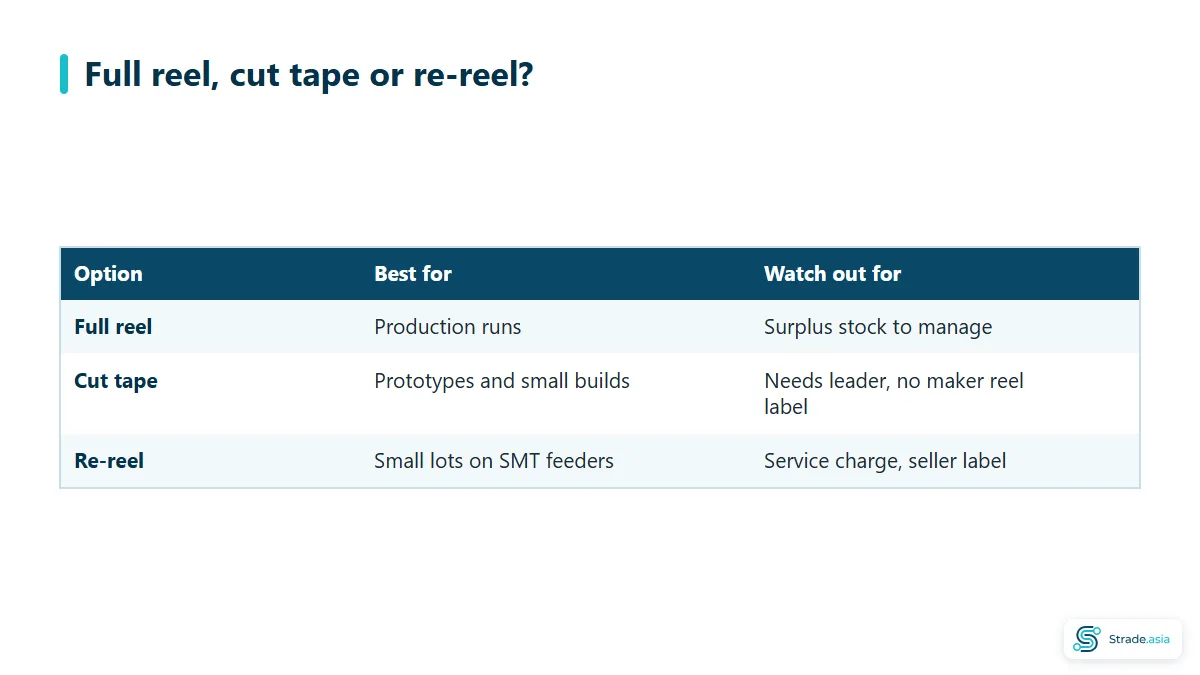
Surface-mount parts usually ship on tape and reel. If you need fewer pieces than a reel holds, there are three options:
- Full reel. Lowest unit price, factory packaging intact, and labels and date code traceable to the manufacturer. Ideal for production, but you may buy more than you need.
- Cut tape. A length cut from a reel. Cheaper in total for small quantities, but a short strip may not load on a pick-and-place feeder without a leader, and the original reel label is not on it. Unless you ask for one continuous strip, a seller may ship several short pieces, sometimes with different date codes.
- Re-reel. Cut tape wound onto a new reel with leader and trailer, so it can be fed by machine. Usually carries a service charge.
Our article on tape and reel, tray and tube packaging explains the formats in more detail. For moisture-sensitive parts, opening a dry pack to split it also starts the floor-life clock, as covered in MSL storage and baking.
Price breaks
Quotes often show several prices at different quantities. The breaks usually follow pack sizes: one price for cut tape, one for a full reel, and lower prices for several reels. Look at the total cost, not only the unit price. Sometimes a full reel costs little more in total than the cut-tape quantity you asked for, and the extra parts cover losses on the line.
SMT lines lose some parts during setup and placement, so the quantity you need is usually a little more than the BOM quantity multiplied by the build quantity. Agree an attrition allowance with production and include it in the RFQ.
Reading a quote
When the quoted quantity differs from your request, check:
- Quantity. Was it rounded up to the MOQ or SPQ?
- Packaging. Full reel, cut tape, tray, tube or bulk? Is re-reeling included?
- Multiples. Must later orders also be in full packs?
- Date code. Does a split reel come from older stock? Ask for date code limits if your customers set them.
- Lead time by quantity. Stock may cover a small quantity now, with the balance coming from the factory later.
- Cancellation terms. Full-reel and factory orders are often non-cancellable and non-returnable.
Balancing cost and stock
Rounding up to full packs leaves surplus. That surplus is not always waste: it can cover the next build, attrition on the line or repairs. But across hundreds of BOM lines it adds up. A few rules help:
- Round up for cheap, common passives where the surplus will be used.
- Buy cut tape for expensive parts, prototypes and pilot runs.
- Share packs across products that use the same part number.
- Review slow-moving surplus regularly; our article on excess component inventory lists the options.
Labels and traceability
A full reel carries the manufacturer’s label with part number, quantity, date code and lot code. Cut tape and re-reeled parts rely on the seller’s labels. Make sure that label still shows the manufacturer part number, date code and lot, and keep the supporting documents with the receipt. Our guide to reading component labels and barcodes covers what to check at goods receipt.
How Strade can help
Strade is an independent electronic component distributor with its own engineers, supplying factories in Vietnam and across Asia. Most of our orders are bought to the customer’s request, from manufacturers, their distributors and vetted open-market suppliers. Every lot is inspected on receipt, including labels, date codes and packaging, and parts are packed against static and handled to their moisture sensitivity level.
When you request a quote, tell us the quantity you need, the packaging your line can use and any date code limits, so the quote matches how you build. Send us your BOM or part list in Excel, CSV or PDF.