
 한국어
 Bahasa Indonesia
 ไทย
 中文 (中国)
 Tiếng Việt
Before the Tet holiday, many factories in Vietnam place orders to cover the first weeks of the new year, and some of those parts will arrive in a form the production line did not expect. The same manufacturer part number can often be supplied on tape and reel, as cut tape, in a tray or in a tube. The format is usually set by a suffix in the ordering code, and getting it wrong costs time at the line: parts that will not fit the feeders, manual placement, re-reeling charges or extra handling of moisture-sensitive devices.
This guide covers the main formats and what to check when you order.
Tape and reel
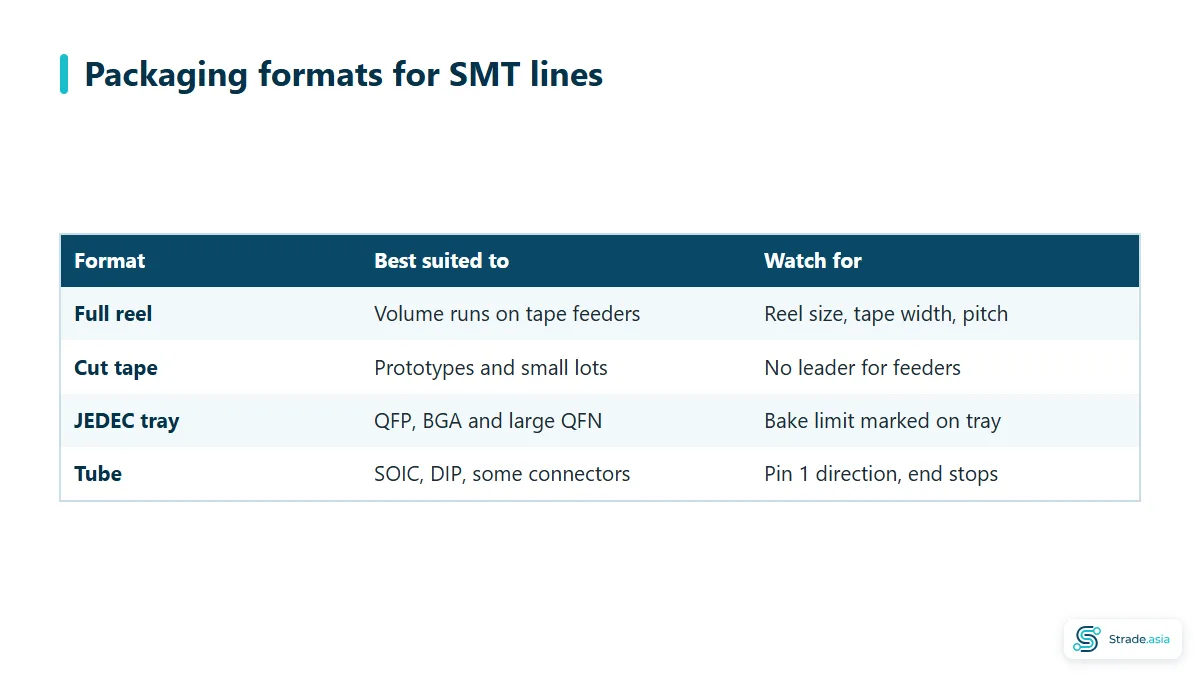
Most SMT parts are supplied on tape and reel, as defined in the EIA-481 standard. The parts sit in pockets in a carrier tape, sealed by a cover tape, and the tape is wound on a reel. Small passives usually come in punched paper tape; larger parts and ICs in embossed plastic tape.
Points to check:
- Tape width and pitch. These must match your feeders. Chip resistors and capacitors typically use 8 mm tape; larger ICs and connectors use 12 mm, 16 mm, 24 mm or wider tape.
- Reel diameter. The common sizes are 7 inch (178 mm) and 13 inch (330 mm), and the same part may be offered on both with different quantities per reel. Check that your feeder banks and reel holders accept the larger size before you order it.
- Leader and trailer. EIA-481 calls for a length of empty, sealed pockets at the start (leader) and the end (trailer) of the tape so that it can be threaded into a feeder. A reel without a proper leader wastes parts or needs splicing.
- Orientation. The standard defines where pin 1 sits in the pocket, but orientation can differ between manufacturers for the same package. Check it against the placement program whenever the source changes.
Cut tape and re-reeling
When you need less than a full reel, distributors cut a strip from the reel. Cut tape is fine for prototypes and hand assembly, but short strips without a leader are hard to load on a feeder and often lead to lost parts. For production, either splice the strip onto a leader at the line or ask for the parts to be re-reeled: wound onto a new reel with a leader and trailer added. Re-reeling usually carries a fee, so compare it with the price of a full reel when the quantity is close. Ask also whether the new reel keeps the manufacturer label, or at least a label with its part number, lot and date code, and for moisture-sensitive parts confirm that cut or re-reeled lots are resealed in a dry pack with a fresh humidity indicator card, desiccant and caution label. Our guide to reading date codes explains why that matters.
JEDEC trays
Large or fine-pitch ICs, such as QFP, BGA and some QFN packages, often come in JEDEC matrix trays. Trays protect the leads and balls, and they stack in a standard outline that tray handlers accept. Many trays are rated for high-temperature baking, which helps with moisture-sensitive parts: the devices can be baked in the tray without being moved. Check the temperature moulded into the tray before you bake. Partial trays should be covered and strapped, because loose parts can shift and damage their leads.
Tubes
Tubes, also called rails or sticks, are used for SOIC, DIP, PLCC and some connectors and power packages. They suit through-hole assembly and low-volume SMT with stick or vibratory feeders. Watch the direction of pin 1 when parts are loaded, and the end stoppers: a tube that opens in transit spills parts that should not go back into production without inspection.
Packaging and moisture control
For moisture-sensitive devices, the format affects how you manage floor life. These parts are shipped in a dry pack: a moisture barrier bag with desiccant, a humidity indicator card and a caution label. If floor life is exceeded, J-STD-033 allows baking, but standard plastic tape, reels and tubes cannot take high temperatures. Parts in tape or tubes need a long, low-temperature bake in dry air, or must be moved to high-temperature trays first, while parts already in high-temperature trays can be baked directly. Our article on moisture sensitivity levels covers floor life and baking in more detail.
Whatever the format, treat incoming parts as ESD-sensitive from the moment the carton is opened, as described in ESD control in the receiving area.
What to state on your order
- The full ordering code, including the packaging suffix.
- Full reel, cut tape or re-reel, and the reel size your line accepts.
- Tray or tube, when the part is offered in more than one format.
- Dry pack, and whether the original manufacturer labels must be kept.
- Any leader and trailer length your feeders need when you order re-reeled parts, or extra quantity if you buy cut tape to splice in-house.
How Strade can help
Strade is an independent electronic component distributor with its own engineers, supplying factories in Vietnam and across Asia. Every lot is inspected on receipt, including part number, labels, date code and packaging, and parts are packed against static and handled for moisture according to their MSL. If you are ordering ahead of Tet, send us your BOM with your packaging needs, and we will quote the format that fits your line.


