한국어
 Bahasa Indonesia
 ไทย
 中文 (中国)
 Tiếng Việt
On 3 July, China’s Ministry of Commerce and the General Administration of Customs announced export controls under which a list of gallium and germanium products will need an export licence from 1 August. Exporters will have to apply for permission and state the end user and end use. For most factories in Vietnam these metals never appear on a purchase order, so the news is easy to ignore. It should not be: gallium and germanium sit at the start of the supply chain for several kinds of components, and China is the leading producer of both metals, according to the US Geological Survey.
What the controls cover
The list covers metals, compounds and some semi-finished materials rather than finished components. On the gallium side it includes gallium metal and compounds such as gallium nitride, gallium arsenide, gallium oxide and gallium phosphide. On the germanium side it includes germanium metal, germanium dioxide, germanium tetrachloride and germanium substrates for epitaxial growth, among other items.
A licence requirement is not a ban. Exports can continue once licences are granted, but the process adds paperwork and time, and nobody outside the licensing authority knows yet how quickly applications will be approved or how many will be.
Which components depend on gallium and germanium
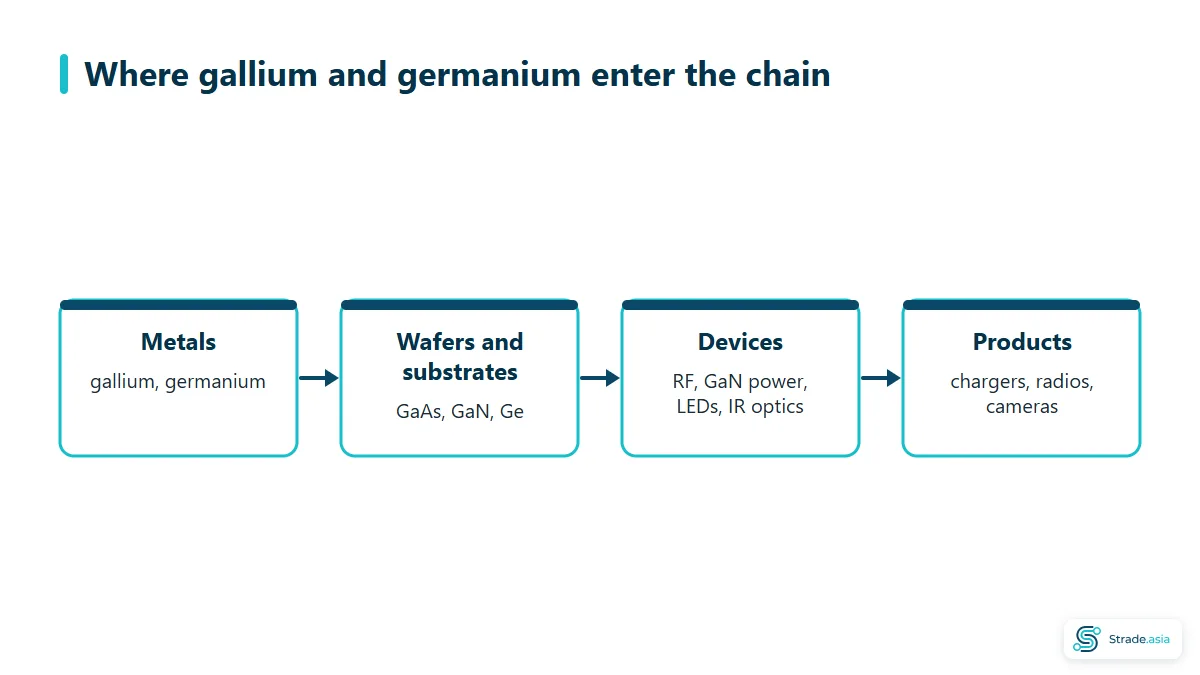
- RF devices. Gallium arsenide and gallium nitride are used in power amplifiers and front-end chips for phones, Wi-Fi, base stations, satellite links and radar.
- GaN power transistors. GaN switches are now common in compact USB chargers and are moving into server and industrial power supplies; our article on USB Power Delivery charger components shows where they sit in a charger.
- LEDs and laser diodes. Most LEDs and many laser diodes are built on gallium compounds.
- Infrared optics. Germanium is a standard lens and window material for thermal imaging cameras and some sensors.
- Optical fibre and high-speed chips. Germanium compounds are used in making optical fibre, and silicon-germanium processes are used in some RF and high-speed devices.
- Space solar cells. Multi-junction solar cells for satellites are often grown on germanium substrates.
Ordinary silicon parts, passive components and most connectors do not depend on these materials in any meaningful way.
What to expect
Device makers and wafer suppliers usually hold stocks of raw materials, and there are producers outside China, so a sudden shortage of finished components is not the most likely short-term effect. Because the licences apply to metals, compounds and semi-finished materials such as wafers leaving China, not to finished devices, the main exposure is for wafer and device makers outside China that buy Chinese material; makers inside China are not subject to the export licence. The questions are how long licensing takes, how much material is approved, and whether buyers react by building stock. Some gallium and germanium production elsewhere could be restarted or expanded, but that takes time.
We have seen similar materials shocks before. Japan’s 2019 controls on materials for Korean chipmakers, covered in Japan-Korea export controls on materials, and the halt of Ukrainian neon output in 2022, described in the war in Ukraine, neon and palladium, both caused concern well beyond their direct effect on parts supply. In both cases, careful questions to suppliers did more good than panic buying.
What buyers should do now
- Map the exposure. List the BOM lines built on GaN, GaAs or other gallium compounds, LEDs and laser diodes, and any germanium optics or modules.
- Ask suppliers about their material sourcing. Ask device makers and distributors whether their wafer or material supply depends on exports from China, what stock they hold, and whether they expect allocation.
- Watch lead times, surcharges and quotation validity on the affected lines, and record any changes in the ERP so planners see them; price increases and quotation validity covers what to check in an offer.
- Avoid panic buying. Extra orders placed by many buyers at once can create the shortage everyone fears.
- Keep design alternatives in view. Silicon MOSFETs can replace GaN in some power designs, at a cost in size or efficiency; that is a design decision, not a purchasing swap.
- Keep your own export compliance in mind. If you export products to customers who ask about material origin, keep supplier declarations on file.
How Strade can help
Strade is an independent electronic component distributor with its own engineers, supplying semiconductors, power products and other components to factories in Vietnam and across Asia. We buy from manufacturers, their distributors and vetted open-market sources, and we can ask suppliers about material sourcing and lead times on the lines you are concerned about. Where a part becomes hard to find, our engineers can propose alternates with matching specifications for your team to approve.
Send us the GaN, GaAs, LED or optical lines on your BOM and we will check current availability.