한국어
 Bahasa Indonesia
 ไทย
 中文 (中国)
 Tiếng Việt
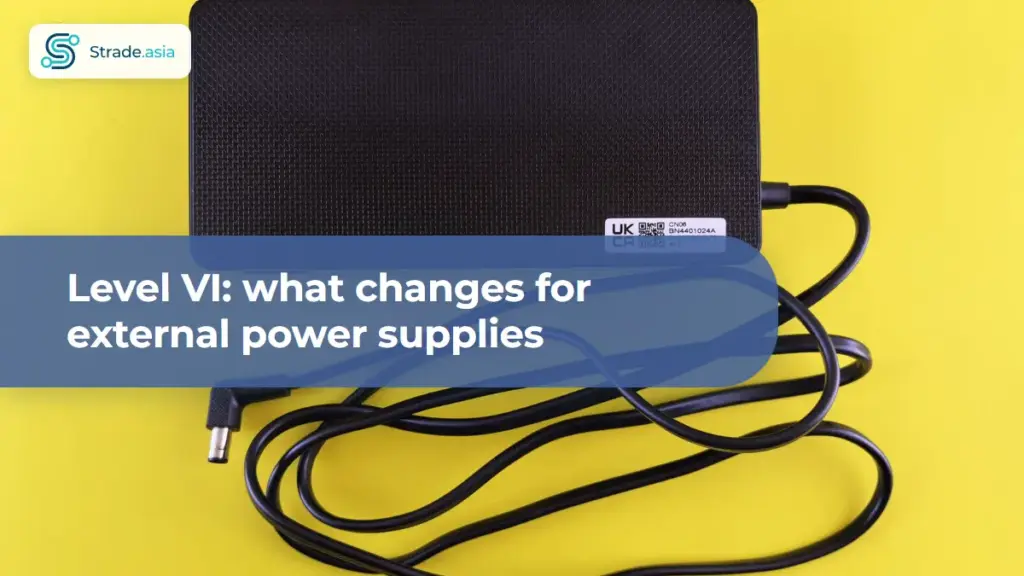
Since 10 February, external power supplies manufactured in or imported into the United States must meet a stricter efficiency standard from the US Department of Energy (DOE), known as Level VI. If your factory ships products to the US with an adapter or charger in the box, or buys adapters as finished parts for a product kit, this rule affects you even though the adapter is not your own design.
What Level VI covers
An external power supply (EPS) is a power supply in a separate housing from the product it powers: typically a wall-plug adapter or a desktop “brick” that converts mains AC to a lower DC or AC voltage. The DOE rule sets limits on two measurements:
- No-load power. The power the adapter draws from the mains when it is plugged in with nothing connected to its output.
- Average active-mode efficiency. The efficiency measured at 25, 50, 75 and 100 percent of rated output, then averaged.
The limits depend on the adapter’s rated output power, and on whether it is a low-voltage design. Level VI is stricter than the earlier US requirement, which matched Level IV, and stricter than the Level V that many adapters already met. It also brings adapters with more than one output voltage, and high-power units, under the rule. Indirect-operation power supplies, which cannot run the end product without its battery, such as dedicated battery chargers, stay under the earlier limits from 2007, while adapters that can power the product directly must meet Level VI. Check the DOE definitions against each design.
Reading the VI mark
Adapter nameplates use the international efficiency marking protocol: a Roman numeral that shows the level the adapter meets. A Level VI adapter carries “VI”. If the nameplate still shows “V” or “IV”, the unit was designed to an earlier level.
Under US law, importing counts as manufacturing, so for adapters built outside the United States compliance is judged at the date of import, not the factory build date. Level V stock built before 10 February cannot be imported into the US on or after that date; only units already imported may be sold through. Treat V-marked adapters as unsuitable for any new US-bound shipment, and confirm the position with your US importer.
The mark is declared by the adapter maker, and DOE also requires covered products to be certified. A mark on the label is a starting point, not proof.
What buyers should check
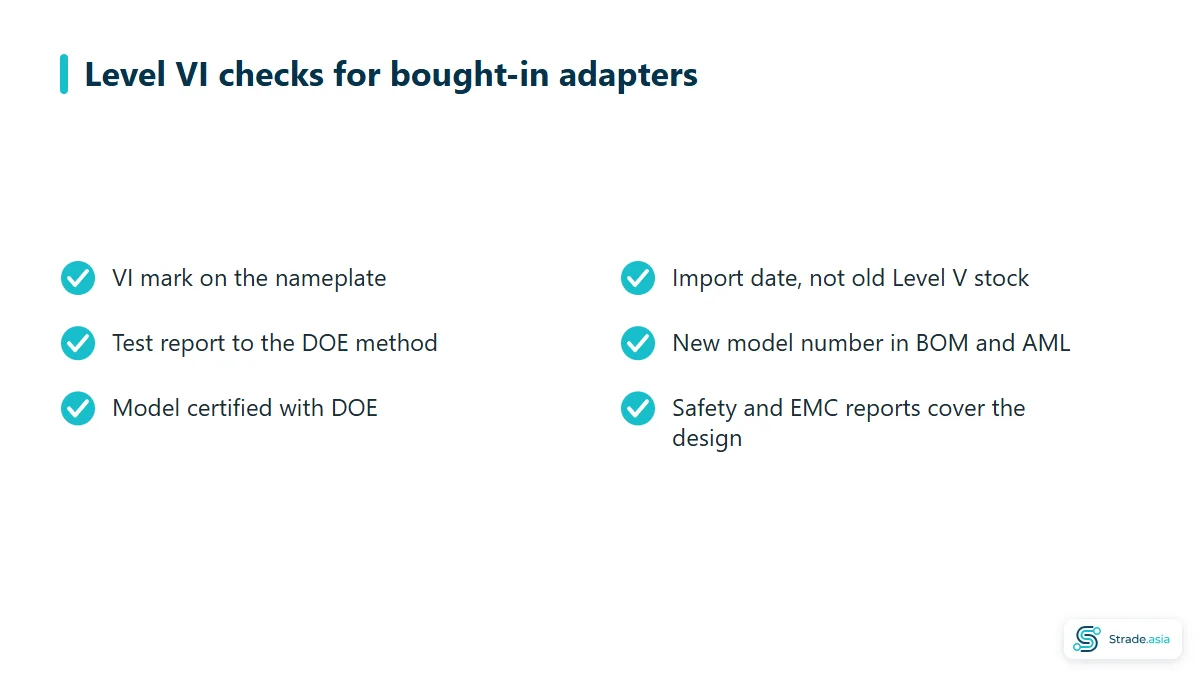
- The nameplate. Check that “VI” appears on samples and on production units, not only in the datasheet or the quotation.
- The test report. Ask the adapter maker for a report showing no-load power and average efficiency measured to the DOE test procedure, for the exact model you buy.
- DOE certification. Ask under which brand and model number the adapter is certified, and confirm the model on your purchase order matches.
- Date code and stock source. Check the date code on the adapter, and be wary of low-priced offers of older Level V stock, which can no longer be imported into the US. Old stock is the most common way a non-compliant unit ends up in a box.
- Model number changes. A Level VI version often has a new model number or suffix. Update your BOM, approved manufacturer list and item master so purchasing does not reorder the old version.
- Safety and EMC. A redesigned adapter is a new product. Make sure its safety certificates and EMC reports cover the new model, not the one it replaced.
What changes inside the adapter
Meeting the tighter no-load and efficiency limits usually means design changes rather than a new label. Many adapter makers have moved to newer PWM controllers with lower standby consumption, and some designs use synchronous rectification on the output. These controller ICs come from a fairly small group of semiconductor makers, some of them involved in last year’s consolidation, which we discussed in what semiconductor mergers mean for your BOM. If you design your own adapters or open-frame supplies, check that the controller you rely on is active and has a second source.
Other markets
Level VI is a US rule. The European Union sets its own requirements for external power supplies under Regulation (EC) No 278/2009, and other countries have their own schemes. The VI mark does not replace CE marking or any other approval. If the same product kit goes to several markets, check the requirements for each destination and choose an adapter that meets the strictest of them, so one part number can serve all.
How Strade can help
Strade is an independent electronic component distributor with its own engineers, supplying factories in Vietnam and across Asia. Power products are our core product group. Our engineers can propose Level VI alternates with matching output, connector and approvals for your team to decide. See our power products.
If your kit includes an adapter that needs checking or replacing, send us the part number or your BOM and we will review the options.