한국어
 Bahasa Indonesia
 ไทย
 中文 (中国)
 Tiếng Việt

Lithium-ion packs are now common in products made in Vietnam: power tools, e-bikes and electric scooters, energy storage, backup power, medical devices and portable instruments. Every one of these packs needs a battery management system (BMS). The BMS keeps the cells within their safe operating limits, estimates how much energy is left and reports to the host equipment. Getting it wrong can mean short pack life at best and a fire at worst, as described in our article on lithium-ion battery safety.
Knowing how a BMS measures, balances and protects the cells, and which components do each job, helps engineers and buyers choose reliable parts and spot single-source risks early.
Cell monitoring
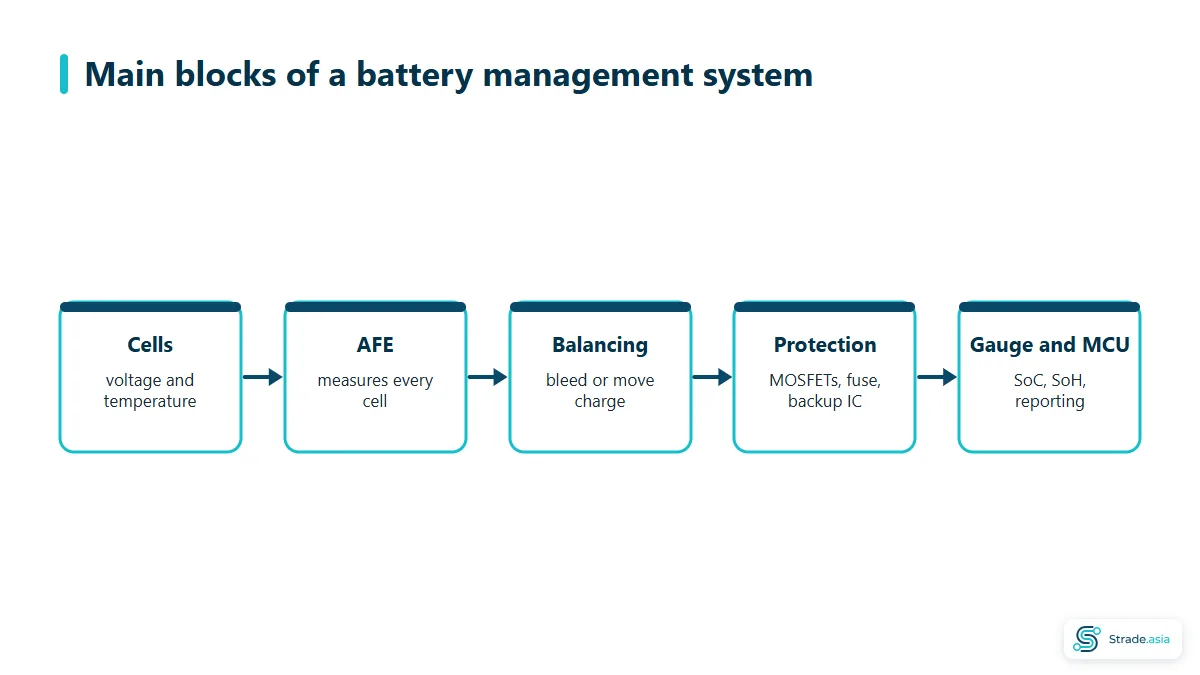
The BMS measures the voltage of every cell, or every group of parallel cells, together with the pack current and several temperatures. In small packs, a single battery monitor IC handles a few series cells. In larger packs, analog front-end (AFE) ICs, each covering a group of cells, are stacked and linked so that a long series string can be measured.
Accuracy matters. Lithium-ion cells have a flat voltage curve in the middle of their charge range, and lithium iron phosphate (LFP) cells, common in energy storage and backup power, are flatter still, so small measurement errors become large errors in estimated charge. Temperature is measured with NTC thermistors on the cells and near the power path.
Cell balancing
No two cells are identical. Over many cycles, small differences in capacity and self-discharge make cells drift apart, and the weakest cell then limits the whole pack. Balancing corrects this:
- Passive balancing bleeds charge from the highest cells through resistors, switched in or next to the AFE. It is simple and low cost, but turns energy into heat.
- Active balancing moves charge from high cells to low cells with inductors, transformers or capacitors. It is more efficient but adds parts and cost.
Most industrial and consumer packs use passive balancing. The balancing resistors need a suitable power rating and placement that spreads the heat.
Protection
Protection is the most safety-critical function. The BMS must disconnect the pack on over-voltage, under-voltage, over-current, short circuit and over- or under-temperature. Typical building blocks:
- Protection MOSFETs, usually two connected back-to-back so that both charge and discharge can be blocked. Low Rds(on) keeps losses down, and the MOSFETs must survive short-circuit current until they switch off. In high-voltage energy storage packs, DC contactors with a pre-charge circuit often take their place in the main current path.
- A gate driver for those MOSFETs, often inside the AFE or protection IC, sometimes with a charge pump for high-side switching.
- Secondary protection: an independent over-voltage IC that, on a fault, typically triggers a three-terminal fuse with a built-in heater (often called a chemical fuse), as a backup if the primary system fails. Any fuse in the pack must be rated for DC at the full pack voltage; our guide to choosing a fuse for power circuits covers ratings and breaking capacity.
Current sensing and fuel gauging
Current is usually measured with a low-value shunt resistor and an amplifier or ADC, and sometimes with a Hall-effect sensor in high-current packs. Shunts for this job need low resistance, a low temperature coefficient of resistance (TCR) and a Kelvin connection for accuracy, either through a four-terminal shunt or through sense traces taken from the pads of a two-terminal one.
The fuel gauge estimates state of charge (SoC) and state of health (SoH). Methods include coulomb counting, which integrates current over time, voltage-based estimation and models that track cell impedance. Dedicated gauge ICs combine these methods; in larger systems, a microcontroller runs the algorithm.
Communication
The BMS reports to the charger and the host equipment. Small packs often use I²C or SMBus. Larger packs, such as energy storage systems, use CAN or other robust buses, and stacked AFEs in high-voltage packs talk to each other through isolated daisy-chain links. Isolation components, such as digital isolators or small transformers, then become part of the BOM.
Notes for buyers
- AFE and gauge ICs are often single-source. Pin-compatible alternates from another maker are rare, and the firmware, or the cell-chemistry data programmed into a gauge, may depend on the chosen IC. Plan stock and lifecycle with care, follow change notices, and inspect open-market lots closely, as with any widely used IC.
- MOSFETs and shunts have more alternates, but check Rds(on) at the real gate voltage, the package and thermal performance before switching.
- Thermistors and fuses must match the design exactly: resistance at 25 °C and B value for NTC thermistors, DC voltage rating and breaking capacity for fuses. A “similar” part can shift protection limits or fail to clear a fault.
- Cells and packs need documents for transport, including UN 38.3 test summaries; see shipping lithium batteries.
- Keep approvals together. Store the records for safety-related parts in one place, so a change to any of them can be reviewed against the pack’s certification.
How Strade can help
Strade is an independent electronic component distributor with its own engineers, supplying factories in Vietnam and across Asia, with power products as a main focus. We source battery monitor and protection ICs, MOSFETs, shunt resistors, fuses, thermistors and connectors, and every lot is inspected on receipt. When a part is short or discontinued, our engineers can propose an alternate with matching specifications for your team to approve. See our range of power products.
To check prices, availability and alternates for your BMS parts, send us your BOM.