한국어
 Bahasa Indonesia
 ไทย
 中文 (中国)
 Tiếng Việt

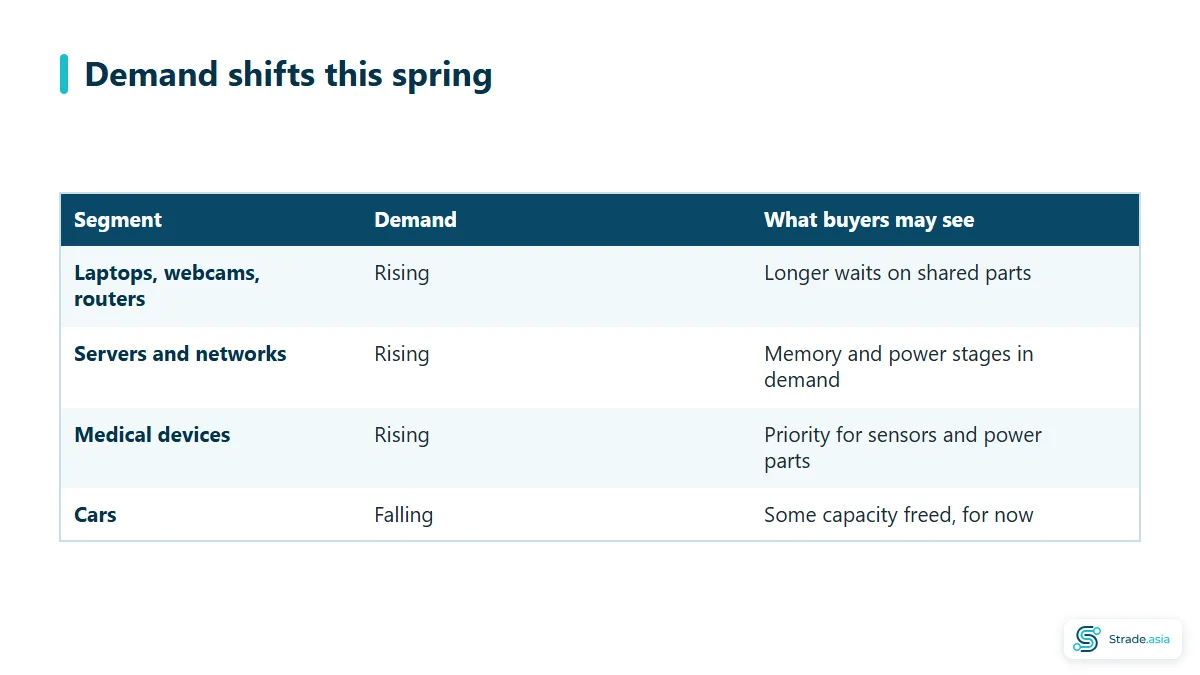
Within a few weeks, the way people work and study changed in many countries. As offices and schools closed, households and companies bought laptops, monitors, webcams, headsets and Wi-Fi routers. Video calls and online services pushed up demand for servers and networking equipment in data centres. Hospitals needed ventilators, patient monitors and thermometers in large numbers.
At the same time, other markets slowed sharply. Car plants in Europe, North America and other regions stopped for weeks, and many are only now restarting. Orders for some industrial equipment have been delayed as companies hold back investment.
For component buyers, the result is neither a general shortage nor a general surplus. It is a shift: some part families are tighter, others easier, and the picture can change from month to month.
Where supply is tighter
Products for home working share many components with the industrial and power equipment made in Vietnam:
- Power management ICs, DC-DC regulators and power MOSFETs used in notebooks, docks, adapters and server power supplies.
- MLCCs and other passives, used in large numbers on every notebook and router board. If you qualify an MLCC alternate, check its capacitance under DC bias, as explained in choosing MLCC alternates.
- Memory, as cloud providers and PC makers buy both DRAM and flash. Our note on buying memory in a downturn described a very different market only a year ago.
- Wi-Fi, Ethernet and USB interface chips, along with the connectors and magnetics around them.
- Image sensors and audio parts for webcams and headsets.
- Sensors, microcontrollers and power parts for medical devices such as ventilators, patient monitors and infrared thermometers, where many makers give priority to equipment needed in hospitals.
Where demand rises quickly, suppliers ship from stock first, and then quoted lead times grow. For some parts, suppliers may limit how much each customer can order; our guide to allocation explains how that works.
Where supply is easier, for now
Some suppliers that serve carmakers and their tier-one suppliers have seen orders cut or pushed out. Part of that capacity may be used for other markets, and stock of some automotive and industrial parts may be easier to find than at the start of the year. Buyers should not assume this will last. When car plants return to normal output, their orders will come back, and lead times on part families shared with automotive may tighten again. Where a commercial-grade part is tight, an automotive-grade (AEC-Q) version of the same device can sometimes serve as an alternate, usually at a higher price, once engineering has checked the datasheet and ordering details. Surplus stock offered on the open market needs the same checks of source and date codes as any other lot.
Why mixed signals are hard to plan for
The difficulty for a factory buyer is that one BOM may contain both kinds of part. A motor drive or a power supply uses the same regulators, MLCCs and interface chips that notebook makers want, alongside parts whose demand has fallen. Lead times on a single BOM may now range from easy to stretched.
Forecasts are also less reliable than usual. Your own customers may have changed their order patterns, and suppliers find it hard to tell short-term stocking from lasting demand. Distributors and manufacturers tend to serve first the customers whose forecasts are clear and stable.
What buyers can do
- Review the BOM by part family. Mark parts used heavily in notebooks, networking, servers and medical equipment. Those are the most likely to tighten.
- Ask for lead times regularly. Check quoted lead times for critical parts every few weeks instead of relying on the last quote.
- Share a clear forecast. Give suppliers your best view of demand for the coming months, and update it when it changes.
- Order tight parts earlier. Where lead times are growing, order sooner rather than waiting for the usual reorder point.
- Prepare alternates. For single-source parts in tight families, ask engineering to qualify an alternate. Spreading sources across makers and countries, as discussed in dual sourcing across countries, adds further protection.
- Watch the market in both directions. Parts that are easy to buy today may tighten when other industries restart.
How Strade can help
Strade is an independent electronic component distributor with its own engineers, supplying factories in Vietnam and across Asia. Our product groups include semiconductors, passive components, connectors and power products. We buy from manufacturers, their distributors and vetted open-market suppliers, and every lot is inspected on receipt. When a part is short, our engineers can propose an alternate with matching specifications for your team to approve.
If lead times on parts of your BOM are moving, send us your BOM and we will check availability and alternates line by line.