
 한국어
 Bahasa Indonesia
 ไทย
 中文 (中国)
 Tiếng Việt
For years DDR4 has been the default memory in industrial PCs, embedded controllers, networking equipment and single-board computers. That is now changing. Over recent months the major DRAM makers have announced or signalled plans to wind down DDR4 production as they move capacity to DDR5 and to high-bandwidth memory (HBM) for AI servers. DDR4 prices have started to rise as buyers react. Timelines differ by maker and by part, and many details are still unclear, but the direction is not.
For consumer PCs the change is routine: new platforms already use DDR5. For factories building industrial and embedded products it is harder. These products are often built unchanged for many years, and many of the processors, SoCs and FPGAs inside them support DDR4 or LPDDR4 but not DDR5. Replacing the memory can mean replacing the processor, the board layout and the software that runs on it.
Why DDR4 matters more in industrial products
- Long product life. A controller or monitoring unit designed around DDR4 may need to be built for many years after launch, long after consumer products have moved on.
- Memory soldered on the board. Many embedded designs place DDR4 chips directly on the PCB instead of using a module. A change in chip organisation or density can require layout and timing work.
- Temperature grade. Industrial products often need extended-temperature parts, which come from fewer product lines and can be harder to replace.
- Qualification cost. Every memory change needs validation: boot tests, stress testing at temperature and, in some industries, customer approval.
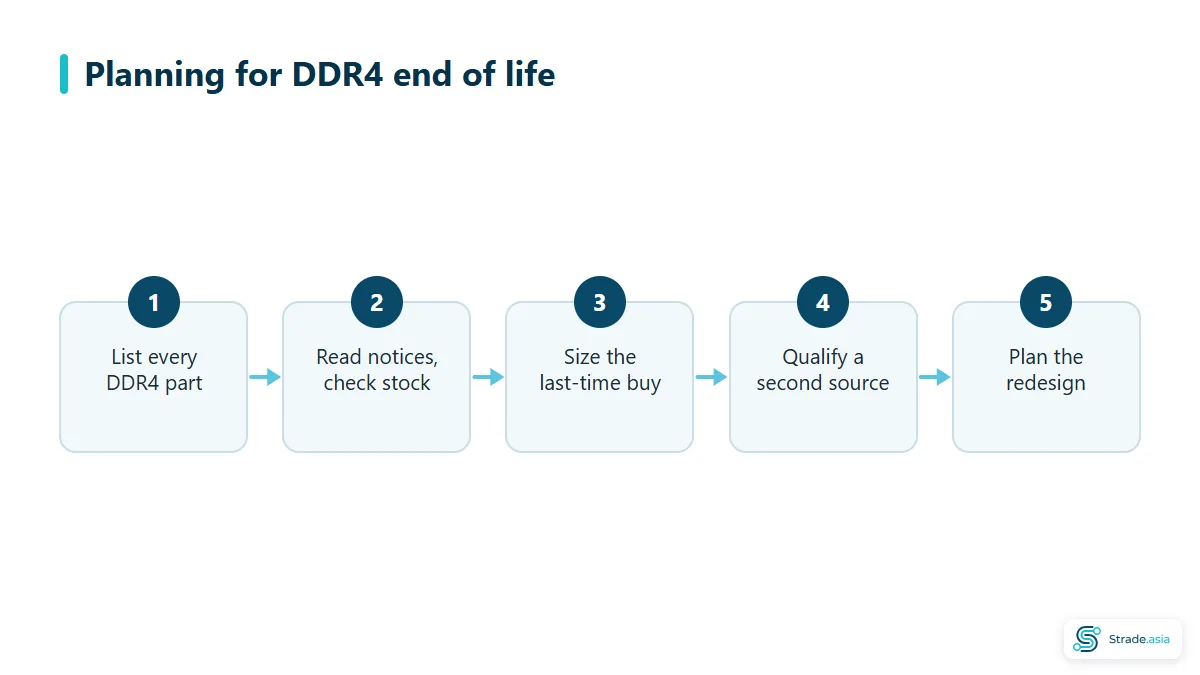
Step 1: Find every DDR4 part
Search your BOMs and approved manufacturer lists for DDR4 chips and modules (UDIMM, SODIMM and industrial modules). For each one, record the full part number, density, organisation (x8 or x16), speed grade, temperature grade, package and the products that use it. Include spare parts and service stock, which are easy to forget.
Step 2: Read the notices and check the market
Ask your suppliers whether an end-of-life or last-time-buy notice has been issued for each part, and what the last order and last shipment dates are. Where no notice exists yet, ask about allocation and lead time, and ask again every month. This is also a good moment to review how your team is handling PCN and EOL notices: who receives them, who decides and how fast.
Step 3: Size the last-time buy
A last-time buy should cover the remaining life of the product, not just the next order. Work out:
- Remaining production volume by year, plus service and warranty needs.
- Yield loss and scrap at assembly.
- Storage conditions: memory chips are moisture sensitive and need dry packing and controlled storage according to their MSL rating.
- Cash and storage cost, compared with the cost of a redesign.
Buying too little forces an emergency redesign later. Buying too much ties up cash in parts that may never be used. Rising prices make the decision harder, so agree the numbers with finance early.
Step 4: Qualify a second source
DDR4 is a JEDEC standard, so parts from different makers with the same density, organisation, speed grade and package are often close replacements. Close is not identical. Timing parameters, behaviour at high temperature and module SPD data can differ, so each alternate needs testing in the real product. Some specialist suppliers aim to keep older memory generations available to industrial customers for longer than the large makers; ask about their longevity plans in writing.
Remarked and refurbished memory also tends to appear when a generation becomes scarce. Buy from traceable sources, check labels and date codes, and test samples before production.
Step 5: Plan the redesign
For products with a long future, a last-time buy only buys time. Use that time to plan a move to DDR5 or newer LPDDR generations where the processor supports them, or to a newer processor platform. The principles of designing for availability apply here: choose memory and processors with a clear roadmap and more than one source.
What to do this month
- List all DDR4 parts and the products that depend on them.
- Ask each supplier for the lifecycle status of each part in writing.
- Agree a last-time buy quantity for every product with a long remaining life.
- Start sample testing of at least one alternate per part.
- Put redesign candidates into the next engineering plan.
Memory prices move in cycles, as buyers saw when memory prices recovered in late 2023. An end of life is different: once a generation stops being made, it does not come back.
How Strade can help
Strade Asia is an independent electronic component distributor with its own engineers, supplying factories in Vietnam and across Asia. We source from manufacturers, their distributors and vetted open-market sources, and inspect every lot on receipt, with X-ray or sample testing for sensitive parts or on request. When a part is short or end-of-life, our engineers propose alternates with matching specifications, and you decide. To check DDR4 availability or alternates, send your BOM through our RFQ page or browse our semiconductor range.


