
 한국어
 Bahasa Indonesia
 ไทย
 中文 (中国)
 Tiếng Việt
RCEP, the Regional Comprehensive Economic Partnership, has been in force since 1 January for ten of its fifteen signatories: Australia, Brunei, Cambodia, China, Japan, Laos, New Zealand, Singapore, Thailand and Vietnam. South Korea joined on 1 February, and the other signatories will follow as they complete ratification. For a factory in Vietnam that imports components from China, Japan or Korea and exports around the region, RCEP adds one more option to a long list of free trade agreements. Whether it saves money depends on rules of origin and on the paperwork.
When the agreement was signed in November 2020, we looked at what RCEP means for electronics trade. Now that it applies, the questions are practical: which goods qualify, how origin is proven, and when another agreement is the better choice.
What RCEP changes, and what it does not
- New pairs of partners. RCEP is the first free trade agreement between China and Japan, and between Japan and South Korea. For goods moving between those countries, it opens a preferential route that did not exist before.
- Overlap for Vietnam. Vietnam already has agreements with every RCEP member, through ATIGA, ACFTA, AKFTA, AJCEP, AANZFTA and bilateral deals with Japan and Korea. RCEP replaces none of them; for each shipment, the importer can use whichever works best.
- Phased tariff cuts. Some tariff lines are duty-free from the first day; others fall step by step over many years. Each member has its own schedule, and some apply different rates depending on which member the goods come from.
- A smaller gain on many chips. Many semiconductors and other IT products already enter at zero duty under the WTO Information Technology Agreement. The benefit is larger for finished equipment, sub-assemblies and parts that still carry duty, such as some cables, transformers, batteries and enclosures.
How origin works under RCEP
Only originating goods get the RCEP rate. A product originates in a member if it is wholly obtained there, made entirely from originating materials, or meets the product-specific rule for its HS code. For most electrical and electronic products, that rule offers a choice: a change in tariff classification, where the finished product falls under a different heading from its non-originating inputs, or a minimum regional value content. The exact rule depends on the HS code, so check the annex for your product rather than assume.
Cumulation
The feature that matters most for electronics is cumulation. Materials that originate in any RCEP member count as originating when they are used in another member. A power supply assembled in Vietnam from Japanese capacitors, Chinese magnetics and Korean ICs can count all of those inputs toward RCEP origin, as long as each supplier can show that its parts are RCEP-originating.
Proof of origin
Origin is shown with a certificate of origin, Form RCEP, issued by the designated body in the exporting member, or with an origin declaration made by an approved exporter. Back-to-back proofs of origin let goods pass through an intermediate member, for example a regional warehouse, and keep their RCEP status if the conditions are met.
Choosing between agreements
For every import line or export product, compare four things:
- The preferential rate under each agreement that covers the two countries.
- The product-specific rule, and whether your bill of materials meets it.
- The documents your supplier, or your own team, can actually produce.
- What your customer, or their customs broker, expects to see.
A lower rate is worth nothing if origin cannot be proven when customs asks. We expect most importers to keep the forms they already know, such as Form E for Chinese goods, and to turn to RCEP where cumulation makes a product qualify or its rate is lower. The logic is the one we described for CPTPP rules of origin: the best agreement is the one whose rules you can meet and document. If your factory is an export processing enterprise, import duty may not apply at all, but origin still matters for what you export; see our note on delivering components to export processing enterprises.
What to do now
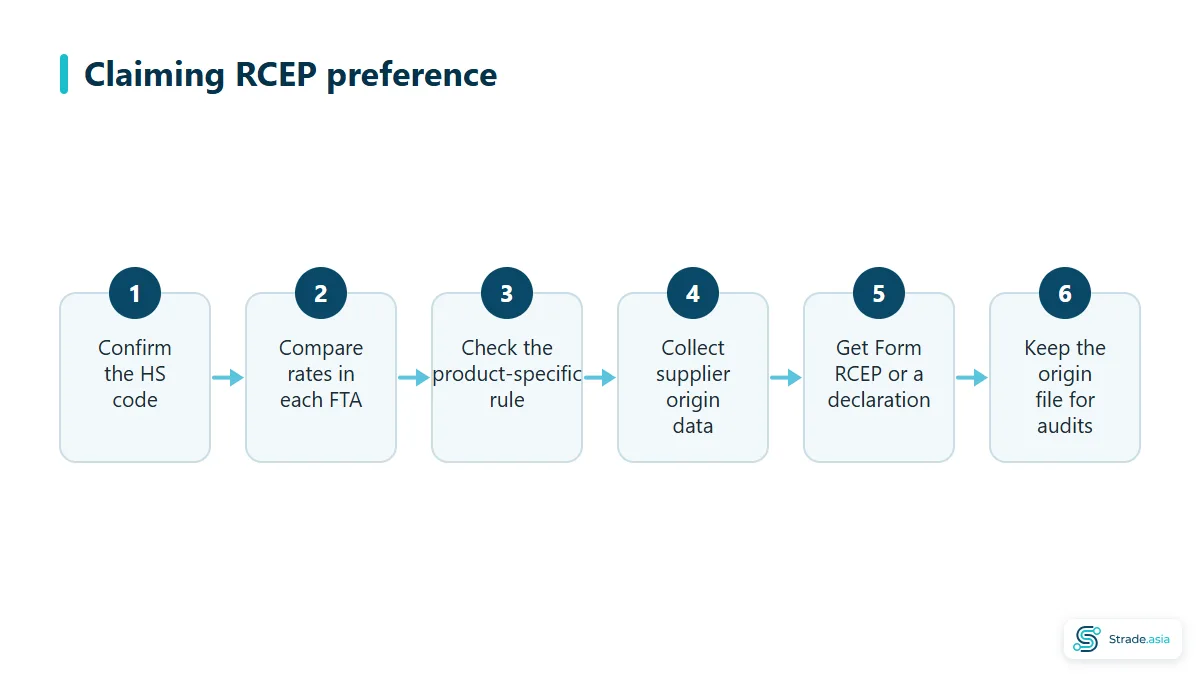
- Confirm the HS code of each finished product and of the main components with your customs broker.
- Ask suppliers in RCEP members whether they can issue Form RCEP, and from when.
- Ask suppliers to state the origin of their parts on their documents, so that you can use cumulation.
- Build an origin file for each product: BOM with HS codes, origin of each input, cost data for the value-content test, and supplier evidence.
- Check how Vietnamese customs is applying the new rules before you file the first claim.
- Compare quotations on landed cost: a supplier that documents origin may end up cheaper than one with a lower unit price.
How Strade can help
Strade is an independent electronic component distributor with its own engineers, supplying factories in Vietnam and Asia. Our services include origin and export documents for Form E, RCEP, CPTPP and EVFTA, with HS code review, and the C/O, CoC and CQ travel with the goods when the source provides them. Deliveries are DDP or DAP to your factory, including export processing enterprises, with customs documents prepared. Read more about origin and compliance, or send your BOM for a quotation and tell us which origin document you need.


