한국어
 Bahasa Indonesia
 ไทย
 中文 (中国)
 Tiếng Việt
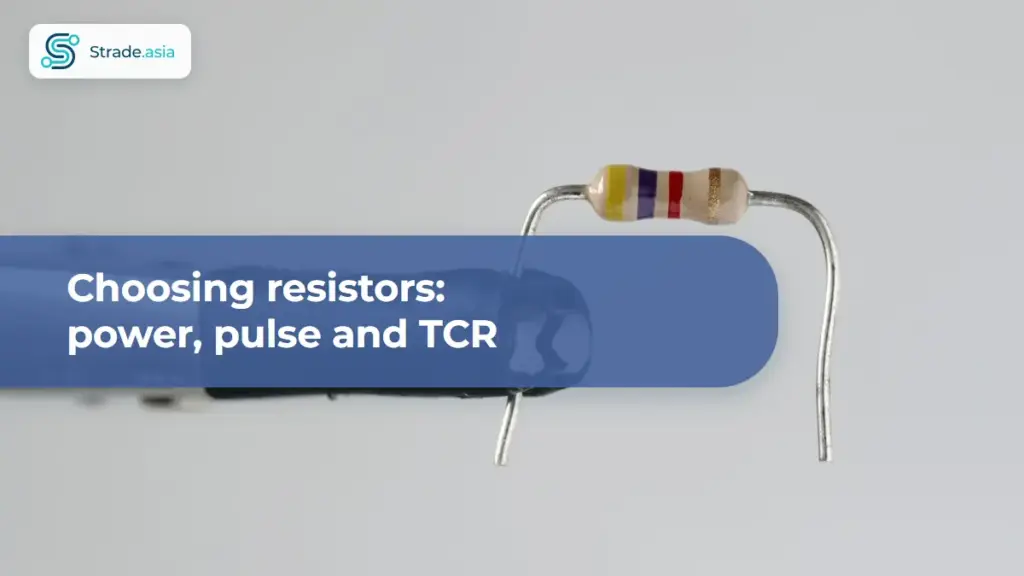
On many boards resistors are the most numerous part and among the cheapest, so they are often chosen by value, tolerance and case size alone. Most of the time that works. When it does not, the failure is expensive: a chip resistor that cracks during a surge test, a measurement circuit that drifts as the cabinet warms up, or a resistor that goes open after a year in an industrial plant. This guide to resistor selection covers the parameters that decide whether a part survives its real job: power rating, voltage, pulse handling, TCR and the environment it works in.
Power rating and derating
The power rating on a datasheet applies only up to a rated ambient temperature, often 70 °C for chip resistors. Above that point the allowed power falls along a derating curve, reaching zero at the maximum operating temperature. Inside an enclosure, next to a power stage or under a heat sink, the local temperature can be far above room temperature, so read the curve at the temperature the part will actually see.
The rating also assumes a test board with a given pad size and copper area. A resistor on small pads, far from copper planes, runs hotter at the same power. Most design rules keep steady dissipation well below the rated value, which also slows long-term drift.
Voltage rating
Every resistor has a limiting element voltage, the highest continuous voltage it can withstand whatever its power rating. The working voltage is the lower of that limit and the voltage that produces rated power, which is the square root of power times resistance. High-value resistors in small case sizes usually hit the voltage limit first.
This matters in mains-powered and high-voltage circuits: voltage dividers sensing a rectified bus, bleeder resistors across DC-link capacitors, and start-up circuits in power supplies. The usual answers are a larger case size, several resistors in series, or a high-voltage series designed for the job. Check the overload and pulse voltage ratings as well, not only the continuous value, as explained in our guide to absolute maximum ratings.
Pulse handling
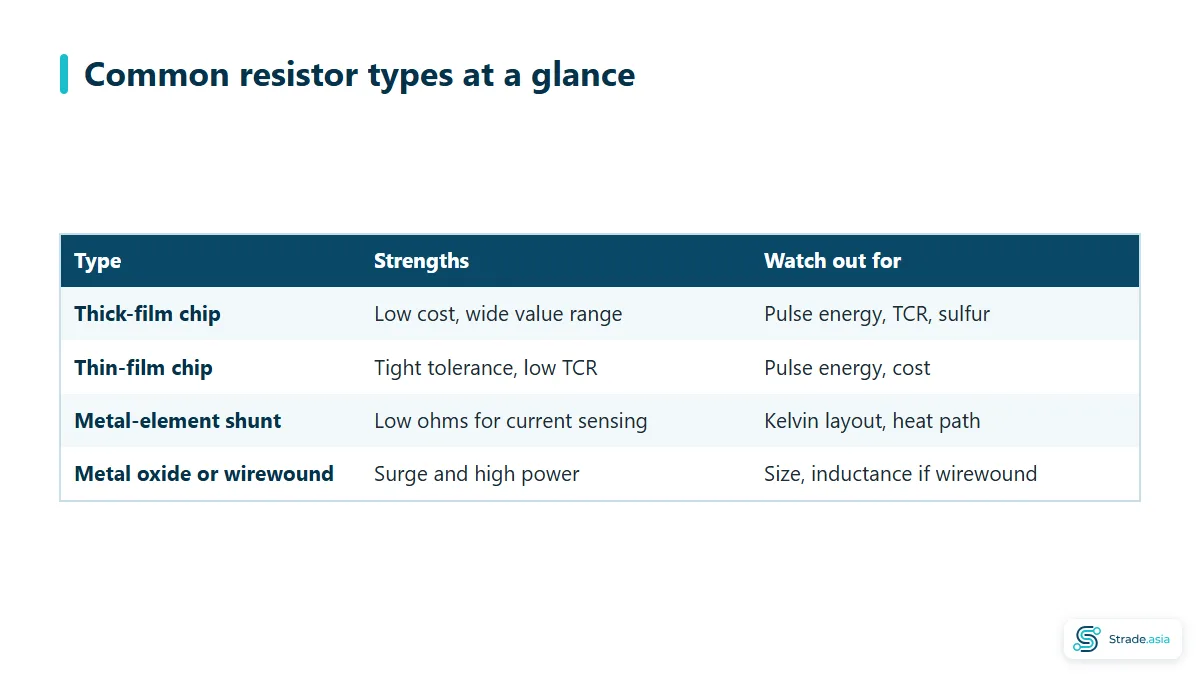
Many resistors see pulses far above their steady rating: inrush limiters, snubbers, gate resistors, discharge circuits and anything exposed to surge or ESD testing. A standard thick-film chip has a thin resistive layer with a laser trim cut, and a short, energetic pulse can damage the narrowest part of that path.
Pulse-withstanding or anti-surge chip resistors use a different layer and trim design to spread the energy. For any resistor that will see pulses, read the single-pulse and repetitive-pulse curves on the datasheet, which show allowed power or energy against pulse duration. Where the energy is high, metal oxide, MELF or wirewound types may be the better choice. Resistors often work alongside surge protection parts, covered in TVS diodes and surge protection.
TCR and stability
The temperature coefficient of resistance (TCR), given in ppm/K, says how much the value moves with temperature. Thick-film chips are commonly specified at ±100 or ±200 ppm/K; thin-film parts reach ±25 ppm/K and better. In precision dividers, reference circuits and sensor front-ends, TCR can matter more than the initial tolerance. Where only the ratio between two resistors matters, a resistor network with matched TCR tracking is often cheaper than two precision parts. Check long-term stability under load too. In warm, humid environments, also check thin-film parts for biased humidity performance, since moisture and voltage together can corrode their thin resistive layer.
Anti-sulfur types
Most chip resistors use silver in their terminations. In air that contains sulfur compounds, the silver slowly turns into silver sulfide, which does not conduct, and the resistance rises until the part goes open. The risk is highest in heavy industry, near rubber processing, in equipment with some rubber gaskets or greases, and in outdoor cabinets. Anti-sulfur resistors use termination materials or structures that resist this attack, and their datasheets usually cite a sulfur exposure test such as ASTM B809. For industrial equipment installed in such environments, the small price difference is easy to justify.
Current sense resistors
Current sensing uses resistors in the milliohm range, where the copper of the pads and traces is a significant part of the total. Points to check:
- Element material and TCR. Metal alloy elements keep TCR low; the copper terminations do not, so layout matters.
- Kelvin connection. Four-terminal parts, or a layout that takes the sense signal from the inner edge of the pads, keep trace resistance out of the measurement.
- Power and pulse. Fault currents can be many times the normal value.
- Heat path. Shunt resistors rely on the board to carry heat away, and some datasheets state the power rating at terminal temperature rather than ambient; follow the recommended pad and copper layout.
Choosing an alternate resistor
Resistors are usually easy to second-source, but “same value, same case size” is not enough, as many buyers found during the chip resistor shortage. An equivalent should match tolerance, TCR, power and voltage ratings, pulse capability, anti-sulfur performance where needed, and qualification such as AEC-Q200 for automotive designs. Write those requirements on the BOM, not just value, tolerance and case size, so that a standard thick-film chip is not quoted for an anti-surge or anti-sulfur part, and record approved options in an approved manufacturer list. Do not over-specify either: thin-film and AEC-Q200 series cost more and have fewer sources.
How Strade can help
Strade supplies passive components, semiconductors and power products to factories in Vietnam and across Asia. Our engineers can check a proposed alternate resistor against the original specification, including pulse and TCR, and the customer decides whether to use it. Each lot is checked on receipt for part number, label, date code and packaging.
Send your resistor lines or full BOM for a quotation, and mention any pulse, voltage or environmental requirements.