한국어
 Bahasa Indonesia
 ไทย
 中文 (中国)
 Tiếng Việt

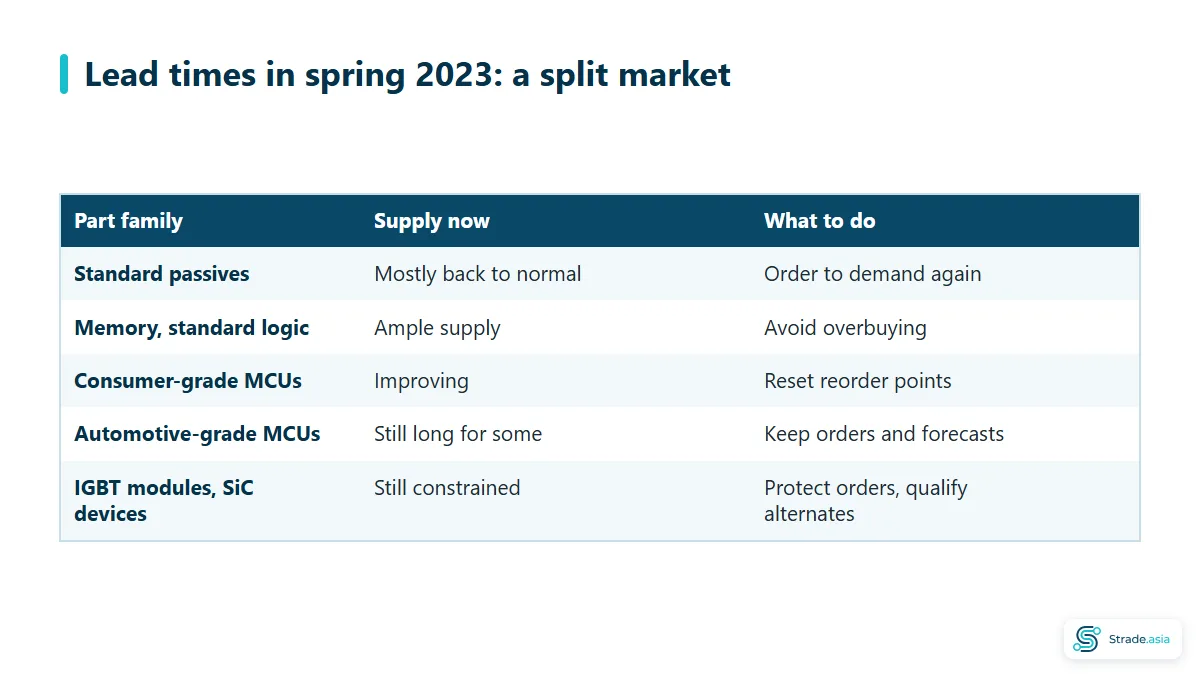
A year ago, almost every component quotation came back with a lead time that made planners wince. This spring the picture is different. Lead-time surveys from distributors and market trackers show that many standard parts are back within normal ranges, and some are available from stock again. It is tempting to read that as “the shortage is over” and to release every buffer at once. That would be a mistake. A small number of part families, most of them power devices and automotive-grade chips, are still constrained, and they are often exactly the parts that stop a line.
Where lead times have come down
The improvement is clearest in parts that serve consumer markets, where demand fell in the second half of last year:
- Standard passive components. Most multilayer ceramic capacitors and chip resistors in common values and case sizes are easy to buy again.
- Memory. DRAM and NAND are in oversupply, and prices have been falling.
- Standard logic, small-signal discretes and many consumer-grade microcontrollers. Lead times have shortened and distributor stock is building up.
As we described last month in inventory correction and NCNR orders, much of this improvement comes from customers working down the stock they built during the shortage, not only from new capacity.
Where they have not
- IGBT modules and discretes used in motor drives, solar inverters, UPS systems and charging equipment.
- Silicon carbide (SiC) MOSFETs and diodes, where demand from electric vehicles and renewable energy is growing faster than substrate and device capacity.
- Some automotive-grade microcontrollers and power management ICs, which are qualified to a specific fab and process and cannot be moved quickly to another site.
- Selected high-voltage and automotive-grade passive components, depending on the series.
For these lines, quoted lead times can still run well beyond a normal planning horizon, and some suppliers continue to allocate output among their customers.
Why the market has split
Three things explain the difference. First, demand: consumer electronics slowed, while electric vehicles, renewable energy and industrial automation kept growing, and all three use large amounts of power semiconductors. Second, capacity: power devices are made on specialised processes, many automotive chips on older, mature process nodes, and new lines and SiC substrate capacity take years to come on stream. Third, qualification: an automotive or industrial customer cannot switch to a part from another fab without requalifying it, so demand cannot simply flow to wherever capacity is free.
The result looks familiar to anyone who planned through 2021. Our article on power semiconductor lead times described the same pressure points, and many of them have not gone away.
What buyers should do now
- Re-baseline lead times line by line. Family averages hide the exceptions. Ask for a current lead time on every line that matters to production, and update planning parameters in the ERP.
- Release buffers gradually, and only where supply has really recovered. Keep safety stock on power devices and automotive-grade parts, and time deliveries of easy parts to match the constrained ones, so that incomplete kits do not sit in the warehouse.
- Keep orders and forecasts in place for constrained lines. Cancelling an IGBT order now may mean starting again at the back of the queue.
- Check allocation agreements. If a supplier still allocates a part, know the rules and keep your forecast current; allocation explained sets out how it usually works.
- Qualify alternates while there is time. For IGBT modules, the second source must match package, pin-out, voltage and current ratings, switching behaviour and thermal performance. That work is slow, so start before the next shortage.
- Review quotation validity. Prices for commodity parts are softening, while prices for constrained power devices may still rise. Short validity periods cut both ways.
Designing for availability
The longer-term answer is in the design. Choosing parts that are made by more than one manufacturer, in standard packages, gives purchasing room to move when one family tightens. Our note on designing for availability lists the design choices that help most, from footprint-compatible packages to approved alternates recorded on the BOM.
How Strade can help
Strade is an independent electronic component distributor with its own engineers, supplying factories in Vietnam and across Asia. Power products are our main product group. We source from manufacturers, their distributors and vetted open-market suppliers, and when an IGBT, SiC device or other constrained part is hard to find, our engineers can propose alternates that match the specification. The customer always decides whether to use them.
If some of your lines still have lead times you cannot accept, send us the part numbers and we will check the sourcing options.