
 한국어
 Bahasa Indonesia
 ไทย
 中文 (中国)
 Tiếng Việt

Not long ago, most microcontrollers and power management ICs could be ordered a few months before they were needed. Today, suppliers are quoting a year or more for many of them, and some will not give a date at all. A quote of 52 weeks, or simply “to be confirmed”, has become a common answer for parts that sit on almost every industrial BOM.
The fire at Renesas’s Naka fab and the shutdowns in Texas added to a shortage that was already deep. For a factory in Vietnam, the practical question is how to keep building when the parts for next spring’s production have to be ordered now.
What a 52-week quote really means
A quoted lead time is the supplier’s current estimate for a new order placed today. It is not a promise. It can lengthen after you order, deliveries may come in partial quantities, and parts on allocation are shared out according to rules you do not control, as explained in allocation explained.
It also tells you where you stand in the queue. An order placed today sits behind every order placed before it. If your production plan for next year depends on a part that has not been ordered yet, that part is already late.
A plan for long lead times
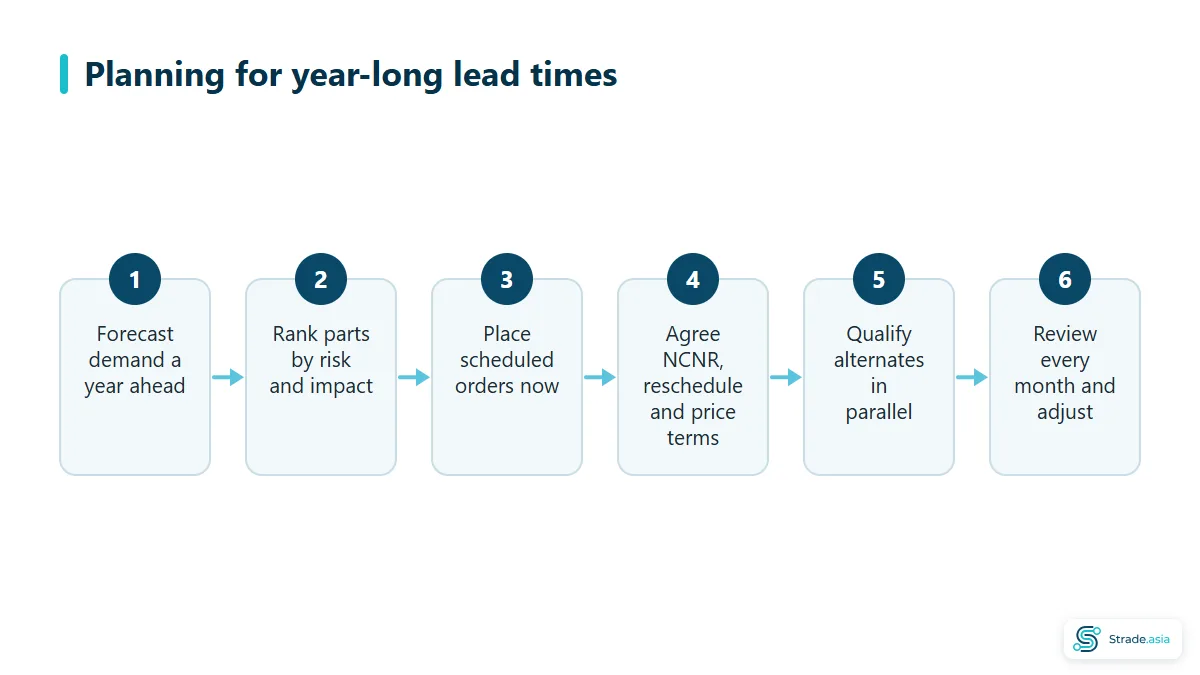
1. Forecast further out
Most factories forecast a few months ahead. For long-lead parts, you need a view of demand for the next year, by part number, even if it is rough. Ask your sales team and your own customers for their plans, and record the assumptions so the forecast can be updated when they change.
2. Rank parts by risk and impact
Not every part needs a year of cover. Mark the parts that combine a long lead time, a single source and the power to stop a line. MCUs, power management ICs, some MOSFETs and certain connectors are typical. Passive parts with many sources usually need less attention.
3. Place scheduled orders now
A purchase order with a delivery schedule, such as monthly quantities over the coming year, puts you in the queue without taking all the stock at once. Check the supplier’s minimum and standard pack quantities so that the schedule makes sense in full reels or trays.
4. Read the terms carefully
Long-lead parts increasingly come with NCNR terms: non-cancellable, non-returnable. Once accepted, you are committed to take and pay for the parts even if your demand falls or the design changes. Before signing, check:
- Whether the price is fixed or set at the time of shipment.
- Whether, and how far ahead, deliveries can be rescheduled.
- What happens if the supplier delivers late or only in part.
- Whether the order is placed with the manufacturer, a distributor or an open-market source.
5. Qualify alternates in parallel
Ordering early does not guarantee delivery. Keep engineering working on second sources for the most exposed parts, starting with the ones that need the least change. If supply arrives first, the alternate is still useful next time.
6. Review every month
Compare forecasts with confirmed dates every month, adjust schedules where terms allow, and escalate any line that slips toward a stoppage.
The risk of ordering too much
When lead times stretch, it is tempting to order more than you need, or the same part from several suppliers, to get into more than one queue. This inflates demand across the market and makes allocation harder for everyone. It also leaves you exposed when supply recovers: NCNR orders cannot be cancelled, and surplus stock ties up cash and storage. If you do end up with too much, our guide to excess component inventory options sets out what can be done, but it is better to order against a real forecast from the start.
How Strade can help
Strade is an independent electronic component distributor with its own engineers, supplying factories in Vietnam and across Asia. We source from manufacturers, their distributors and vetted open-market suppliers, so for a long-lead part we can look at more than one channel and explain the terms that come with each. Every lot is inspected on receipt. When the lead time is too long for your plan, our engineers can propose alternates with matching specifications for your team to approve.
Send us your BOM with the quantities you need over the coming year, and we will check lead times, sourcing options and alternates line by line.


