
 한국어
 Bahasa Indonesia
 ไทย
 中文 (中国)
 Tiếng Việt
Power management ICs remain among the hardest parts to buy this year, and simple linear regulators are no exception. An LDO may be one of the cheapest parts on a board, but without it the board does not ship. Because regulators from many manufacturers share packages, voltages and even similar part numbers, it is tempting to treat them as interchangeable. Often an alternate works. Sometimes the “compatible” part oscillates, overheats or never turns on. The checks below catch most of those cases before they reach the production line.
Start with the basics
Confirm the input voltage range, including the absolute maximum rating, against the worst case on your input rail, including transients; our guide to absolute maximum ratings explains why the margin matters. Check output voltage and accuracy, output current and current limit. For adjustable regulators, the internal reference voltage differs between families, so the feedback resistors may need to change.
Dropout voltage
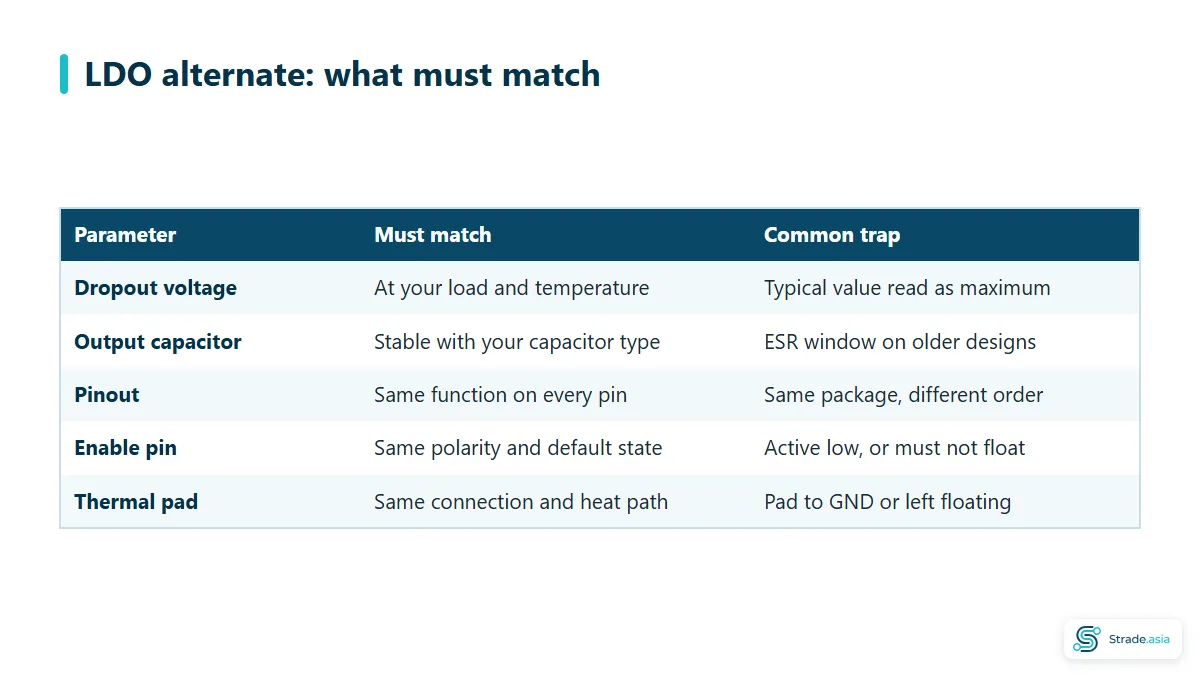
Dropout is the minimum difference between input and output at which the regulator still holds its output. Compare the maximum value, not the typical one, at your load current and lowest operating temperature. Older regulators with bipolar pass transistors, such as the 1117 family, need around a volt or more; modern CMOS LDOs need far less. When the input is only slightly above the output, such as a 3.3 V rail from a supply that sags under load, a part with higher dropout can fall out of regulation without any obvious fault.
Output capacitor stability
An LDO’s control loop depends on its output capacitor. Many older designs, especially those with PNP pass transistors, are stable only when the capacitor’s ESR sits inside a window. Too low an ESR, as with a ceramic capacitor, can make them oscillate, which is why such boards often use tantalum or aluminium capacitors. Most modern CMOS LDOs are designed for low-ESR ceramics and specify a minimum capacitance instead.
This creates two rules. Replacing an ESR-sensitive regulator with a ceramic-stable one is usually safe, provided the existing capacitors meet its minimum capacitance and maximum ESR. Replacing a ceramic-stable regulator with an ESR-sensitive one on a board with only ceramics is risky. Remember that an MLCC loses effective capacitance under DC bias, as explained in choosing MLCC alternates and DC bias, and that changing the capacitor itself has its own trade-offs, covered in tantalum capacitors: derating and alternatives.
Pinout in the same package
The same package does not mean the same pinout. In SOT-23-5, many LDOs use the order input, ground, enable, bypass or no connection, output, but not all do. The fourth pin may be a noise bypass, a feedback input, a power-good output or unconnected, and each needs a different connection. In larger packages, an 1117-type regulator in SOT-223 has its tab at the output, while a 78xx-type regulator in DPAK has its tab at ground. Check every pin and the tab, not just the outline.
Enable pin
Enable inputs can be active high or active low. Some have an internal pull-up or pull-down, so the part starts when the pin is left open; others must not float. If the pin is tied to the input, check that its rating allows the full input voltage. If it is driven from a microcontroller, check the logic thresholds at the GPIO voltage. Some three-pin regulators have no enable at all, which matters if your design switches the rail.
Thermal pad and power dissipation
Dissipation is roughly the voltage drop across the regulator multiplied by the load current, so it is set by the circuit rather than by the part. What changes is how well the package removes that heat. Thermal resistance can differ between parts in the same package, and exposed pads are not all the same: some must connect to ground, some are internally tied to another pin and must be left floating or connected accordingly. Check the datasheet, and measure the case temperature at full load.
Other details worth a look
- Quiescent current, for battery-powered or standby circuits.
- PSRR and noise, for rails that feed ADCs, references or RF circuits.
- Reverse current protection, where the output can be held above the input.
- Soft-start, power-good and output discharge, which affect power sequencing.
A practical approval process
- Collect the original datasheet and the real operating conditions: input range, load, temperature and capacitor types.
- Compare the alternate parameter by parameter, using the table above.
- Check the footprint pin by pin, including the pad.
- Test on the real board: start-up, load steps, output ripple on a scope at minimum and maximum input, and temperature rise.
- Record the approved alternate on your approved manufacturer list, as suggested in designing for availability, so the next buyer does not repeat the work.
How Strade can help
Strade is an independent electronic component distributor with its own engineers, supplying factories in Vietnam and across Asia, with power products as our core group. When a regulator is short or reaches end of life, our engineers propose alternates with matching specifications, including the details above, and your team makes the final decision. See our semiconductor range.
Send us the regulator part numbers or your full BOM, and we will check availability and suitable alternates.


