한국어
 Bahasa Indonesia
 ไทย
 中文 (中国)
 Tiếng Việt
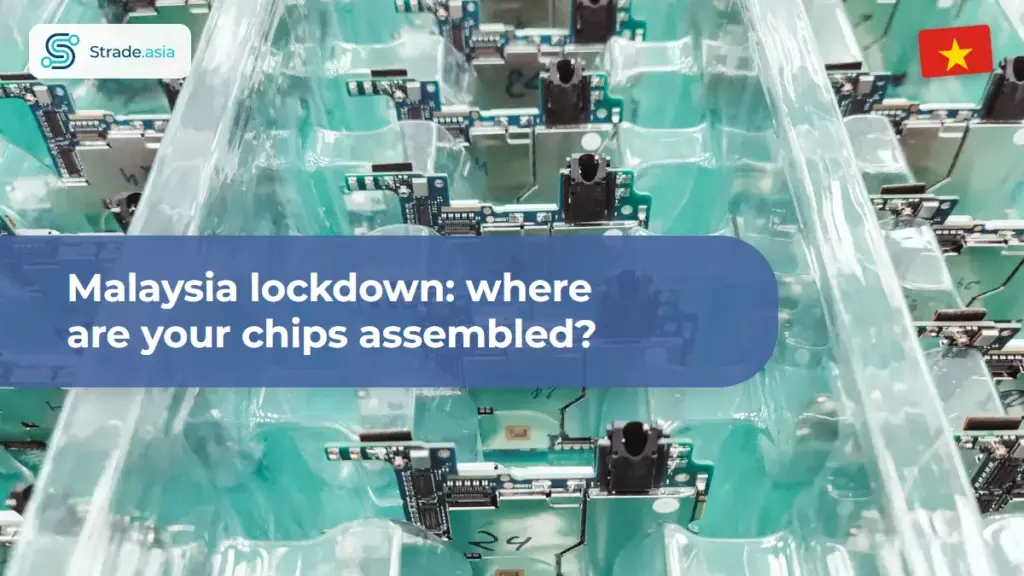
Since 1 June, Malaysia has been under a full movement control order to bring a severe wave of Covid-19 cases under control. The lockdown has been extended, and only sectors classed as essential may operate, with limits on the number of workers on site and strict health rules. Parts of the electrical and electronics industry are allowed to keep running under these conditions, but output depends on how many people each plant can bring in and on keeping cases out of the factory.
For component buyers, this matters more than it may first appear. Malaysia is one of the world’s main centres for semiconductor assembly and test, the stage where a finished wafer becomes a packaged, tested chip. Penang, Kedah, Perak, Melaka and the Klang Valley host back-end plants run by many of the largest chipmakers and by outsourced assembly and test companies.
Front end and back end
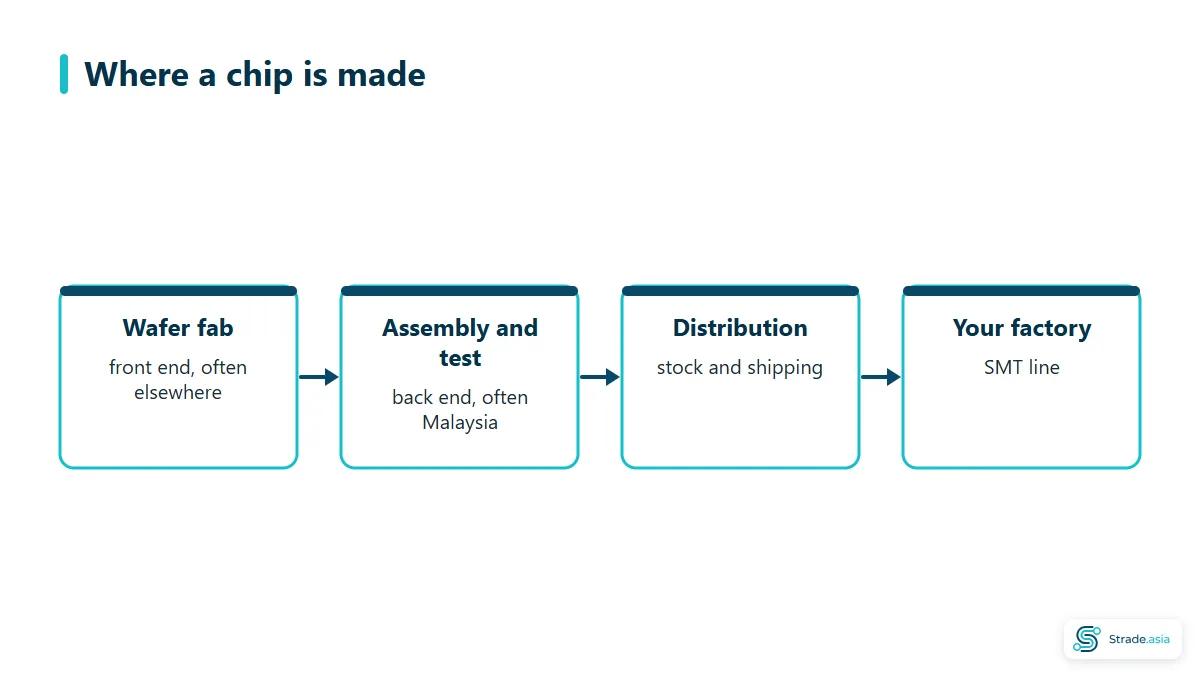
Making a chip has two broad stages. The front end is the wafer fab, where circuits are built on silicon. The back end is assembly and test: wafers are cut into dies, mounted in packages, bonded, moulded, marked and tested before going onto reels or trays.
The two stages are often in different countries. A wafer made in Europe, the US or Japan may be packaged and tested in Malaysia, the Philippines, Thailand, China or elsewhere in Asia. A stoppage at either stage stops the part.
Most of this year’s attention has gone to fabs: the car chip shortage, the Texas storm and the Renesas fire. The back end is easier to overlook, yet a reduced workforce at an assembly plant has the same effect on your deliveries as a fab outage. It comes on top of lead times that were already stretched to a year or more for many parts, as described in planning for 52-week lead times.
Which of your parts are exposed
You cannot tell from the manufacturer’s name where a part is assembled. The same part number may be assembled at more than one site, and many manufacturers use several outsourced assembly and test plants as well as their own. Useful sources of information:
- Labels and markings. The country of origin on the reel or box label usually reflects where the part was assembled. Our guide to reading component labels and barcodes shows where to find it.
- Your receiving records. If you record origin at goods-in, your history shows which parts have recently come from Malaysia.
- The supplier. Manufacturers can say which assembly sites are qualified for a part, and whether another site can take over.
Passive components, connectors and other parts are also made in Malaysia, so the check should not stop at semiconductors.
What to ask suppliers now
- Is this part assembled or tested in Malaysia? Ask by part number, not by manufacturer.
- Is another assembly site qualified? A second site that already holds the qualification can take over faster than a new one.
- How are current orders affected? Ask whether confirmed ship dates already account for the lockdown, and request updates as restrictions change.
- Is there finished stock elsewhere? Parts already packaged and held in distribution or in regional hubs are not affected by the current restrictions.
- Will a site change come with a PCN? If production moves to another assembly site, check what you will need to approve.
What to do in your own planning
For parts that are both assembled in Malaysia and critical to your line, consider raising safety stock where supply allows, confirming deliveries more often and starting work on alternates. Spreading supply across countries, as discussed in dual sourcing across countries, is a long-term answer; for now, knowing your exposure is the first step.
The government has said restrictions will ease in phases as conditions allow. How quickly back-end output recovers will depend on that, and on each plant’s ability to protect its workforce. Plan for uncertainty rather than for a date.
How Strade can help
Strade is an independent electronic component distributor with its own engineers, supplying factories in Vietnam and across Asia. We source from manufacturers, their distributors and vetted open-market suppliers, and inspect every lot on receipt, including labels and date codes. If a part assembled in Malaysia is held up, our engineers can propose alternates with matching specifications for your team to decide on.
Send us the part numbers you are concerned about, and we will check availability and alternative sources.