한국어
 Bahasa Indonesia
 ไทย
 中文 (中国)
 Tiếng Việt

On 19 March, a fire broke out at Renesas Electronics’ Naka factory in Ibaraki Prefecture, Japan. It started in plating equipment in the building that houses the plant’s 300 mm wafer line, and production on that line stopped. Renesas has said it aims to restart the line within about a month. Bringing output back to the level customers were already struggling to obtain is a separate and longer matter.
Renesas is one of the largest suppliers of microcontrollers to the car industry, and a large share of the line’s output goes to automotive customers. The fire comes after car plants had already run short of chips, as we described in why carmakers ran short of chips, and after the Texas winter storm stopped three fabs in February. For factory buyers in Vietnam, the questions are the same as after every such event: which of our parts are exposed, and what can we do about it?
Why this fire matters
The timing is the main problem. A year ago, other fabs might have absorbed some of the lost output. Today almost every fab making MCUs and analog parts is running full, so there is little room to move production elsewhere at short notice.
Moving a chip to another fab is slow in any case. Each product is built on a specific process, and a transfer means requalifying it, which takes months. Automotive customers must also approve the change. Manufacturers sometimes do move products after a disaster, and when they do, a change notice follows; our guide to handling PCN and EOL notices covers what to check.
There is history here too. The Naka plant was badly damaged by the March 2011 earthquake, and the shortage that followed showed how much of the car industry depended on one site. A decade later, the same site is again a pinch point.
Checking your exposure
Do not assume the fire only matters if you build car parts. Industrial MCUs can share families, processes and production lines with automotive ones. Start with a list of every MCU on your BOMs, with manufacturer, family, package and the products it goes into. Then ask your suppliers which part numbers are affected and whether existing ship dates still stand. Answers may change over the coming weeks as the manufacturer assesses the damage, so ask again rather than relying on a single reply.
Why an MCU alternate is hard
For a resistor or a diode, an alternate is a matter of matching ratings and footprint. A microcontroller carries your firmware, and that changes everything.
- Core and architecture. Moving from one MCU family to another, for example from a Renesas RX or RL78 part to an Arm Cortex-M device, means a new compiler, new libraries and code changes.
- Peripherals. Timers, ADCs, communication interfaces and their registers differ between families, so drivers must be rewritten and retested.
- Memory. Flash, RAM and data flash sizes must fit the existing code, with headroom.
- Pin functions. Even parts in the same package can assign functions to pins differently, which may force a board change.
- Tools and production. Debuggers, production programmers and test fixtures may need updating.
- Validation. Functional testing, EMC testing and, for some products, safety certification have to be repeated.
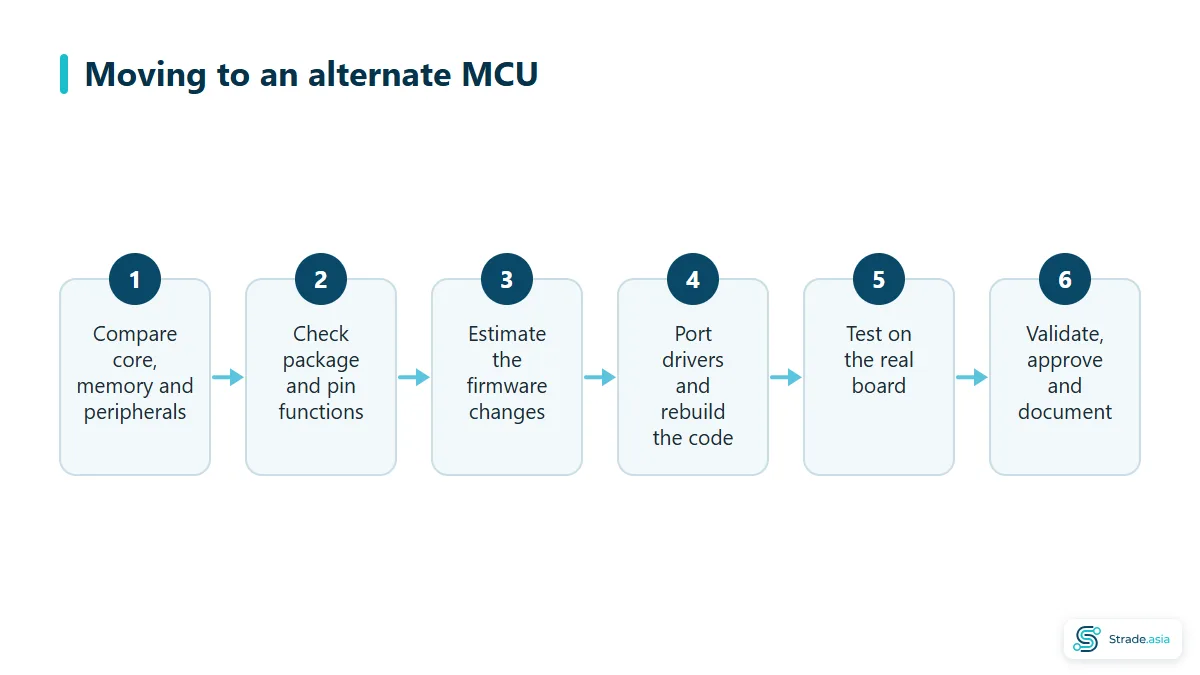
The easiest options are usually within the same family: a variant with more memory, a different temperature grade or another package. Other parts from the same manufacturer made at a different fab come next. A different manufacturer is the most work, so it needs the earliest start.
What buyers can do now
- Build the MCU list. One table, every MCU, every product it goes into.
- Ask for status in writing. Ask which parts are affected and request updated ship dates.
- Protect what you have. Make sure stock already on hand is reserved for the products that matter most.
- Check family variants first. Ask engineering which pin-compatible variants would need little or no firmware change.
- Start the hardest port early. For the most critical single-source MCU, begin evaluating an alternate now, even if supply recovers before you need it.
- Be careful with open-market MCUs. Remarked and recycled MCUs are common in a shortage. Check date codes and labels, and test samples, including programming and functional checks.
How Strade can help
Strade is an independent electronic component distributor with its own engineers, supplying factories in Vietnam and across Asia. We source from manufacturers, their distributors and vetted open-market suppliers. Every lot is inspected on receipt, and sensitive parts can be X-rayed or sample-tested. When an MCU is short or reaches end of life, our engineers can propose alternates with matching specifications, starting with the options that need the least change, and your team makes the final decision.
Send us your MCU list or BOM and we will check availability and possible alternates.