
 한국어
 Bahasa Indonesia
 ไทย
 中文 (中国)
 Tiếng Việt
A year ago most outlooks for electronics manufacturing in Vietnam were about growth. The year that followed was shaped less by demand than by disruption: new US tariffs, export controls on critical materials, a dispute at a major chipmaker, and a memory market that turned tight within a few months. Some of these measures have been eased or paused in recent weeks, but none of the underlying risks has gone away.
This article does not forecast prices or lead times for 2026. Nobody can do that reliably. Instead, it sets out the risks that 2025 exposed and how buyers and engineers can build them into next year’s purchasing plan.
Four risks to plan around
Memory
DRAM and NAND are tight as capacity moves towards HBM and server memory for AI, while DDR4 is winding down. For most factories the question for 2026 is not only price but availability, especially for older and lower-density parts. Our November note on rising memory prices includes a buying checklist.
Tariffs and origin
US reciprocal tariffs took effect in August, with a higher penalty rate for goods deemed transshipped. Rates and rules can still change, but the need to prove origin will not go away. The documentation checklist for exporters sets out the records to keep.
Discretes and logic
The Nexperia dispute showed that cheap standard parts can stop production when one large supplier is disrupted. Whatever happens next in that case, the lesson stands: a part with a single approved source is a risk, however common it looks.
Rare earths and magnets
Licensing of rare earths and related magnets affected motors, fans and actuators. Controls of this kind can be tightened or relaxed at short notice, so buyers should know where magnets sit in their BOMs.
Building the 2026 plan
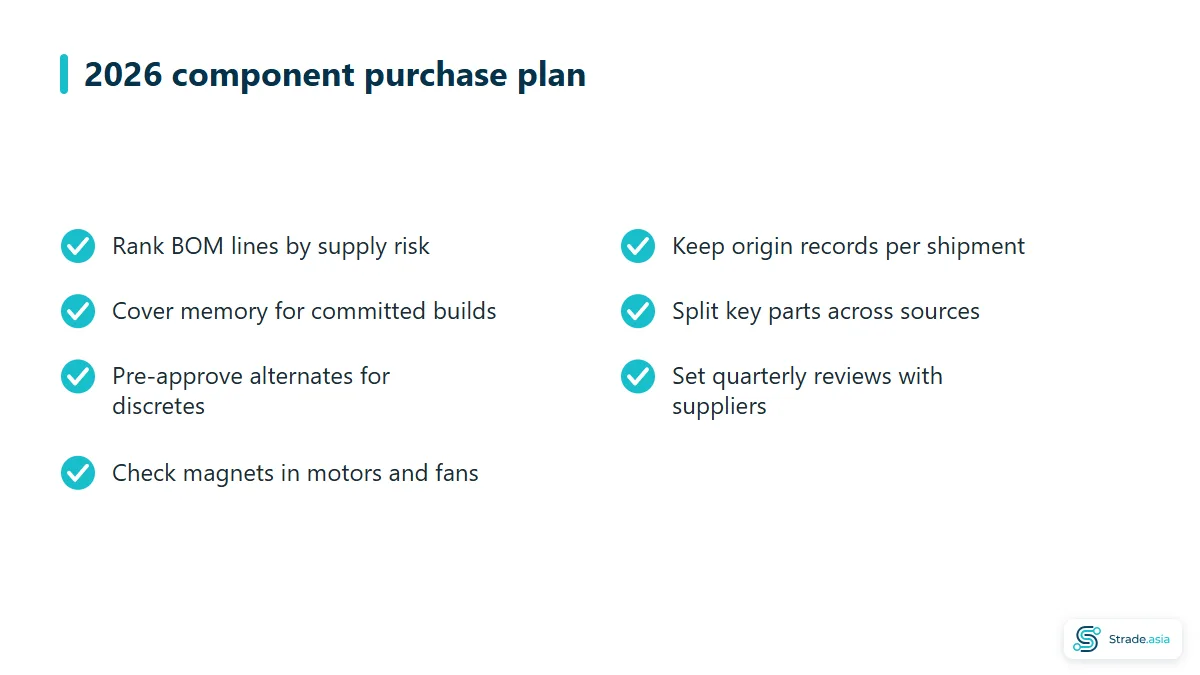
- Rank BOM lines by risk. Score each part on number of approved sources, lifecycle status, lead time, and exposure to tariffs or export controls. Spend effort at the top of the list, not evenly across the BOM.
- Cover memory for committed builds. Place firm orders for production that is already sold. Keep forecasts for the rest under monthly review rather than stockpiling.
- Pre-approve alternates. For discretes, logic, passives and power parts, get engineering approval for at least one alternate before a shortage arrives, and record it in the approved manufacturer list.
- Check magnets. Ask fan, motor and actuator suppliers which magnet material they use and how secure its supply is.
- Document origin per shipment. Keep BOM origin data, supplier declarations and production records up to date. Make it a routine, not a project.
- Diversify sources. Spread key parts across manufacturers and, where possible, across production countries, so that one country’s measures cannot stop a whole product.
- Agree review points. Set quarterly reviews with key suppliers to update lead times, allocation status and lifecycle notices.
Budget and cash
Higher memory prices and possible duties mean that 2026 budgets built on early-2025 prices may be too low. Agree with finance which parts justify buffer stock (long lead time, single source, critical to production) and which do not. Buffer stock is insurance, and insurance has a cost; spend it where a stoppage would cost most.
Contracts and terms
Review quote validity, price adjustment clauses, Incoterms and who carries import duty. Under DDP the seller pays the duty; under FOB or FCA the buyer does. Make sure contracts reflect what both sides now expect, before the first orders of the year are placed.
Engineering and purchasing together
Most of the actions above need both teams. Purchasing sees the market first; engineering decides what can be changed. A short monthly meeting with a shared list of at-risk parts, open alternates and lifecycle notices is often enough to turn surprises into planned changes.
How Strade can help
Strade Asia is an independent electronic component distributor with its own engineers, supplying factories in Vietnam and across Asia with semiconductors, passive components, connectors, power products and other groups. Most orders are bought to your requirement, and when a part is short or end-of-life our engineers propose alternates with matching specifications for you to approve. We deliver DDP or DAP to factories and export processing enterprises with customs documents prepared, and support origin files including Form E, RCEP, CPTPP and EVFTA. To start planning, send your 2026 BOM through our RFQ page or read about our supply chain services.


