한국어
 Bahasa Indonesia
 ไทย
 中文 (中国)
 Tiếng Việt

An industrial controller, an HMI panel or a network gateway is often built to the same design for many years. The memory inside it rarely stays the same for that long. A commercial DRAM module, eMMC chip or SSD can change its internal components without changing its part number, or disappear when the consumer products it was made for move on. For a factory that must rebuild the same board for years, choosing memory is a supply decision as much as a technical one.
What actually differs between commercial and industrial memory
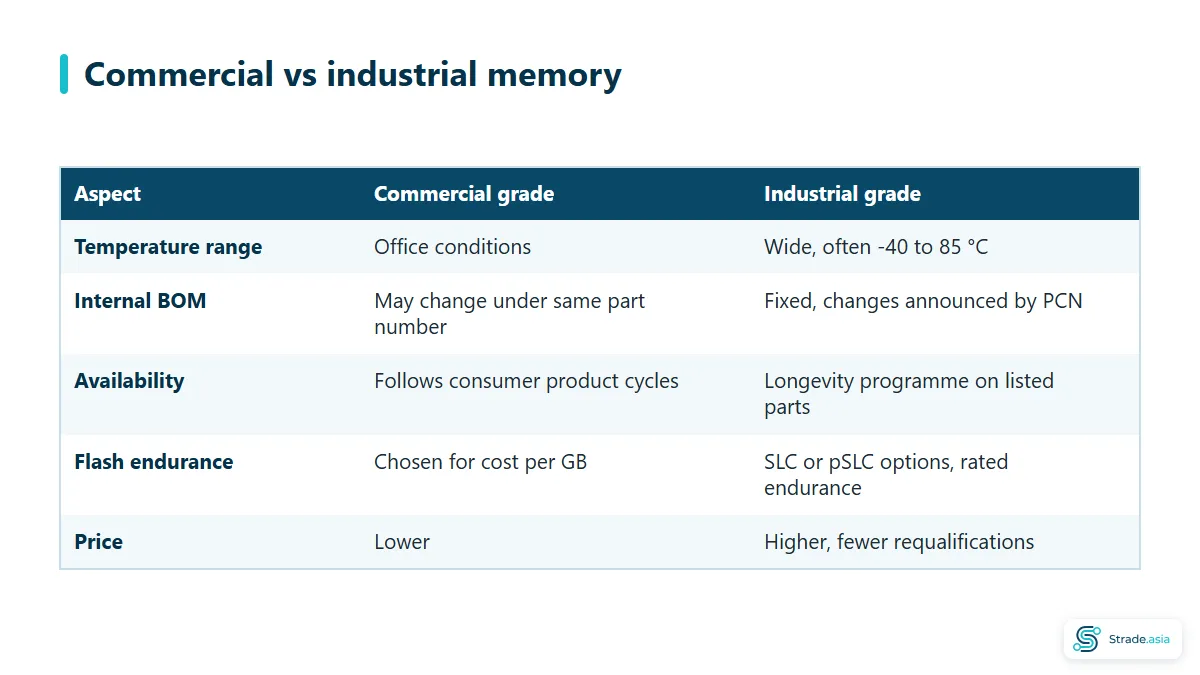
Memory for PCs and phones is designed for office temperatures, short product cycles and the lowest price. Industrial-grade memory is aimed at equipment that runs hot, cold or non-stop and must be rebuilt unchanged. The differences that matter:
- Temperature range. Commercial parts are usually specified from 0 °C up to about 70 or 85 °C. Industrial grades commonly cover -40 to 85 °C, and some go higher. Check whether the figure means ambient or case temperature.
- Fixed internal BOM. A consumer SSD or memory card may ship with a different controller, NAND die or firmware from one lot to the next under the same part number. Industrial products usually lock the internal bill of materials and announce changes through a product change notice (PCN).
- Endurance and data retention. For flash, the cell type (SLC, pSLC, MLC, TLC) and the rated write endurance decide how long a device survives data logging, frequent updates or swap use.
- Power-loss behaviour. Industrial SSDs and eMMC often add protection against corruption when power drops during a write, which matters on machines switched off at the main breaker.
- Screening and traceability. Extended testing, lot traceability and, for vehicles, AEC-Q100 qualification of the memory ICs.
Longevity programmes: read the terms
Several memory and module makers run longevity programmes for selected industrial parts. The details vary, so read the actual terms:
- Which exact part numbers are covered, and for how long from which date.
- Whether the commitment covers the internal BOM or only the external part number and form factor.
- How much notice is given before end of life, and whether a last-time buy window is offered.
- What happens on a die shrink or a move to another fab.
A longevity programme reduces risk; it does not remove it. Whole memory generations still end. When the major DRAM makers began winding down DDR4 during 2025, many industrial designs that had assumed years of supply had to plan last-time buys or a move to DDR5, as described in our note on DDR4 end of life and legacy memory.
Handling change notices
A PCN for memory is rarely cosmetic. A new die revision can change timing margins or power consumption, and a firmware change can alter wear levelling or error handling. When a notice arrives:
- List which of your products use the part, in what quantity, and how long they will stay in production.
- Read exactly what changes: die, fab, package, firmware, label or only the packing.
- Ask for samples of the new version and test them on your own board, including at temperature extremes.
- Decide between qualifying the new version, a last-time buy or a redesign, before the last order date rather than after it.
Our guide to handling PCN and EOL notices covers the general process.
Qualifying memory for a long production life
- Test on the real board at both ends of your temperature range, including a cold start.
- For DRAM, run stress tests at the speed and timing your design actually uses.
- For flash, estimate the daily write volume of your application and compare it with the endurance rating, with margin.
- Approve a second source where you can. Two modules with the same capacity and speed are not automatically interchangeable.
- Keep the qualification report with the exact part number, date code and firmware version tested.
Price and timing
Industrial memory costs more per gigabyte. When the market tightens, as it did at the end of 2025 (memory prices climb on AI demand), lead times and allocation reach industrial parts too. Plan purchases against your build schedule, share a forecast with your supplier, and for products near end of life consider buffer stock of the few memory lines that would stop production.
A short checklist for buyers
- Write the full part number, including temperature and packing suffixes, in the BOM.
- Ask whether the internal BOM is fixed and how changes are notified.
- Ask for the lifecycle status and the expected notice period before end of life.
- Record the date codes and firmware versions you qualified.
- Plan last-time buys before the end-of-life date, not after.
How Strade helps
Strade is an independent electronic component distributor with its own engineers, supplying factories in Vietnam and across Asia. Memory is part of our semiconductor range, sourced from manufacturers, their distributors and vetted open-market sources. When a memory part reaches end of life or becomes hard to buy, our engineers compare specifications and propose alternates; the customer decides. Every lot is checked on receipt for part number, label, date code, packaging and visual condition, and moisture-sensitive parts are packed according to their MSL.
Need memory for a product that must stay in production for years? Send your part list with the temperature range and quantities you need.