
 한국어
 Bahasa Indonesia
 ไทย
 中文 (中国)
 Tiếng Việt
Since mid-December, a wave of attacks on merchant ships in the southern Red Sea has led most of the large container lines to stop sending vessels through the Suez Canal. Ships sailing between Asia and Europe are being rerouted around the Cape of Good Hope, a much longer voyage. For a factory in Vietnam that buys some components from Europe, or ships finished products there, this is not a headline to skim past. It changes transit times, freight costs and the reliability of every delivery date that depends on a container crossing between the two regions.
What has changed on the water
The detour around southern Africa adds a significant number of days to each Asia–Europe voyage and ties up more ships to run the same weekly schedules. Carriers have announced emergency surcharges, and spot rates on Asia–Europe lanes have risen sharply since December. Schedules are less reliable, because vessels arrive out of their usual sequence and ports must absorb bunched arrivals. Empty containers also return to Asia later than planned, which can tighten equipment availability on other lanes too.
Air freight is the obvious fallback, and some shippers are already moving urgent cargo by air or by combined sea-air routings. That raises demand for air capacity at the same time, so it is worth booking early rather than assuming space will be there.
Which components are exposed
Most semiconductors are small and valuable enough to move by air, and many are packaged and tested in Asia anyway, so a large part of a typical BOM is not directly affected. The exposure sits elsewhere:
- Parts made in European plants and shipped by sea: some connectors, relays, power modules, industrial sensors, cable assemblies and large passive components.
- Heavy or bulky items: transformers, enclosures, large electrolytic capacitors, battery packs and power supplies, where air freight is expensive.
- Goods restricted in air freight: lithium batteries and some chemicals often travel by sea because of dangerous goods rules, so they have fewer alternatives (see our note on shipping lithium batteries under UN 38.3).
- Your own outbound shipments: if finished goods go to European customers by sea, their delivery dates move too, which can change your build plan.
What buyers can do now
The disruption may ease within weeks or last for months; nobody can say yet. A sensible response works in either case.
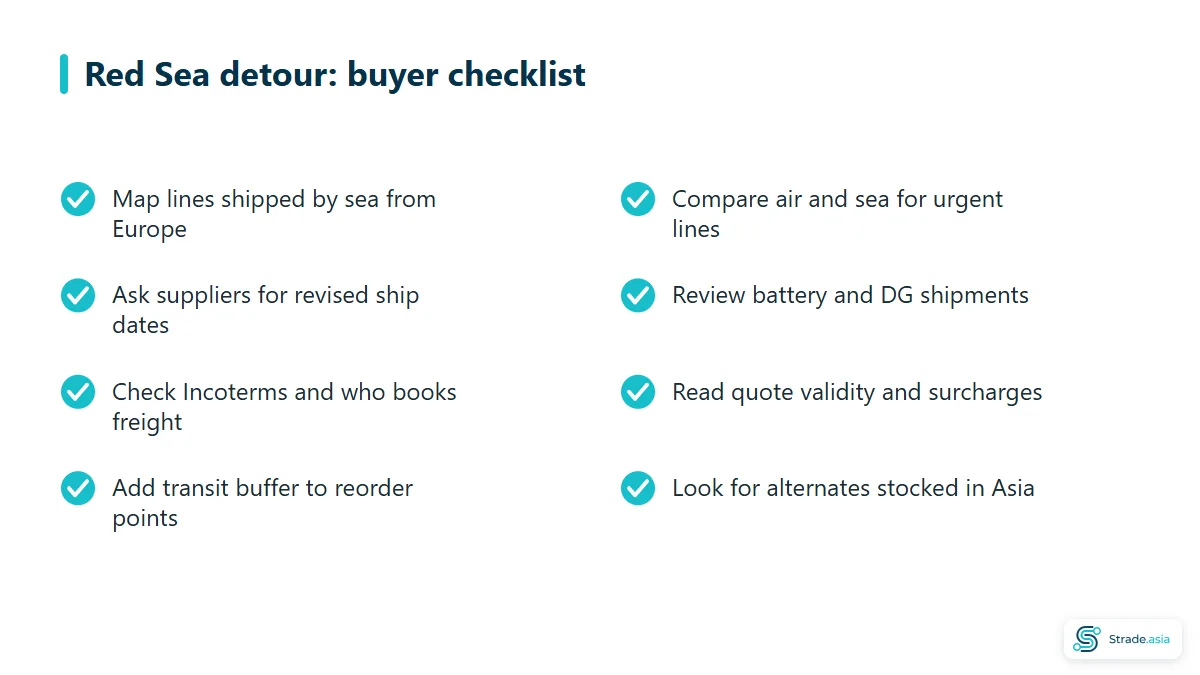
- List the lines that move by sea from Europe. Use purchase history to find which parts arrived by container and from which origin.
- Ask for revised ship and arrival dates. Ask suppliers whether they are rerouting, switching to air or holding cargo, and whether quoted lead times now include the longer voyage.
- Check your Incoterms. Under EXW or FCA you book the freight and carry the delay; under DAP or DDP the seller manages the routing, but you still feel the late arrival. Our guide to Incoterms 2020 sets out who controls what.
- Add buffer where it matters. Raise reorder points or safety stock for the European-sourced lines that would stop a line, not for everything. The trade-offs are covered in buffer stock and consignment.
- Compare air and sea for urgent lines. For small, high-value parts the extra cost of air is often far lower than the cost of a stopped line.
- Read quotes carefully. Short validity periods and freight surcharges are likely while rates keep moving.
- Look for alternates stocked in Asia. Many European designs have equivalents made or stocked in Asia. An engineer should check pin-out, ratings and approvals before any switch.
Lessons from earlier disruptions
The container crisis of 2021 showed that freight problems spread beyond one route: equipment shortages, port congestion and rising rates reached lanes that were never directly affected, as described in container shipping disruption and freight costs. The same pattern may repeat. Watch freight indexes and carrier advisories each week, and keep your planners and suppliers working from the same set of dates.
How Strade can help
Strade is an independent electronic component distributor with its own engineers, supplying factories in Vietnam and across Asia. We source from manufacturers, their distributors and vetted open-market suppliers, so when a European-made part is stuck on a longer voyage we can check whether the same part is available elsewhere in Asia, and our engineers can propose a matching alternate for your team to approve. Shipments are delivered DDP or DAP to your factory, including export processing enterprises, with customs documents prepared.
If some of your lines depend on sea freight from Europe, send us your BOM or the affected lines and we will look at the sourcing options.


