한국어
 Bahasa Indonesia
 ไทย
 中文 (中国)
 Tiếng Việt
For most of 2021 and 2022, the question in every purchasing meeting was how to get parts. Buyers placed orders far beyond their normal planning horizon, accepted non-cancellable, non-returnable (NCNR) terms and built safety stock wherever they could. Then, in the second half of 2022, demand for consumer electronics slowed sharply. PCs, smartphones and many household devices sold less than planners had expected, but the orders placed during the shortage kept arriving. Today many factories, and many of their customers, hold more stock than they need in some part families, while a few other lines are still hard to buy. That mix is what makes this inventory correction tricky.
What an inventory correction looks like
An inventory correction is the period when customers, distributors and manufacturers work down stock that was built for demand that did not come. New orders slow, quoted lead times shorten and prices for commodity parts soften. Memory makers have reported weak demand and high inventories in their recent results, and many distributors describe the same pattern in standard parts.
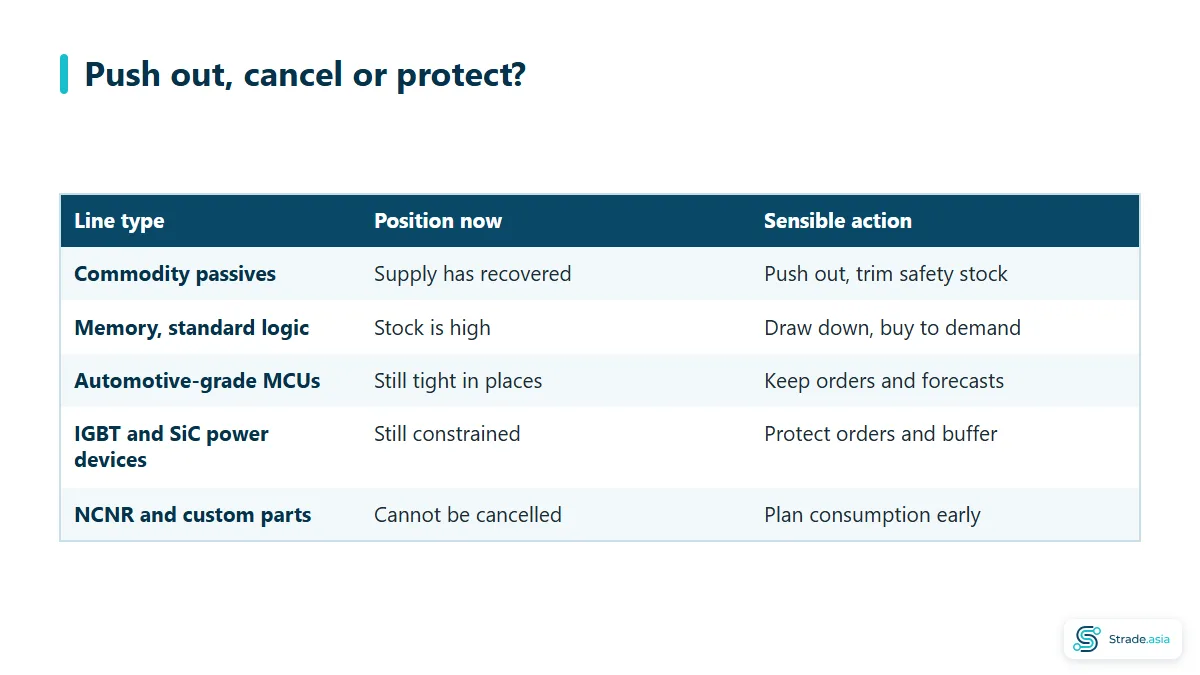
The correction is uneven. It is most visible in parts that go into consumer products and least visible in parts tied to automotive and industrial demand, where some lines remain on allocation. For a factory in Vietnam, the result is often a BOM that is half in surplus and half still exposed. We have seen this swing before: the passive component shortage of 2018 also ended in surplus within a few quarters.
Push-outs and cancellations
When demand falls, the first reaction is to cancel. A more careful approach works better:
- Check open orders and the terms first. Look for duplicate orders placed with several suppliers during the shortage, so that surplus lines are not kept open by mistake. Standard orders for catalogue parts can usually be rescheduled or cancelled only within a window set out in the supplier’s terms, often linked to the quoted lead time. Outside that window, expect fees or a refusal.
- Prefer push-outs to cancellations. Moving a delivery date keeps your place in the queue and the agreed price, and suppliers agree to it more readily.
- Talk early and give a revised forecast. Suppliers are handling many requests at once; a clear schedule gets a faster answer than a blanket cancellation.
- Leave constrained lines alone. Cancelling an order for a part that is still on allocation can cost a place in the queue that took months to reach.
Handling NCNR orders
NCNR terms became common during the shortage, especially for allocated parts, custom or programmed parts, and stock bought on the open market. They mean what they say: once accepted, the buyer must take delivery and pay.
For NCNR stock already on order:
- Confirm the delivery schedule and ask whether deliveries can be staggered. Some suppliers will agree within the terms, even if they cannot cancel.
- Plan consumption across products. A part bought for one model may be usable on another board, or at a sister plant. Contract manufacturers should first check who carries excess stock under each customer agreement, and export processing enterprises should check the customs rules before moving or selling parts locally.
- Check the stock you will hold. In a humid climate, moisture-sensitive parts need dry storage and floor-life tracking, as explained in moisture sensitivity levels, and long storage needs good records of date codes and lots.
- Consider resale for true excess. Our guide to options for excess component inventory covers returns, consignment and resale.
Before accepting new NCNR terms, ask whether the part is really constrained, whether the quantity can be split into a firm portion and a later release, and whether the lead time justifies the commitment. Mark NCNR lines clearly in the ERP so planners see them before they change the build plan.
Keep safety stock where it still matters
The risk now is overcorrection: cutting every buffer because some families are in surplus. Several lines remain tight, notably IGBT modules, silicon carbide devices and some automotive-grade microcontrollers, where demand from electric vehicles, renewable energy and industrial automation is still strong. For those parts, keep orders and forecasts in place, and hold buffer stock or a consignment arrangement as described in buffer stock and consignment. Releasing a buffer is easy; rebuilding it when the next shortage starts is not.
A checklist for the next few months
- Sort the BOM into surplus, balanced and constrained lines, using current lead times rather than last year’s.
- For surplus lines, push out deliveries and reduce safety stock gradually.
- For constrained lines, keep orders, forecasts and any allocation agreements in place.
- List every NCNR order with its delivery dates and the products that consume it.
- Review open-market stock bought during the shortage: inspection records, date codes and storage conditions.
- Reset reorder points and planning lead times line by line.
How Strade can help
Strade is an independent electronic component distributor with its own engineers, supplying factories in Vietnam and across Asia. Most of our orders are bought to the customer’s requirement, so we quote against your actual demand rather than a stocking plan. When a line is still constrained, we source from manufacturers, their distributors and vetted open-market suppliers, and our engineers can propose alternates that match the specification for your team to approve. Our component supply chain service explains how we work with regular buyers.
If you are reworking your purchase plan, send us the lines that worry you, surplus or short, and we will look at the options with you.