한국어
 Bahasa Indonesia
 ไทย
 中文 (中国)
 Tiếng Việt

This year’s shortage has made one lesson very clear: the most expensive part on a BOM is the one you cannot get. Across the industry, engineering teams are redesigning boards in a hurry to replace parts with year-long lead times, often while the production line waits. Much of that pain is decided at the design stage. Designing for availability means choosing components so that, when one source fails, another can take its place with little or no change to the board or the firmware.
Why design decides supply risk
Once a board is in production, purchasing can only choose among the parts the design allows. If a design uses a part that only one manufacturer makes, in a package nobody else uses, there is nothing to negotiate when that manufacturer goes on allocation. If the design allows three manufacturers, purchasing has options. The decision that matters was made months earlier, by an engineer who may never have seen a lead time report.
Principles for choosing parts
Prefer standard packages
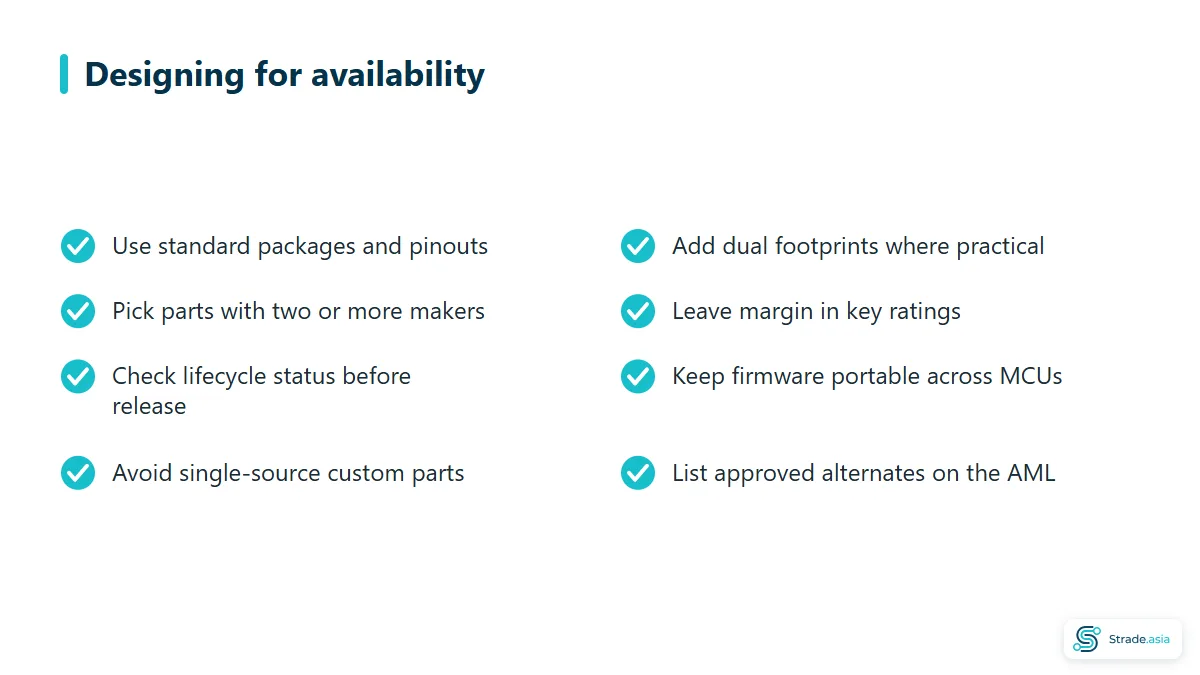
Industry-standard packages such as SOT-23, SOIC, SOT-223, DPAK and TO-220, and standard chip sizes for passives, are made by many manufacturers. A standard package is not a guarantee of compatibility, because pinouts and thermal pads can still differ, but it makes an alternate possible. Proprietary packages and unusual pin counts should need a clear reason.
Choose functions with more than one maker
Common functions such as op-amps, logic, voltage regulators, MOSFETs, diodes and passive components usually have equivalents from several manufacturers. Where the design allows, pick a part that has at least one real alternate today, and record it on your approved manufacturer list. Our guide to the approved manufacturer list and second sources explains how to keep that list useful.
Check the lifecycle before you release
A part marked “not recommended for new designs”, or one that has already received a last-time-buy notice, should not go into a new product. Check the manufacturer’s lifecycle status, and look at the PCN history for signs of trouble. See handling PCN and EOL notices for what those notices mean.
Avoid single-source custom parts where you can
Custom ICs, custom magnetics and specially marked parts lock you to one supplier. Sometimes they are the right choice. When they are, agree supply terms early, hold extra stock and keep the drawings and specifications needed to have the part made elsewhere.
Design footprints that accept more than one part
Where layout space allows, a footprint that accepts two package variants, or two regulator types with different pinouts, gives purchasing a second option without a board change. The cost is a little board area and some care in the BOM.
Leave margin in key ratings
A design that uses a part at the edge of its ratings can only accept an alternate with identical or better specifications. Margin in voltage, current, temperature and, for MLCCs, effective capacitance under DC bias widens the field. The capacitor case is covered in choosing MLCC alternates and DC bias.
Keep firmware portable
Microcontrollers are the hardest parts to replace, as the Renesas Naka fire showed. Choose families with many memory and package variants, keep hardware-specific code behind an abstraction layer, and leave headroom in flash and RAM so that a different variant can run the same code.
Make availability part of design review
The simplest change is to add availability to the design review checklist. For each line on the BOM, record the number of qualified manufacturers, the current lead time and the lifecycle status. Ask purchasing to review the BOM before release, not after the first shortage. A part that fails the check is not banned, but someone has to accept the risk knowingly.
For products already in production, the same review shows which lines to work on first: single-source parts with long lead times, especially those that would stop the line. Qualifying an alternate for them now is far cheaper than doing it during a shortage.
How Strade can help
Strade is an independent electronic component distributor with its own engineers, supplying factories in Vietnam and across Asia, and we also support customers with OEM and ODM work. When a part is short or reaching end of life, our engineers propose alternates with matching specifications, and your team decides. The same knowledge helps at the design stage: lines with one source or long lead times are easier to fix before a product is released. Read more about our ODM service.
Send us your BOM, whether it is a design in progress or a product already in production, and we will check availability, lifecycle and possible alternates.