
 한국어
 Bahasa Indonesia
 ไทย
 中文 (中国)
 Tiếng Việt

Semiconductor supply was already tight when a severe winter storm reached Texas in mid-February. Freezing temperatures knocked out a large part of the state’s power generation, and the grid operator, ERCOT, ordered rolling outages. In Austin, large industrial users were asked to shut down so that power could go to homes. Samsung, NXP and Infineon all halted their wafer fabs in the city.
Power has since returned, and the companies are working to restart. But a wafer fab does not resume when the lights come back on, and the effect on component supply will be felt for some time. For buyers already dealing with the shortage that hit carmakers last month, this is another shock to plan around.
Why a fab cannot simply switch back on
A fab runs around the clock, with wafers moving through a long sequence of process steps over many weeks. An unplanned shutdown interrupts all of them at once. Before normal output can resume:
- Facilities have to be checked and the cleanroom, gases, water and chemicals brought back to specification.
- Process tools have to be inspected and requalified so that wafers come out within specification.
- Wafers that were in process when production stopped may have to be scrapped or reworked.
Once wafers are moving again, they still need many weeks to get through the fab, then more time in assembly and test. The gap therefore shows up later, as output that would have shipped in the coming months. How large that gap will be is not yet clear, and suppliers themselves are still assessing it.
Which parts may be exposed
Between them, the Austin fabs make chips for automotive, industrial, communications and consumer customers. NXP and Infineon are both major suppliers to the car industry, so the shutdown adds pressure to automotive chips, and through them to the industrial parts that share the same production lines.
Exposure is not the same as buying from these companies. Large manufacturers run several fabs, and many products are made at more than one site or are qualified for a second fab. Other parts come from a single fab only. The question that matters is where each of your part numbers is made, and whether the manufacturer has another qualified source for it.
Single-site risk, again
This is not the first time one site has shaken component supply. The Kumamoto earthquakes in 2016 stopped several plants in southern Japan, and the fire at a Japanese fab last October left some parts with no immediate source, as we described in single-source risk after a fab fire. Each event looks unusual on its own. Taken together, they show that site risk belongs in normal supply planning, especially when the market has no spare capacity to absorb a loss.
What buyers should do now
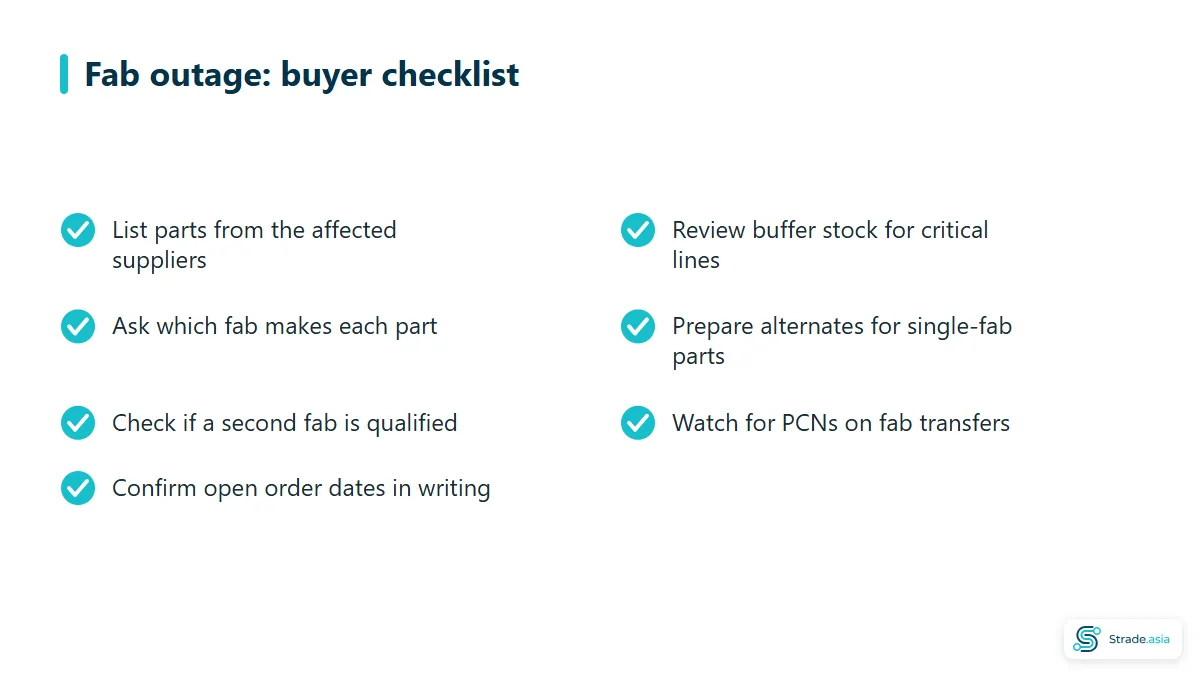
- List parts from the affected suppliers. Start with MCUs, interface and power-related ICs, which are already the tightest categories.
- Ask which fab makes each part. Distributors may not know; the manufacturer’s sales or quality team can usually say whether a part is made in Austin and whether another fab is qualified.
- Confirm open order dates in writing. Ask whether current ship dates already take the shutdown into account. Dates given before mid-February may no longer hold.
- Review buffer stock for critical lines. For parts that would stop production, consider pulling in deliveries or raising safety stock while the market allows.
- Prepare alternates for single-fab parts. Engineering checks take time, so begin now for the parts with no second source.
- Watch for change notices. Manufacturers sometimes move products to another fab after a disruption. Such moves come with a PCN, and you may need to approve the change or requalify.
Two cautions apply. Do not over-order across the board, because allocation systems often look at order patterns and inflated orders can distort them. And treat sudden open-market offers for scarce parts with care: check traceability, date codes and packaging, and test samples where the part is critical.
How Strade can help
Strade is an independent electronic component distributor with its own engineers, supplying factories in Vietnam and across Asia. We buy from manufacturers, their distributors and vetted open-market suppliers, and inspect every lot on receipt for part number, labels, date code, packaging and appearance, with X-ray or sample testing for sensitive parts or on request. When a part becomes hard to find, our engineers can propose an alternate with matching specifications, and your team decides whether to use it.
If you are not sure whether your BOM depends on the Austin fabs, send us the affected part numbers and we will check sourcing options and alternates.


