한국어
 Bahasa Indonesia
 ไทย
 中文 (中国)
 Tiếng Việt
On 10 September, during the US President’s visit to Hanoi, the United States and Vietnam upgraded their relationship to a Comprehensive Strategic Partnership. Semiconductors feature in the joint leaders’ statement: the two sides agreed to cooperate on developing Vietnam’s semiconductor ecosystem, on training the engineers and technicians it will need, and on building more resilient supply chains. For purchasing managers in Vietnamese factories the question is practical. Does any of this change how, and from where, we buy components?
What the statement says, and what it does not
The statement sets a direction rather than a list of projects. It signals political support for semiconductor investment in Vietnam and for workforce development, which matters to companies deciding where to place new capacity. It does not change tariffs, export control rules or the way components are bought and shipped today. Any new factories that follow will take years to plan, build and qualify.
Where Vietnam stands in the semiconductor supply chain
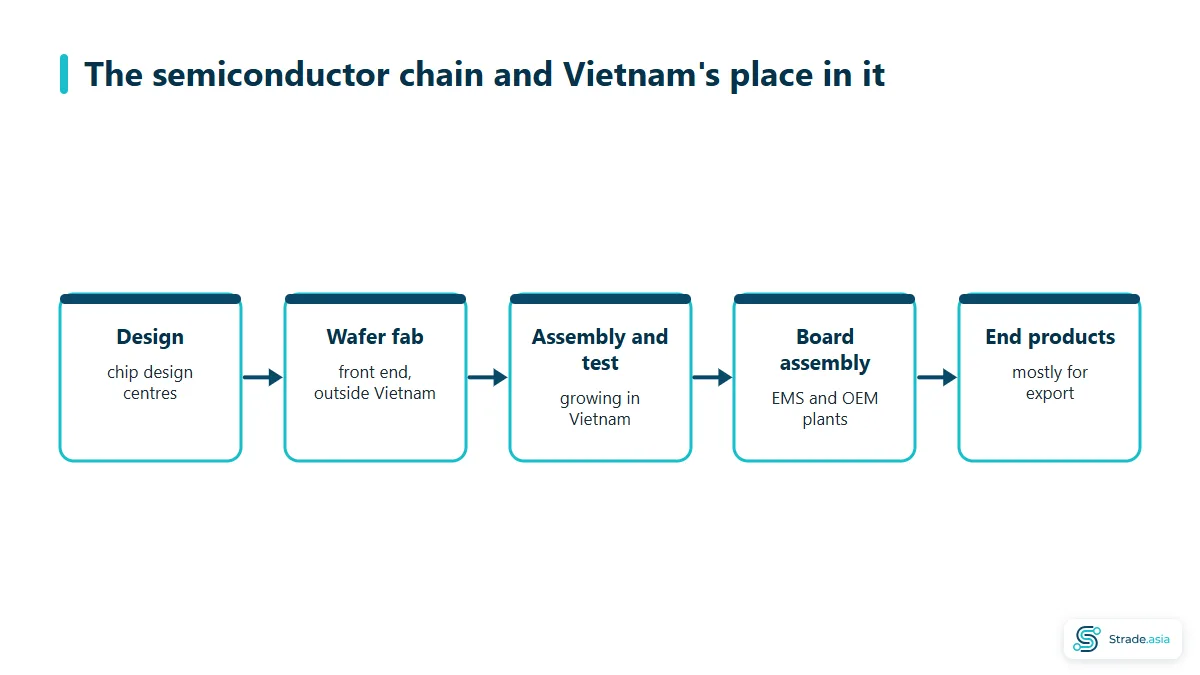
Vietnam is already part of the semiconductor chain, mainly at the back end. International chipmakers run assembly and test operations here, including Intel’s plant in Ho Chi Minh City, and several companies have chip design centres in Hanoi and Ho Chi Minh City. Much larger is the board and product assembly base: electronics are among Vietnam’s largest exports, and many global brands build phones, computers, networking gear and industrial equipment here. We covered how semiconductors run through this industry in semiconductors in the electronics industry.
What Vietnam does not have is volume wafer fabrication. The silicon inside nearly every chip used in Vietnam is processed elsewhere, mostly in East Asia, and that will not change soon.
What it may mean over the coming years
If the partnership leads to the investment both governments hope for, the likely effects are gradual:
- More assembly, test and packaging capacity in Vietnam, which brings packaging materials, test equipment and skilled jobs, and closer contact between local factories and chip suppliers.
- More design work, as design centres grow and local universities train more engineers.
- More manufacturers adding plants in Vietnam, continuing the shift that started when companies began spreading production across countries, described in dual sourcing across countries.
- Closer attention to compliance. US-origin technology carries US export control rules with it, wherever it is used, and customers will expect suppliers in Vietnam to know their obligations.
For component buyers, the nearer-term effect is more likely to come through customers than through chip plants. Brands that want to reduce reliance on a single country are already asking their suppliers about capacity in Vietnam, and each new project brings demand for components, test equipment, engineering support and documentation. Much of the component stock that serves factories in Vietnam is still held in regional hubs such as Hong Kong, Singapore and southern China, so new lines should plan for regional lead times and customs clearance from the start.
None of this guarantees shorter lead times or lower prices for components. A chip assembled in Vietnam still depends on wafers made elsewhere and on global demand, and the industry is still working through the inventory correction that began last year.
What buyers can do now
- Know where your parts are made. For key lines, record the wafer fab and assembly locations the manufacturer declares; this helps with both risk planning and origin questions.
- Check how origin is declared. Origin rules for semiconductors can depend on where the wafer is processed, not only where the chip is packaged. US customs, for example, generally treats the country of wafer fabrication as the origin of a chip, so a chip packaged in Vietnam from a wafer made in China may still count as Chinese for Section 301 tariffs. Keep manufacturer declarations on file.
- Strengthen local supply where it makes sense. Stock held in Vietnam, delivered DDP or DAP, reduces exposure to cross-border delays, as covered in our guide to setting up production in Vietnam.
- Keep second sources across regions. A new local option is useful, but it does not replace a qualified alternate from another manufacturer.
- Build skills. Engineers who can read datasheets, judge alternates and handle change notices are as valuable to a factory as any new plant nearby.
How Strade can help
Strade is an independent electronic component distributor with its own engineers, supplying factories in Vietnam and across Asia with semiconductors, passive components, connectors and power products. We buy from manufacturers, their distributors and vetted open-market sources, and deliver DDP or DAP to factories, including export processing enterprises, with customs documents prepared. More on how we work with factories is on our page for manufacturers.
Whether you are setting up a new line in Vietnam or expanding an existing one, send us your BOM for a quotation.