
 한국어
 Bahasa Indonesia
 ไทย
 中文 (中国)
 Tiếng Việt
Since 9 July, Ho Chi Minh City has applied strict social distancing under the Prime Minister’s Directive 16, and the measures have since been extended. From 19 July, the southern provinces and cities followed, and Hanoi has applied similar measures since late July. People may leave home only for essential reasons, and factories may keep running only if they meet strict health conditions.
Many factories in the industrial parks and export processing zones of the south are operating under on-site arrangements, where workers stay, eat and work inside the factory, or under the “one route, two destinations” model, where workers travel by arranged transport between fixed accommodation and the plant. Others have reduced output or paused for a time. For component buyers, the question is no longer only whether parts are available, but how they reach the production floor.
What has changed for deliveries
Ports and airports continue to operate, and imported components still arrive by sea and air. Customs clearance continues. The pressure is on the last part of the journey, from the port, airport or warehouse to the factory.
- Road transport needs registration. Vehicles carrying goods move under a priority “green lane” system that requires registration in advance, and drivers must carry recent negative test results.
- Rules differ by province. Testing intervals, checkpoints and permitted routes are set locally and can change at short notice, so a delivery that crosses a provincial boundary needs extra checking.
- Receiving is limited. Factories working on site often cannot let drivers or outside staff in, so goods are handed over at the gate or at a set receiving point.
- Transit takes longer. Checkpoints, testing and changing routes mean a trip can take longer than before, and arrival times are less predictable.
None of this means deliveries stop. It means each delivery needs more planning than before.
A practical plan for receiving parts
Receiving on site
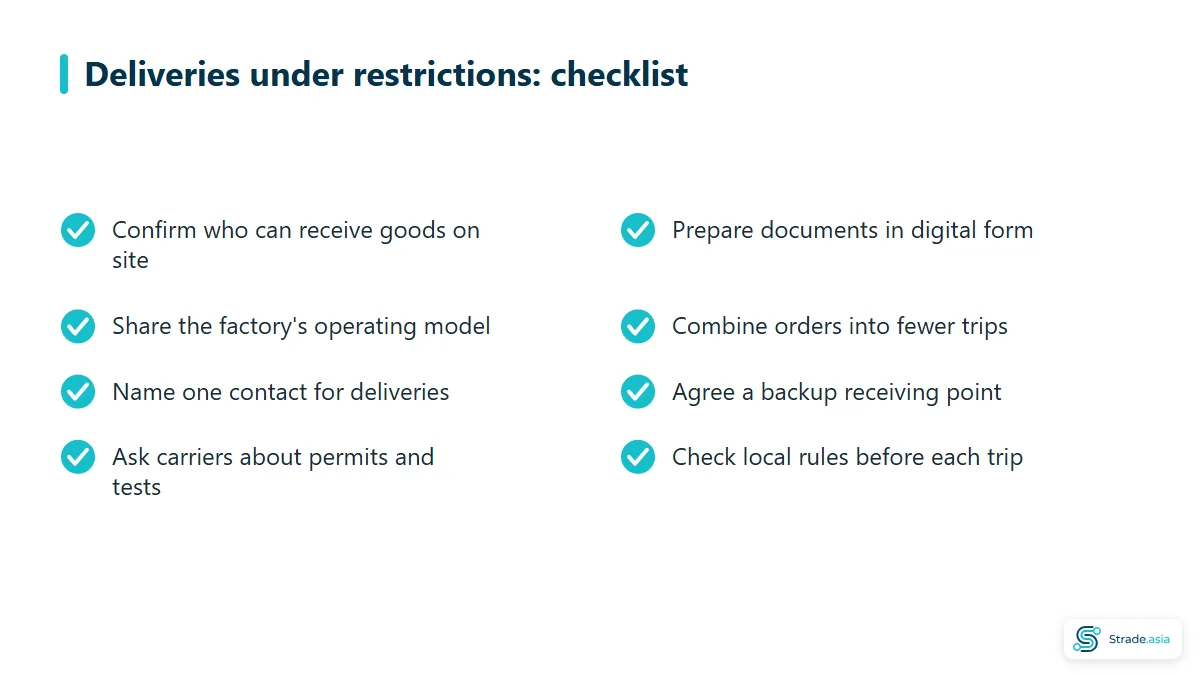
Agree with your suppliers exactly where and how goods will be handed over: which gate, at what times and to whom. If your factory runs on site, name one person inside who can receive, check and sign for goods, and make sure that person’s phone number is on every order.
Documents
Delivery notes, invoices and certificates such as CoC, C/O and CQ can be shared by email before the goods arrive, so that receiving at the gate is quick. For export processing enterprises, customs procedures still apply to each delivery; our guide to delivering components to export processing enterprises explains what is needed. Prepare these documents early rather than at the gate.
Fewer, fuller trips
Every delivery now carries extra effort for permits and testing. Combining several orders into one trip reduces that effort and the number of handovers. Where possible, order a little earlier and accept a slightly larger delivery, rather than many small ones.
Buffer on site
Because transit times are less predictable, consider holding more stock of the parts that would stop a line, provided storage and cash allow. The options are covered in buffer stock and consignment.
Communication matters most
In a period when rules change at short notice, the most useful habit is regular contact. Tell your suppliers how your factory is operating and when that changes. Ask them to confirm each delivery the day before, and to tell you immediately if a vehicle is held up. Keep a short list of open orders and expected arrivals that your planners and suppliers both use.
It also helps to look beyond the local situation. Component supply is still tight worldwide, and the recent lockdown in Malaysia has affected chip assembly and test. A clear view of which parts are at risk, and a calm, steady routine for receiving them, will do more than any single emergency measure.
How Strade can help
Strade is an independent electronic component distributor with its own engineers, supplying factories in Vietnam and across Asia. We deliver DDP or DAP to factories, including export processing enterprises, and prepare the customs documents, with CoC, C/O and CQ supplied with the goods when the source provides them. If your factory’s receiving arrangements have changed, tell us when you send a request so that the delivery plan can fit them.
Send us your BOM or the lines you need, together with your receiving arrangements, and we will check availability and delivery options.


