
 한국어
 Bahasa Indonesia
 ไทย
 中文 (中国)
 Tiếng Việt
Connectors are among the cheapest lines in an industrial BOM, yet they cause a large share of field problems: overheated power contacts, intermittent signals from fretting, water ingress and cables shaken loose by vibration. Most of these failures trace back to selection rather than to the connector itself. A connector that works on a test bench can fail in a cabinet next to a hot inverter, or on a machine that vibrates for years. Run through the checklist below before releasing a design or approving an alternate.
1. Current rating and derating
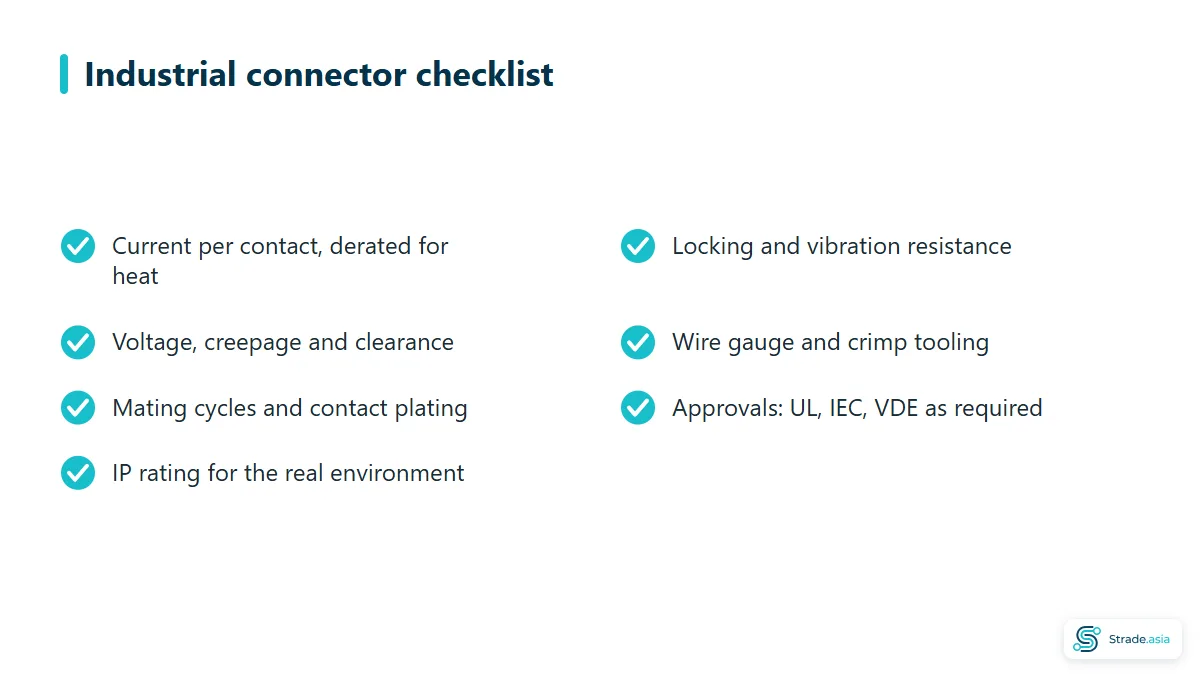
The current rating on the front page of a datasheet usually applies to a single contact, at a stated ambient temperature, with a specified wire size and an allowed temperature rise. Real conditions are harsher: many contacts in the housing carry current at the same time, the cabinet is warm and the wire may be smaller. Look for the derating curve, which plots allowable current against ambient temperature and the number of loaded contacts, and design to it. The fuse protecting the circuit must protect the connector and wire as well; see choosing a fuse for power circuits. During the first full-load test, measure the temperature of the power contacts; a hot contact is an early warning of an undersized connector or a poor crimp.
2. Voltage, creepage and clearance
The voltage rating depends on creepage and clearance distances, which in turn depend on pollution degree, overvoltage category and altitude, as defined in IEC 60664-1. A connector rated for a given voltage at pollution degree 2 may not be suitable in a dusty, humid cabinet classed as pollution degree 3. Check the rating under your equipment’s conditions, not just the headline figure.
3. Mating cycles and plating
Durability is quoted as the number of mating cycles the contacts survive while staying within resistance limits, and plating largely decides it. Gold plating suits low-level signals and frequent mating; tin is cheaper and fine for contacts mated only a few times, but it is prone to fretting corrosion under micro-motion. Do not mate gold-plated contacts with tin-plated ones. Check the specified plating thickness as well: a thin gold flash is not the same as a defined gold layer over nickel, and two parts in similar-looking series can differ here.
4. IP rating
IP ratings under IEC 60529 describe protection against solids and water; IP67, for example, means dust-tight and protected against temporary immersion. The rating applies only when the connector is mated with the right cable and seal, and sometimes only with a cap fitted when unmated. Check what applies to your installation, including washdown, condensation and cleaning chemicals.
5. Locking and vibration
Friction-fit connectors can back out under vibration. Use positive latches, screw coupling such as that on M12 circular connectors, or push-pull locking, and add strain relief so that the cable, not the contacts, takes the load. For equipment on vibrating machines, check the manufacturer’s vibration and shock test data.
6. Wire gauge and crimp tooling
Each crimp contact accepts a specified wire range and insulation diameter, and the crimp is only reliable when made with the tool or applicator the manufacturer specifies. Housings and contacts described as “compatible” with another brand are not always intermateable, and mixing them can void approvals. Check this carefully when adding a second source to the approved manufacturer list.
7. Approvals
Equipment for export often needs connectors with UL recognition, compliance with IEC 61984 or VDE approval. Ask for the certificates and check that the approved ratings match the conditions in your design, not only the catalogue values.
Buying connectors
Connectors are often sold in packaging quantities and minimums that differ from other parts, especially crimp contacts supplied on reels; see MOQ, SPQ and packaging quantities. A long lead time on a single housing can hold up an entire wiring harness, so include connectors in your availability reviews, as discussed in designing for availability. Where possible, choose series that several manufacturers produce to a common standard, such as circular industrial connectors, so you have options when one source is short.
How Strade can help
Strade supplies connectors alongside semiconductors, passive components and power products to factories in Vietnam and across Asia. Our engineers can check proposed alternates for mating compatibility, ratings and approvals, and your team makes the final decision. Browse our product groups or send your BOM for a quotation.


