한국어
 Bahasa Indonesia
 ไทย
 中文 (中国)
 Tiếng Việt
In September, Vietnam’s Prime Minister approved a strategy for developing the country’s semiconductor industry to 2030, with a vision to 2050. It follows a year of growing attention to the sector: the upgrade of US–Vietnam relations to a Comprehensive Strategic Partnership in September 2023, which highlighted semiconductors (see our note at the time), new packaging and test investment in the north, and a national push to train chip engineers. For factories in Vietnam that buy components, the obvious question is whether more chips will soon be available locally. The honest answer: some things will change, but gradually, and not quite in the way the headlines suggest.
What the strategy focuses on
The strategy covers the whole value chain, but its emphasis is clear. It puts people, chip design capability, and packaging and testing first, building on foreign investment, while working toward wafer fabrication over a longer horizon. It works alongside a national programme to train semiconductor engineers and connects to incentives for high-tech investment and research. The strategy also sets targets for companies, revenue and workforce. Those are best read in the official text rather than in summaries, and reaching them will depend on investment decisions that have not yet been made.
Where Vietnam stands today
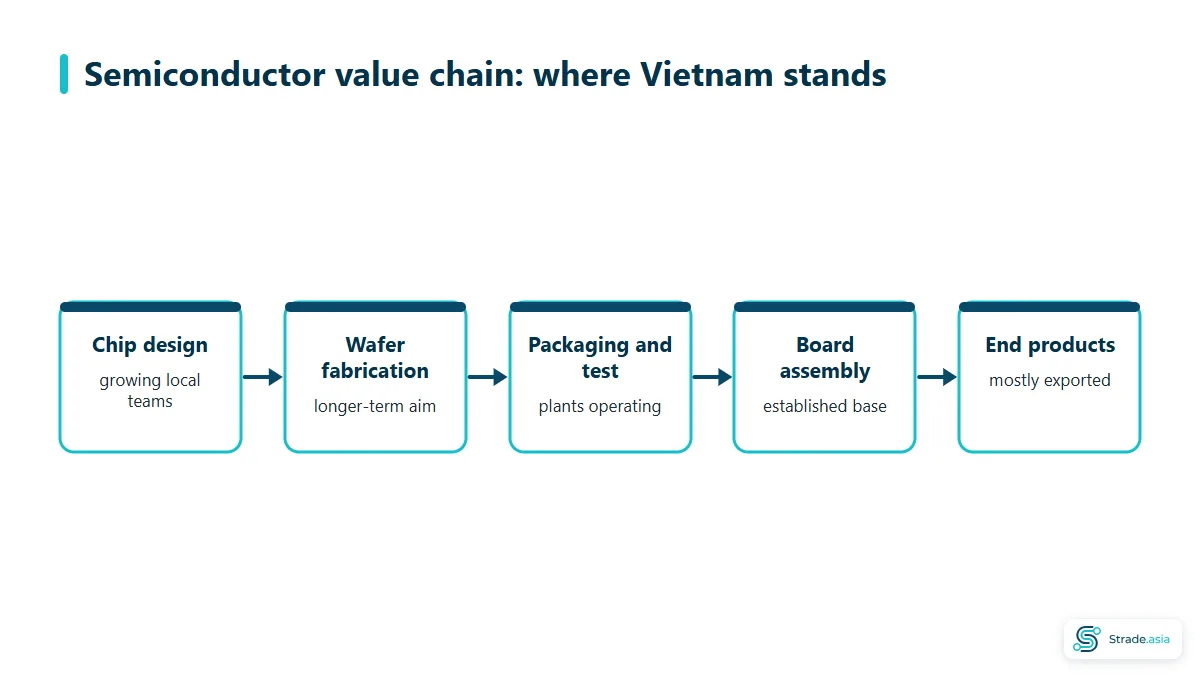
- Design: a growing number of chip design teams, many of them working for foreign companies, plus new university programmes.
- Fabrication: no commercial wafer fab producing at scale yet; this is the longest-term goal.
- Packaging and test: where Vietnam already has industrial capacity. Intel has run a large assembly and test plant in Ho Chi Minh City for more than a decade, Amkor opened a plant in Bac Ninh in 2023, and other back-end projects are under way in northern provinces.
- Board assembly and end products: the established base, from phones and computers to industrial equipment, mostly for export.
What it means for local supply
Local back-end capacity does not mean local stock. Chips packaged and tested in Vietnam belong to their manufacturers and enter global distribution channels. A chip assembled in Bac Ninh may still reach your factory through a warehouse in another country. Lead times and allocation follow the manufacturer’s global rules, not geography.
Supporting industries should grow. Back-end plants need materials, consumables, spare parts for equipment, chemicals, gases and services. That creates opportunities for local suppliers and, over time, a deeper industrial base around the plants.
Engineers should become easier to find. Training in design, test and process engineering will add skills that benefit every electronics factory, from incoming inspection and failure analysis to design-in work.
Origin needs care. Where a chip is packaged does not automatically decide its origin for customs or trade-agreement purposes; the rules differ by importing country and by agreement. Check before you assume, as with RCEP rules of origin.
A realistic timeline
Semiconductor capability takes years to build. New engineers need several years of experience before they lead design or process work, a packaging plant takes years to move from announcement to volume production, and a wafer fab needs reliable power, ultra-pure water and a mature supplier network around it. Treat the strategy as a direction that will reshape the local market over this decade, not as a source of new supply in the next few quarters. In the meantime, the practical sourcing work stays the same: qualified sources, documented origin and alternates for single-source parts.
What buyers and engineers can do now
- Map where your key parts are made, including assembly and test sites; some may already come from plants in Vietnam.
- Watch for local qualification opportunities in passive, power and electromechanical parts as suppliers set up nearby.
- Build links with universities and training centres for interns and future engineers.
- Keep sourcing spread across countries. Local capacity reduces risk only once it is qualified; see dual sourcing across countries.
- Follow the implementing decrees and incentives, which will show how quickly the strategy moves from paper to plants.
How Strade can help
Strade is an independent electronic component distributor with its own engineers, supplying factories in Vietnam and across Asia from manufacturers, their distributors and vetted open-market suppliers. We deliver DDP or DAP with customs documents prepared, and support origin paperwork such as Form E, RCEP, CPTPP and EVFTA, including HS code review. Learn about our origin and compliance service or send your BOM for a quotation.