한국어
 Bahasa Indonesia
 ไทย
 中文 (中国)
 Tiếng Việt

In much of Vietnam, humidity is high for most of the year. In the north, the damp spring weather brings condensation on walls, floors and anything cooler than the air; in the south, the rainy season brings months of saturated air. Electronic assemblies in pump stations, control panels, outdoor cabinets and vehicles meet that humidity every day, often with dust, salt or chemical vapours on top. Leakage currents, corrosion and dendrite growth between conductors are the usual results. Conformal coating is one of the most effective defences, but only when the right material is applied to a clean, dry board.
How humidity damages assemblies
Moisture alone is rarely the whole problem. Water films dissolve ionic residues from flux, handling and the environment, and the resulting electrolyte lets current leak between closely spaced conductors. With voltage applied, metal ions can migrate and grow dendrites until they bridge two conductors. Fine-pitch parts and high-voltage circuits are most at risk, and condensation, when a cold unit meets warm humid air, is the worst case.
A conformal coating is a thin polymer film that follows the contours of the board. It slows moisture, stops dust and contaminants from bridging conductors and adds some mechanical protection. It is not hermetic: water vapour still passes slowly through every coating. That is why what lies underneath matters as much as the coating itself.
Coating types
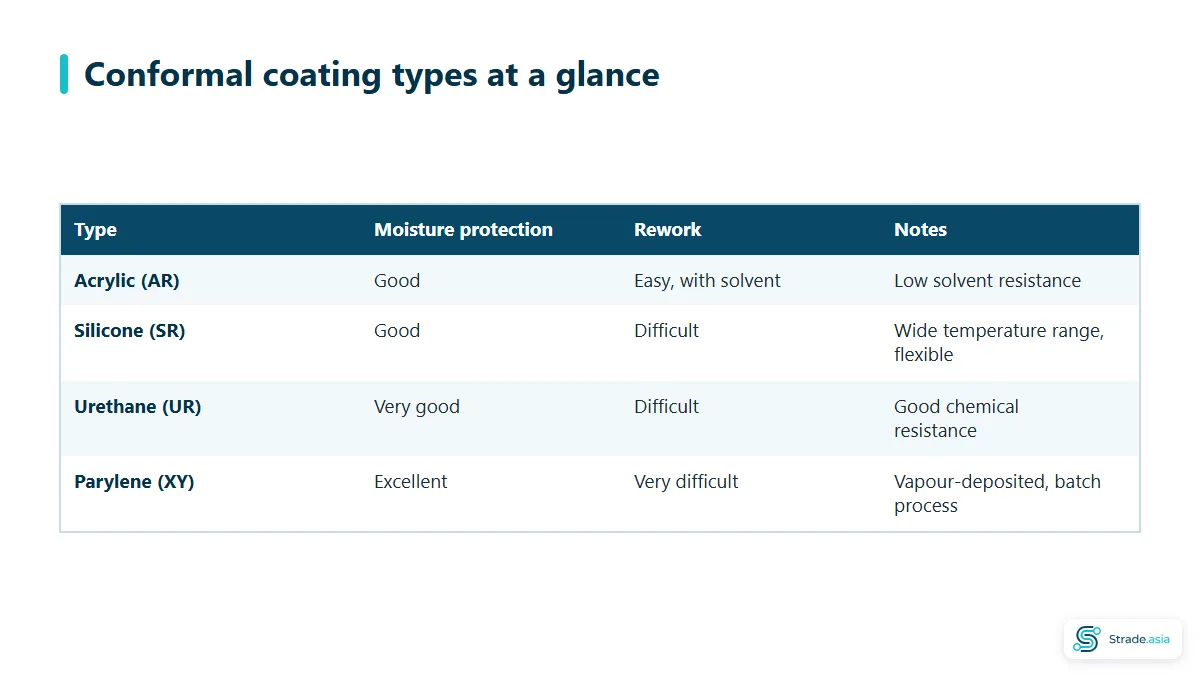
IPC-CC-830 is the common qualification standard for coating materials, and the IPC-HDBK-830 handbook gives guidance on selection and application. The main types are:
- Acrylic (AR): easy to apply and easy to remove with solvent for rework. Good moisture protection, but poor resistance to solvents and fuels.
- Silicone (SR): flexible and stable over a wide temperature range, suited to hot or vibrating equipment. Harder to rework, and silicone contamination must be kept away from soldering and bonding areas.
- Urethane (UR): good humidity and chemical resistance; rework is harder and usually needs special strippers or careful burn-through.
- Parylene (XY): deposited from vapour in a vacuum chamber, giving a very thin, uniform, pinhole-free layer. An excellent barrier, but a batch process with higher cost, extensive masking and very difficult rework.
- Epoxy (ER): hard and abrasion-resistant but almost impossible to rework, so it is less common on boards that may need repair.
Getting the process right
- Clean first. Coating over flux residues or fingerprints traps contamination under the film. If you use no-clean flux, confirm with the coating supplier that the combination is compatible, or clean before coating.
- Dry the board. Bake or condition assemblies before coating so moisture is not sealed in, especially in factories without climate control.
- Mask carefully. Connectors, test points, switches, potentiometers, heat sink contact areas and grounding points usually need keep-out areas. Mark them on the assembly drawing so every shift does the same.
- Control thickness. Too thin leaves gaps over sharp edges and component leads; too thick can crack under thermal cycling or trap solvent. Follow the material’s recommended range and measure it.
- Inspect under UV. Most coatings contain a UV tracer, so coverage gaps, bubbles and wicking under masked areas show up under UV light. IPC-A-610 includes acceptance criteria for coated assemblies.
- Plan for rework. If products will be repaired locally, choose a coating that your service team can remove and reapply.
Components and storage matter too
Coating protects the finished board, but moisture problems can start earlier. Moisture-sensitive parts must be stored and baked according to their MSL rating before reflow, as explained in moisture sensitivity levels. Parts and bare boards stored for months in a humid warehouse can oxidise on leads and pads, which harms solderability. Components rated for the right temperature and humidity, and enclosures with proper seals, venting and drainage, complete the protection. For a new production line in Vietnam, plan these details from the start, as discussed in setting up production in Vietnam.
How Strade can help
Strade supplies electronic components to factories in Vietnam and across Asia, in antistatic packaging with moisture control according to MSL. Every lot is checked on receipt for part number, labels, date code, packaging and appearance. Our engineers can help you select components rated for humid, high-temperature environments and propose matching alternates when a part is short. Learn more on our page for manufacturers or send your BOM for a quotation.