한국어
 Bahasa Indonesia
 ไทย
 中文 (中国)
 Tiếng Việt
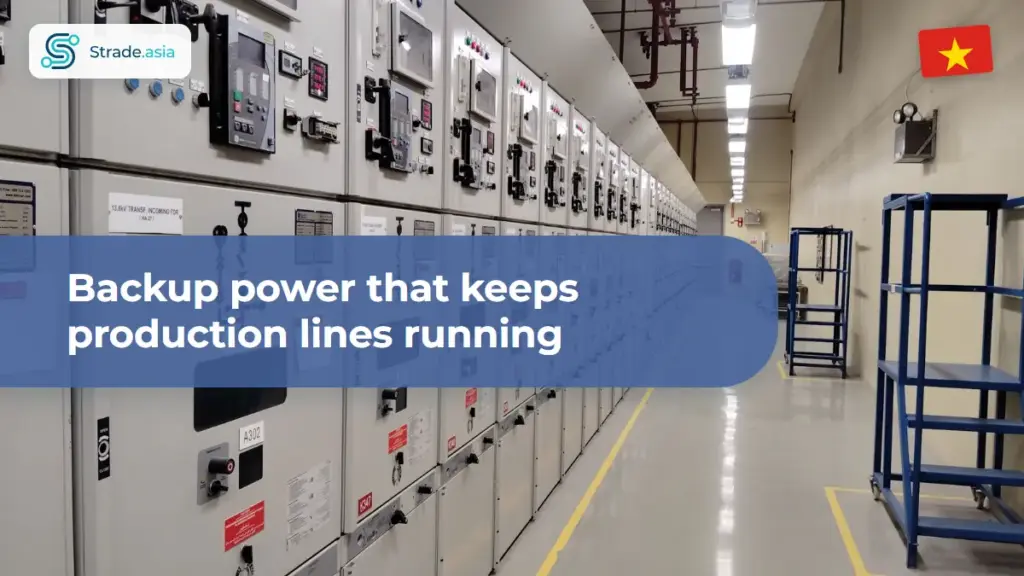
In May and June 2023, a heatwave and low water levels at hydropower reservoirs left northern Vietnam short of electricity. Rolling power cuts reached industrial parks, and many factories lost production hours or ran on diesel generators. With the hot season only a few months away, plant managers are reviewing their backup power. The useful question is less “do we have a generator?” and more “what happens to the line in the seconds before it starts, and which loads must never see an interruption?”
Why a generator alone is not enough
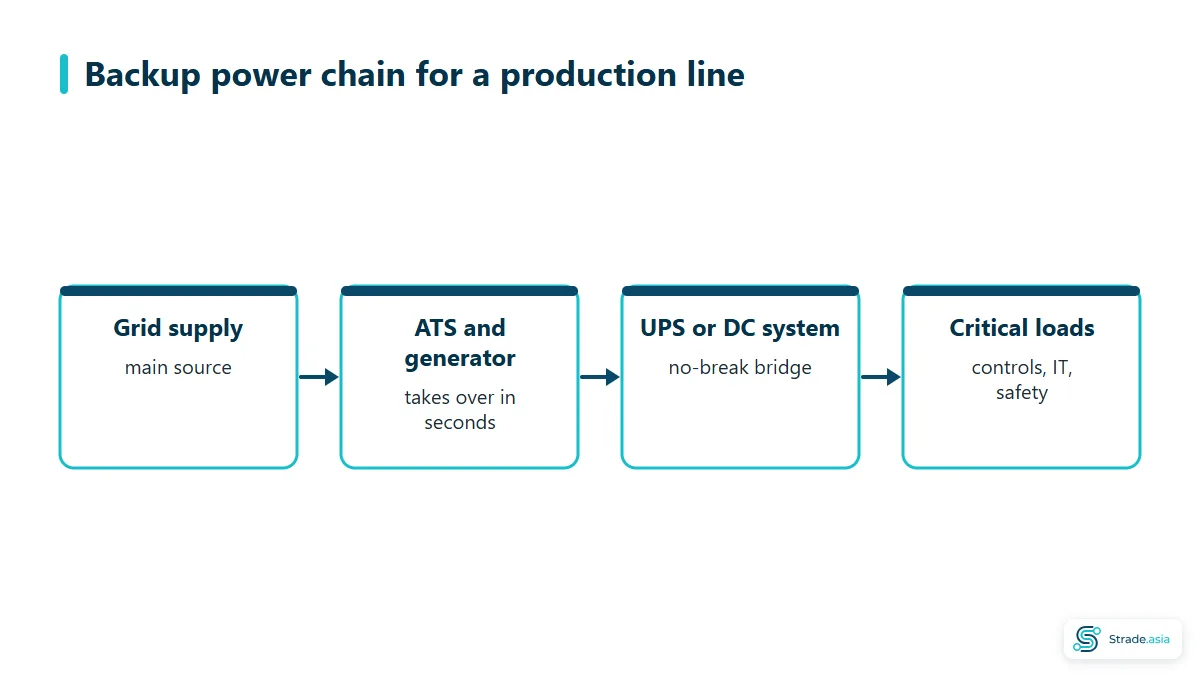
A standby generator needs time to start, stabilise and take load through an automatic transfer switch (ATS), usually several seconds or more. That gap is enough to reset PLCs, crash MES and test-station PCs, drop servo drives into fault and stop a reflow oven conveyor with boards inside. Short voltage dips cause trouble too: many trips on a production floor come from sags lasting a fraction of a second, not from full outages. A UPS or DC power system closes that gap and rides through the dips. Standards such as SEMI F47, which defines voltage-sag immunity for semiconductor process equipment, show how seriously some industries take the problem.
UPS topologies
- Offline (standby): the load runs on mains and the inverter switches in on failure. Low cost and efficient, but there is a short transfer time and little conditioning. Suitable for single PCs and small, non-critical loads.
- Line-interactive: adds automatic voltage regulation that corrects sags and swells without using the battery. A good fit for network cabinets and office-type loads.
- Online double-conversion: the rectifier and inverter run all the time, so the load sees clean, regulated power with no transfer time. The right choice for PLC panels, servers, test systems and any load sensitive to waveform quality, at the cost of lower efficiency and more heat.
Check whether the UPS has a static bypass and a maintenance bypass, so a fault or a service visit does not drop the load.
DC power systems
Control circuits, protection relays and telecom equipment often run better from a DC system: rectifier modules charge a battery bank and feed a DC bus, commonly 24 V, 48 V or 110 V DC. There is no inverter to fail, the battery sits directly on the bus, and modular rectifiers allow N+1 redundancy. Where most critical loads are 24 V controls, a DIN-rail DC UPS module with its own battery can be simpler and cheaper than a large AC UPS.
Battery choices
- VRLA lead-acid: low upfront cost and familiar, but service life falls sharply in hot rooms, so plan for air-conditioned battery space.
- Lithium iron phosphate (LiFePO4): lighter, with longer cycle life and better tolerance of heat, at a higher upfront cost. It needs a proper battery management system; see battery management system basics and lithium-ion battery safety.
Whatever the chemistry, monitor battery temperature and run a real discharge test at regular intervals. A battery that looks healthy on float charge can still collapse under load, and the first sign is often a UPS that drops the line during the next outage.
Sizing questions to answer first
- Which loads are critical? Separate loads that need no-break power from those that can wait for the generator.
- Real power and power factor. Measure kW and kVA rather than adding nameplate values, and check inrush and step loads from motors, heaters and drives.
- Required runtime. Enough to bridge to the generator, or enough for a controlled shutdown where there is no generator.
- Generator compatibility. The UPS input current distortion and the generator’s voltage and frequency stability must suit each other; an undersized generator and a UPS rectifier often clash.
- Environment. Battery room temperature, ventilation and floor loading.
- Protection. Surge protection at the incoming supply and on long cable runs; our note on TVS diodes and surge protection covers the board-level side.
- Testing and maintenance. Plan regular transfer tests, battery tests and a replacement schedule, and write down who does them.
How Strade can help
Power products are Strade’s core product group. Our engineers can help you compare power supplies, DC-DC converters and protection components for control panels and backup systems, and propose matching alternates when a specified part is short; your team makes the final decision. Every lot is checked on receipt, and CoC and other documents travel with the goods when the source provides them. Browse our power products or send your list of power parts for a quotation.