
 한국어
 Bahasa Indonesia
 ไทย
 中文 (中国)
 Tiếng Việt
Every inverter, motor drive, battery system and power supply needs to know its current: to regulate the output, to protect the switches in a short circuit, to estimate battery charge or to report energy use. The sensing method is often chosen early and then copied from one design to the next, yet it decides accuracy across temperature, how fast a fault is caught, and how safely a high-voltage circuit is separated from the control side. It also decides which parts a buyer will have to find when one becomes hard to get.
The main options
Shunt resistor and amplifier
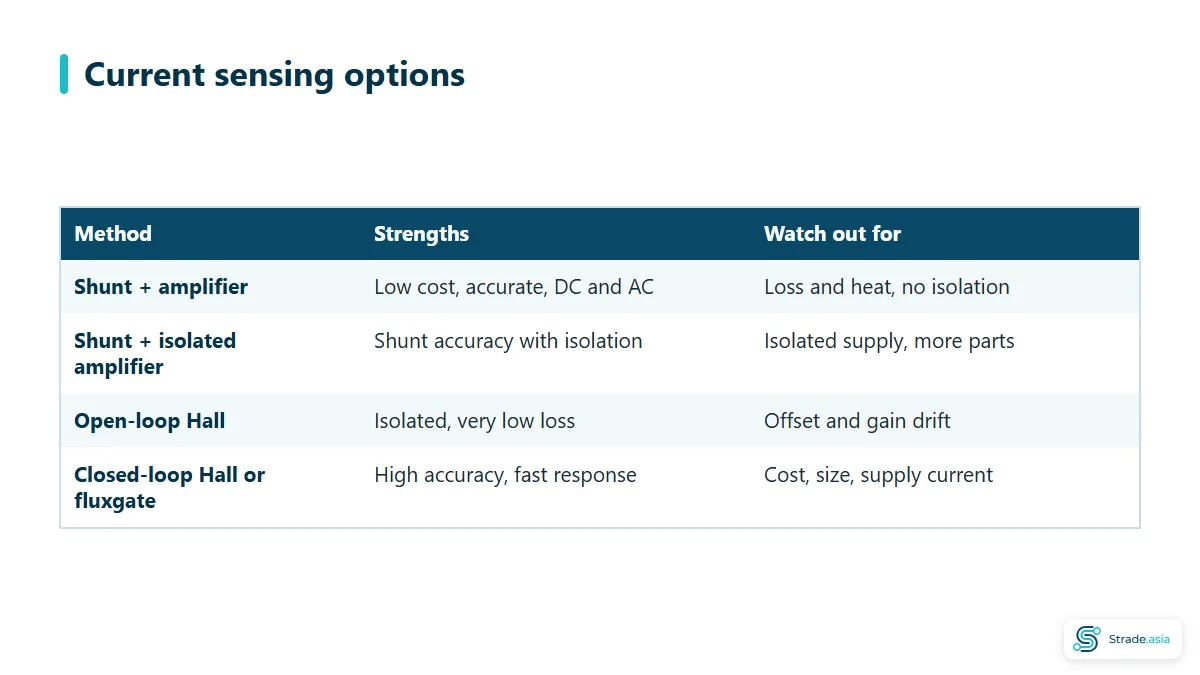
A low-value resistor in the current path produces a small voltage, which an amplifier scales for the ADC. It is simple, cheap and accurate, and it works for both DC and AC. The trade-offs:
- Power loss. Loss rises with the square of the current, so high-current designs use very low resistance values and accept a smaller signal.
- Temperature coefficient (TCR). Resistance changes with temperature, and the shunt heats itself under load. Metal-element shunts with low TCR hold accuracy; our article on resistor selection for power, pulse and TCR covers the details.
- Kelvin connection. Sense the voltage at the shunt’s own sense terminals or pads, so solder and copper resistance do not add error.
- Common-mode voltage. A high-side shunt sits at the supply voltage, and in a half-bridge it swings with every switching edge. The amplifier must accept that range and reject fast transients.
Shunt and isolated amplifier
When the shunt sits at high voltage, for example in the phase output of a motor drive or a solar inverter, an isolated amplifier or isolated delta-sigma modulator carries the signal across an isolation barrier. Accuracy stays close to a plain shunt solution, but each channel needs an isolated supply on the high-voltage side, and the isolation rating becomes a safety specification.
Hall-effect sensors
A Hall sensor measures the magnetic field around the conductor, so it is isolated by nature and adds almost no loss. Integrated Hall ICs pass the current through a conductor inside the package; modules use a core around a busbar or cable. Open-loop sensors are simple but drift more in offset and gain with temperature. Closed-loop and fluxgate sensors are more accurate and faster, at higher cost, size and supply current.
For AC-only measurement, current transformers and Rogowski coils also give isolation with low loss.
Accuracy across temperature
The accuracy printed for 25 °C is not the accuracy you get in a hot cabinet. Add up offset, offset drift, gain error, gain drift, non-linearity and, for Hall sensors, magnetic offset after an overcurrent. For shunts, add the resistor’s tolerance, its TCR and self-heating. Accuracy at low current usually depends on offset; at high current, on gain. Decide which matters: battery state-of-charge estimation needs low offset over long periods, while overcurrent protection needs speed more than precision.
Bandwidth and response time
Control and protection need different speeds. A current control loop needs a sensor much faster than the loop itself, while short-circuit protection must react within microseconds to save the power switches. Many designs combine a precise measurement for control with a fast comparator or the gate driver’s desaturation detection for protection, as described in our article on gate drivers for MOSFETs and IGBTs. Check response time, settling and recovery after overload, and the sensor’s rejection of fast voltage edges.
Isolation ratings
Where a sensor bridges a high-voltage circuit and the control side, check:
- Basic or reinforced isolation, and the working voltage it is rated for.
- Withstand and surge voltage ratings, and the component standards behind them, such as UL 1577 and IEC 60747-17 for isolators.
- Creepage and clearance of the package against the system standard for your equipment, for example IEC 61800-5-1 for drives or IEC 62368-1 for power and IT equipment.
- Common-mode transient immunity (CMTI), which matters more as switching edges get faster.
The system standard, pollution degree and altitude decide what is required; the sensor datasheet is only one input.
What buyers should ask
- The full part number, including current range, sensitivity and package. Sensors that look alike can differ in range or output type.
- For shunts: resistance, tolerance, TCR, power and pulse ratings, and whether the footprint is four-terminal.
- For Hall sensors: accuracy over the full temperature range, response time, supply voltage and output.
- For isolated parts: certificates that cover the exact part number.
- Second sources: Hall modules and isolated amplifiers are often not pin-compatible between makers, so qualify alternates during design, not during a shortage.
Current sensing is also central to battery energy storage, where the BMS relies on it to estimate charge and protect the pack.
How Strade helps
Strade is an independent component distributor with its own engineers, supplying semiconductors, passive components and power products to factories in Vietnam and across Asia. We source shunt resistors, current-sense amplifiers, Hall sensors and isolated amplifiers on request. When a sensor is hard to buy, our engineers compare range, accuracy, isolation and footprint and propose alternates; the customer decides. Every lot is checked on receipt.
Need current sensors or shunts for a power design? Send your part list for a quotation.


