
 한국어
 Bahasa Indonesia
 ไทย
 中文 (中国)
 Tiếng Việt
Three suppliers quote the same part number. One is clearly cheapest per piece, so the order goes there. Weeks later the real cost appears: freight charged separately, import duty on a non-preferential origin, a full reel bought when the build needed a third of it, a bank fee on an advance payment, and a delay that held up a shipment to your own customer. Unit price is the easiest number to compare and often the least complete. A better basis is total landed cost: what the part costs once it is on your shelf, ready for the line.
What landed cost includes
Delivery terms
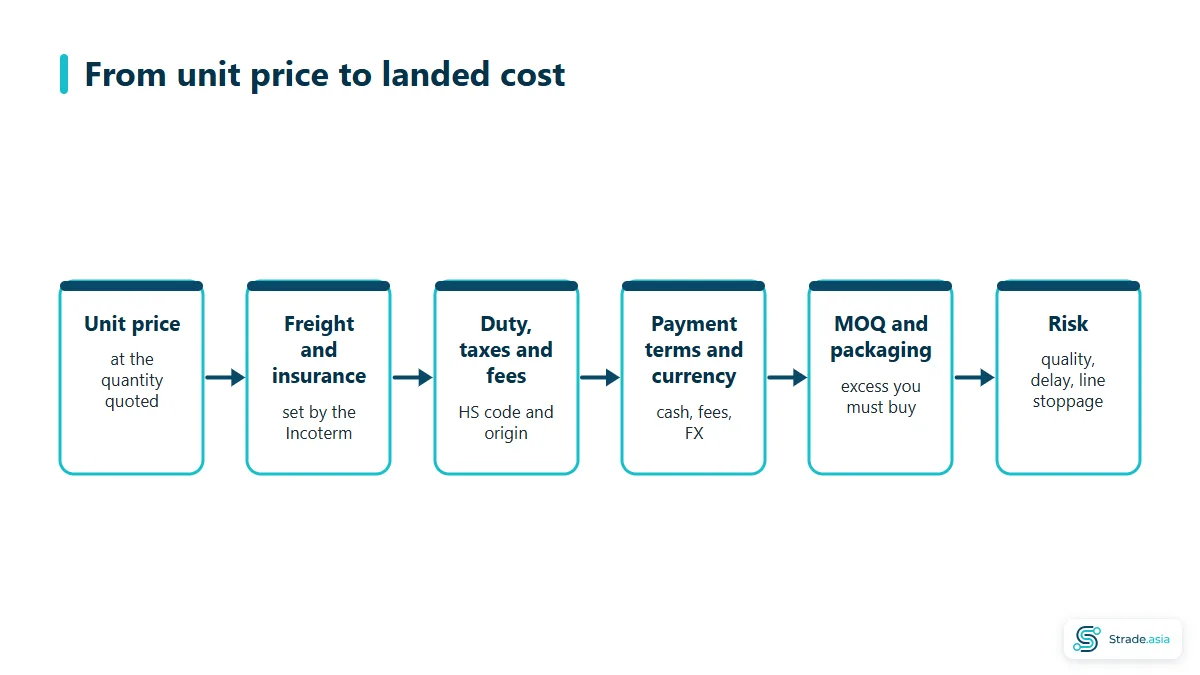
The Incoterm decides which costs and risks are already in the price. An EXW or FCA quote leaves you to arrange international freight, insurance, import clearance and local delivery. A DAP quote includes delivery to your site but leaves import duty and taxes to you; DDP includes them. Put every quote on the same basis before comparing. Our note on Incoterms 2020 explains each term. For small lots, watch minimum courier and handling charges, which can outweigh a small difference in unit price.
Duty, taxes and fees
Import duty depends on the HS code and on the origin of the goods, and a valid certificate of origin under a trade agreement can reduce it. Import VAT is usually recoverable, but it still ties up cash until it is. Add customs brokerage, inspection and documentation fees. Export processing enterprises have their own customs treatment, so the same quote can lead to a different landed cost for them than for a domestic factory.
Payment terms and currency
A quote that requires full payment in advance is not the same price as one on credit terms. Count the cost of money tied up, bank transfer fees, and the exchange-rate risk when the quote is in a currency other than the one you sell in. Check how long the price stays valid; our article on price increases and quotation validity explains why that matters in a rising market.
MOQ, packaging and excess
If the build needs 1,200 pieces and a supplier only sells full reels of 5,000, the extra pieces are part of the cost unless you will use them before they age or become obsolete. Cut tape may need extra handling to run on your placement machines. Compare quotes on the quantity you actually need, in a packing your line can use. See MOQ, SPQ and packaging quantities for how these rules work.
Quality risk
A low price from an unknown source carries the risk of counterfeit, recycled or badly stored parts. Count the cost of incoming inspection, X-ray or testing for that source, and the cost if a bad lot reaches the line: rework, scrap and a missed delivery. A price far below the market for a part in short supply is a warning, as our article on electronic component scams explains.
Lead time and reliability
A cheaper quote with a longer or less certain lead time costs money in other ways: more safety stock, air freight to recover a delay, overtime, or a line that waits. Ask for the lead time in writing, what it is based on (stock, factory lead time or goods in transit), and how the supplier will tell you if it changes.
Documents
If your customer or customs needs a CoC, C/O or CQ, a quote without them may force a second purchase elsewhere, or cost you the preferential duty rate on an exported product.
How to compare quotes in practice
- Put every quote on the same Incoterm and the same currency.
- Add freight, insurance, duty, taxes and fees to reach a landed cost per line.
- Add the cost of excess pieces you must buy, less what you can realistically use later.
- Add the cost of the payment terms and the currency risk.
- Add inspection cost by source, and a risk allowance for sources you do not know.
- Check each lead time against your build date; a quote that misses the date is not an option at any price.
- Record the comparison, so the next buyer can see why a supplier was chosen.
Do the full calculation for high-value and critical lines. For low-cost passive parts, a simpler rule is often enough, as long as the source is one you trust.
Questions to ask every supplier
- Which Incoterm and delivery address does the price assume?
- Is the price for the exact part number, including the packing suffix?
- What are the MOQ, the standard pack and the price breaks?
- Which documents come with the goods?
- How long is the quote valid, and what is the lead time based on?
How Strade quotes
Strade is an independent component distributor with its own engineers, supplying factories in Vietnam and across Asia. We deliver DDP or DAP to factories and to export processing enterprises and prepare the customs documents, which makes the landed cost of each line easier to compare. Every lot is checked on receipt, and CoC, C/O and CQ documents travel with the goods when the source provides them. Our supply chain service explains how we source and deliver.
Comparing suppliers for a BOM? Send a request for quotation with your delivery address and the Incoterm you prefer.


